
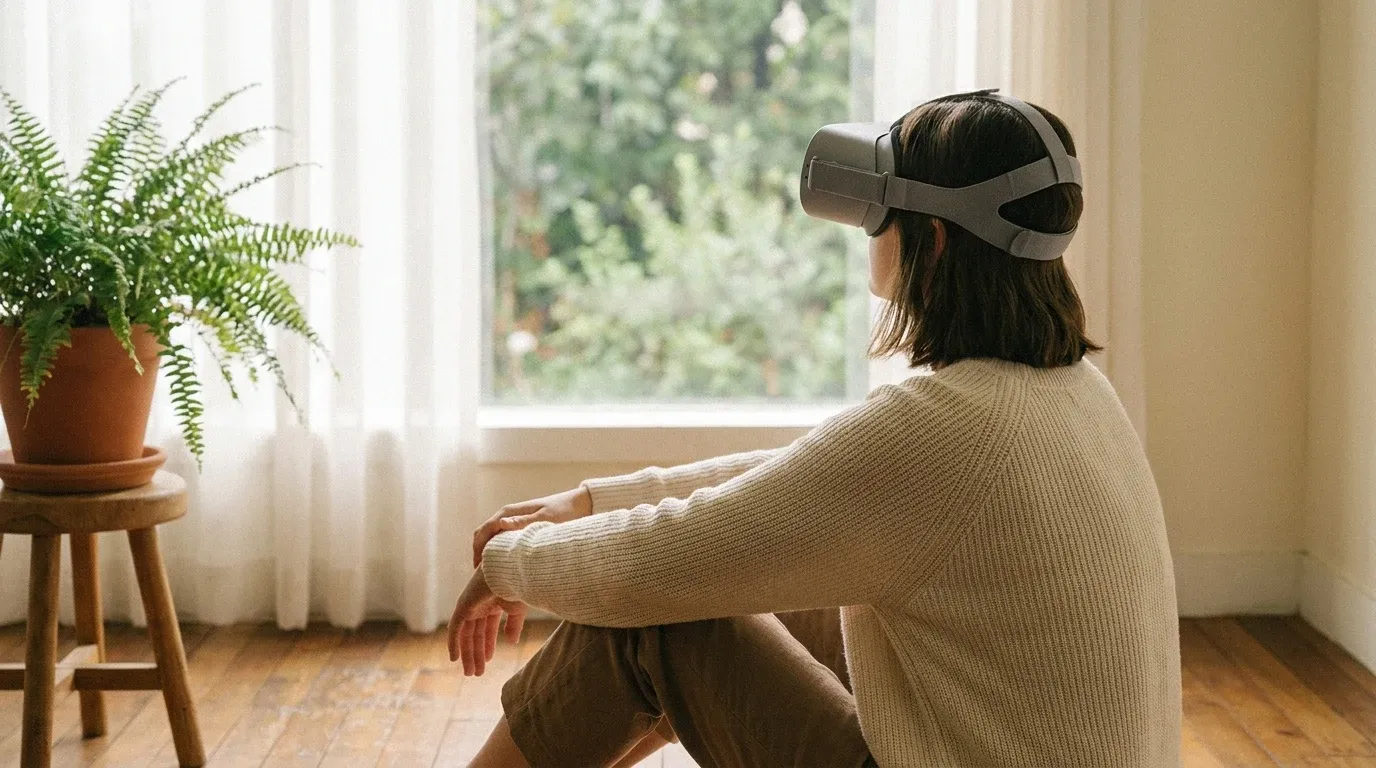
If you live in a city, work at a desk, or simply can't carve out time to stand barefoot in a park, you've probably wondered whether a technological shortcut exists. VR headsets are more affordable than ever in 2026, and nature simulations have become genuinely immersive. The question researchers are now asking is a practical one: can a virtual forest walk produce the same physiological calm as an actual one?
The answer is more nuanced than a simple yes or no, and it matters a great deal for how you think about stress management going forward.
Why Real Nature Works So Well on Stress
The restorative effects of spending time outdoors are not a matter of opinion. They're measurable. Studies have consistently shown that spending as little as 20 minutes in a natural setting produces a significant drop in cortisol, the body's primary stress hormone. Heart rate variability improves. Blood pressure eases. The parasympathetic nervous system, your body's rest-and-digest mode, becomes more active.
As covered in depth here at keedia, 20 minutes outside measurably lowers your cortisol, and the effect is dose-dependent. The longer and more immersive the outdoor exposure, the stronger the physiological response.
Two leading theories explain why this happens. Attention Restoration Theory suggests that natural environments allow your directed attention to rest, because nature captures involuntary attention effortlessly. Stress Recovery Theory argues that humans evolved alongside natural landscapes, and that visual and auditory cues from those environments trigger an automatic calming response at a biological level.
Both theories carry strong empirical support. And both have been used to justify asking whether VR can replicate the triggering conditions.
What the Research on VR Nature Actually Shows
Researchers studying virtual nature environments have found real effects, but the picture is incomplete. Across multiple controlled studies, participants who spent time in immersive VR nature simulations, forests, coastal scenes, meadows with ambient sound, reported meaningfully lower perceived stress and improved mood compared to control groups shown urban VR environments or no VR at all.
That's not nothing. Subjective stress is a legitimate health metric, and reducing it has downstream effects on behavior, sleep quality, and decision-making.
The more complicated finding is what happens with physiological markers. When researchers measure cortisol levels, heart rate variability, and skin conductance after VR nature sessions, the results are consistently weaker than equivalent real outdoor exposure. VR nature moves the needle, but not as far. Some studies find no significant difference in cortisol at all, even when participants report feeling calmer.
The gap appears to come down to what VR can and cannot replicate. Current headsets deliver high-quality visual and auditory immersion. What they don't deliver is thermal sensation, the warmth of sunlight on your skin, the feeling of a breeze, the humidity of a forest. They also lack what researchers call "soft fascination," the subtle unpredictability of real natural movement, a bird landing unexpectedly, clouds shifting, water flowing in nonlinear patterns. These elements appear to matter more to the physiological response than previously understood.
The Cortisol Gap Is Real, But It's Not the Whole Story
It would be easy to dismiss VR nature because it doesn't fully replicate cortisol suppression. That framing misses the point for most people who would actually use this technology.
Consider who benefits from a partial restorative effect. Office workers in city centers who don't have a park within walking distance of their workplace. People with mobility limitations who can't easily access green space. Individuals living through extreme weather seasons where outdoor exposure is genuinely limited. For these groups, VR nature isn't competing with a forest walk. It's competing with another hour at a desk or a passive scroll through social media.
Stress management, like physical training, is most useful when you think about it as a layered system rather than a single intervention. Your morning habits shape how well you handle stress across the full day, and midday restoration, even partial, compounds over time. A VR nature session that reliably lowers perceived stress and improves mood has real value inside that system, even if it doesn't drive cortisol down as sharply as a walk in the woods.
Headset Costs and Practical Access in 2026
The affordability question has shifted considerably. Entry-level standalone VR headsets now retail in the $250 to $400 range, with mid-tier options sitting around $500 to $700. That's a meaningful one-time cost, but it's far below the price point of even a few months of urban wellness memberships.
The content side has also matured. Dedicated nature immersion apps offer curated environments ranging from Japanese forest paths to New Zealand coastlines, many of them designed with ambient binaural audio intended to enhance the calming effect. Subscription costs for premium nature content typically run $10 to $20 per month, which is accessible for most working adults who are already investing in their wellness in other ways.
The practical barrier is not the hardware. It's habit formation around actually using it. Like any wellness tool, a VR headset collecting dust delivers no benefit.
How to Use VR Nature Effectively
Based on current research, here's what appears to work best when using VR nature for stress restoration:
- Session length matters. Sessions under 10 minutes show minimal effect on either subjective or physiological stress. Aim for 15 to 20 minutes to allow the nervous system time to shift.
- Audio is not optional. Studies consistently show that removing naturalistic sound from VR nature environments significantly reduces restorative effect. Use spatial audio or binaural recordings and wear headphones, not speakers.
- Minimize pre-session visual noise. Going directly from a bright screen into a VR headset reduces immersion. Give yourself 60 to 90 seconds of eyes-closed breathing first.
- Choose environments aligned with personal preference. Research suggests that individual landscape preferences influence the restorative response. If you find coastal scenes more calming than dense forest, that preference is meaningful, not arbitrary.
- Stack it with other recovery behaviors. VR nature fits naturally alongside passive recovery approaches that outperform expensive recovery tools, including deliberate rest, breathing work, and consistent sleep.
VR Nature and the Broader Stress Management Stack
One of the clearest lessons from stress physiology research is that no single intervention carries the full load. Cortisol regulation, heart rate variability, and autonomic nervous system balance are influenced by sleep, nutrition, movement, social connection, and environmental exposure together. VR nature fits into this picture as a supplement, not a foundation.
What you eat also plays a role in how your body handles stress. The relationship between diet and stress resilience is more direct than most people realize, as explored in this piece on how what you eat for breakfast changes how you handle stress throughout the day.
Physical training adds another layer. Whether you're managing chronic stress or acute overload, a consistent movement practice supports cortisol regulation and autonomic flexibility independently of nature exposure. These systems reinforce each other rather than compete.
The optimal approach for most people is straightforward on paper, even when it's harder to execute in practice:
- Prioritize real outdoor time whenever it's accessible, even brief sessions.
- Use VR nature on days or during periods when real outdoor access isn't practical.
- Don't treat VR as a reason to skip outdoor exposure when it is available.
- Combine both approaches with strong sleep, movement, and dietary habits for compounding benefit.
The Honest Bottom Line
Virtual nature is not a replacement for the real thing. The physiological evidence is clear on that point. But framing VR nature as a failed substitute misreads what it actually offers: a meaningful, accessible stress tool for people whose daily reality doesn't include easy access to green space.
Partial cortisol reduction is still cortisol reduction. Measurable mood improvement is still mood improvement. For a city-center desk worker fitting a 20-minute VR forest session into their lunch hour, the gap between virtual and real nature matters far less than the gap between doing something and doing nothing.
The research will keep refining these answers as hardware improves and multisensory simulation, including temperature and airflow, becomes more viable. For now, think of VR nature the way you'd think about any useful but imperfect wellness tool. It earns a place in your routine precisely because you're realistic about what it does and doesn't do.