
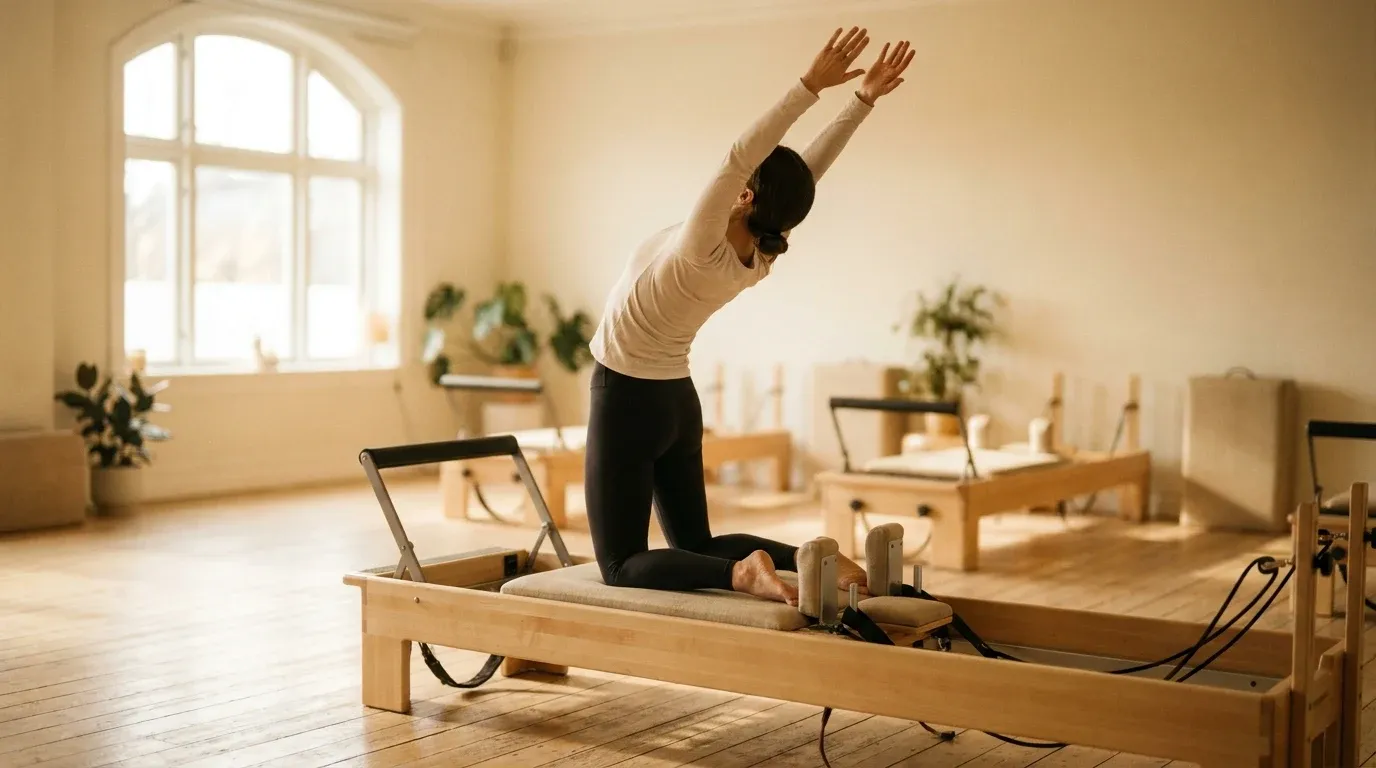
If you spend eight or more hours a day at a desk, your body is adapting to that position whether you want it to or not. Muscles shorten. Spinal support weakens. Your head drifts forward and your shoulders round inward. It happens gradually, and most people don't notice until the pain starts. Research published in October 2026 makes a direct case that Pilates is one of the most evidence-supported corrective interventions for exactly these patterns. Here's what the data shows, and why it matters beyond just posture.
What Desk Work Actually Does to Your Body
Prolonged sitting in a flexed, forward-facing position creates a predictable set of musculoskeletal consequences. The two most common are rounded shoulders (also called protracted scapulae) and forward head posture, where the skull shifts anteriorly relative to the spine. For every inch your head moves forward, the effective load on your cervical spine roughly doubles. Over years of desk work, this adds up to chronic strain on the neck, upper back, and shoulders.
What makes these patterns particularly stubborn is that desk posture systematically weakens the muscles designed to counteract it. The deep spinal extensors, the lower trapezius, the serratus anterior, and the deep neck flexors all become underactive while the chest, hip flexors, and upper trapezius become overactive and tight. You're not just tired. You're structurally imbalanced.
This is the physical reality that Pilates directly addresses. It's also part of a broader pattern documented in research synthesizing 68 studies on how to cut sedentary time at work, which confirms that passive breaks alone don't reverse the musculoskeletal load of prolonged desk sitting.
What the 2026 Research Actually Found
The October 2026 findings are notable because they move beyond the general claim that Pilates is good for your core. The research specifically identifies Pilates as a corrective intervention for the spinal support muscles that sedentary desk work weakens over time, including the multifidus, transverse abdominis, and the posterior chain more broadly.
The mechanism matters here. Pilates doesn't just strengthen muscles in isolation. It trains integrated activation patterns, recruiting deep stabilizers alongside larger movement muscles in sequences that mirror the postural demands of upright, functional positioning. That's why it's more effective for postural correction than, say, generic gym exercises that load the body in already-dominant movement patterns.
For rounded shoulders specifically, Pilates exercises emphasizing scapular retraction, thoracic extension, and external shoulder rotation directly counteract the internal rotation and protraction that desk posture produces. For forward head posture, the emphasis on cervical alignment and deep neck flexor activation throughout virtually every Pilates movement creates the kind of repeated neuromuscular input that shifts habitual positioning over weeks of consistent practice.
The same research cites measurable improvements in balance and coordination, which are secondary effects of improved spinal stability and proprioception. These aren't trivial. Poor proprioception correlates with higher injury risk and slower physical recovery, both of which affect long-term work capacity.
The Cognitive and Mental Health Case
Here's where Pilates separates itself from most physical interventions in a workplace context. The 2026 research also documents stress reduction and enhanced focus as measurable outcomes, not just subjective reports. That makes Pilates one of the few single interventions that addresses both the physical and cognitive dimensions of workplace performance simultaneously.
The stress reduction effect is consistent with what's known about mind-body exercise modalities more broadly. Pilates requires sustained attentional focus on breath, body position, and controlled movement. That kind of present-moment physical engagement activates the parasympathetic nervous system and interrupts the default-mode rumination associated with workplace stress and anxiety.
This is particularly relevant given what's happening in the broader employee wellness landscape. Remote work has been linked to a 58% increase in mental health visits, and the psychological load of hybrid and distributed work environments isn't decreasing. Interventions that deliver both physical and mental benefits from a single session are increasingly valuable from an efficiency standpoint, especially for employees who don't have hours to dedicate to separate fitness and stress-management routines.
The focus enhancement effects also have direct productivity implications. Controlled movement practices improve executive function markers including working memory and sustained attention. If you're looking for evidence to bring to leadership or an HR team, that's a concrete link between a wellness offering and measurable output quality.
Why Pilates Works Better Than Generic Corporate Wellness
Most corporate wellness programs offer generic benefits that aren't calibrated to the specific physiological profile of desk workers. A gym subsidy is useful, but it doesn't direct employees toward exercises that counteract what sitting at a computer does to the body. Pilates is different because its corrective emphasis is structurally aligned with the problem.
It's also progressive in a way that matches the reality of different fitness levels in a workforce. Beginners can work on a mat with no equipment and build foundational stability. More advanced practitioners can use the reformer for loaded, full-body movement. That spectrum makes it one of the more inclusive options in corporate fitness, unlike high-intensity programs that self-select for already-active employees.
The comparison to other wellness tools is worth making explicitly. When choosing between a coaching app and a human coach, the evidence suggests that human-led sessions produce stronger adherence and behavioral change for complex physical skills. Pilates instruction falls into that category. Learning movement patterns correctly requires feedback that apps can't fully replicate, particularly in early stages when compensatory habits are being unlearned.
The Hybrid Delivery Model and Corporate Integration
One of the practical barriers to corporate Pilates programs has historically been logistics. Reformer equipment is large and expensive, mat-only sessions are effective but limit progression, and scheduling group classes around variable work hours creates friction. The 2026 market has substantially addressed this through hybrid delivery models.
The emerging standard combines in-office or studio reformer sessions, typically weekly or biweekly, with app-based mat programs employees can complete at home or during breaks. Corporate pricing for this kind of hybrid arrangement typically runs between $80 and $150 per employee per month depending on session frequency and platform. For companies with existing wellness budgets, that's competitive with many gym subsidy programs that don't provide the same corrective specificity.
For HR and benefits leaders building the business case, the cost-per-outcome framing is increasingly viable. Musculoskeletal disorders are one of the leading drivers of short-term disability claims and productivity loss in desk-worker populations. A program that demonstrably reduces postural dysfunction, stress, and focus deficits has a credible ROI story, particularly when paired with utilization data from app-based components.
The workplace wellness conversation is also increasingly intersecting with concerns about AI-driven workplace stress as a genuine employee health problem. Pilates doesn't solve organizational pressure, but it provides employees with a consistent physiological reset that builds stress resilience over time. That's a meaningful contribution to wellbeing strategy even when structural stressors can't be eliminated.
What Private Equity Investment Signals About the Market
Pilates is attracting significant private equity capital in 2026. Major studio chains and reformer-based franchise operators have been acquisition targets, and several Pilates-focused digital platforms have closed substantial funding rounds. This isn't just financial noise. Capital flows at this scale signal infrastructure development: more locations, standardized instructor training, enterprise-grade technology, and the kind of operational scale that makes corporate partnership negotiations realistic.
For HR buyers, that infrastructure shift matters practically. It means more Pilates providers now have the organizational capacity to handle multi-site corporate accounts, offer volume pricing, and integrate with benefits administration systems. Two years ago, negotiating a corporate Pilates partnership often meant working with small independent studios with limited administrative bandwidth. That friction is decreasing as the market consolidates and professionalizes.
The premium fitness sector more broadly is experiencing a structural shift toward experience-driven, outcome-focused offerings, a trend visible in how premium fitness clubs are repositioning themselves globally in 2026. Pilates sits at the intersection of several of those trends: evidence-based, instructor-led, progressive, and increasingly accessible at multiple price points.
Getting Started: What Actually Works
If you're evaluating Pilates personally or as a corporate offering, a few practical points are worth keeping in mind.
- Frequency matters more than duration. Two to three sessions per week of 45 minutes produces measurably better postural outcomes than one long weekly session. Neuromuscular retraining requires repeated input to shift habitual patterns.
- Instructor quality varies significantly. Look for instructors with comprehensive training credentials (not weekend certifications) and experience working with populations that have postural dysfunction specifically, not just general fitness clients.
- Don't skip the assessment. A good Pilates instructor will identify your specific postural profile before designing a program. Generic class formats are less effective for corrective goals than individualized or small-group work, at least initially.
- Combine it with movement breaks. Pilates sessions several times a week don't fully offset eight hours of continuous sitting. The evidence is clear that breaking up sedentary time throughout the day compounds the corrective effects of structured exercise.
- Give it twelve weeks. Postural change is structural. Most participants in the research literature show meaningful improvement in postural measurements at the eight-to-twelve-week mark. Shorter trials aren't a fair test of the intervention.
The evidence case for Pilates in a desk-worker context is now strong enough that it's worth treating seriously, not as a niche wellness trend, but as a targeted corrective tool with documented physical and cognitive outcomes. If your work involves a screen and a chair, that's directly relevant to you.