
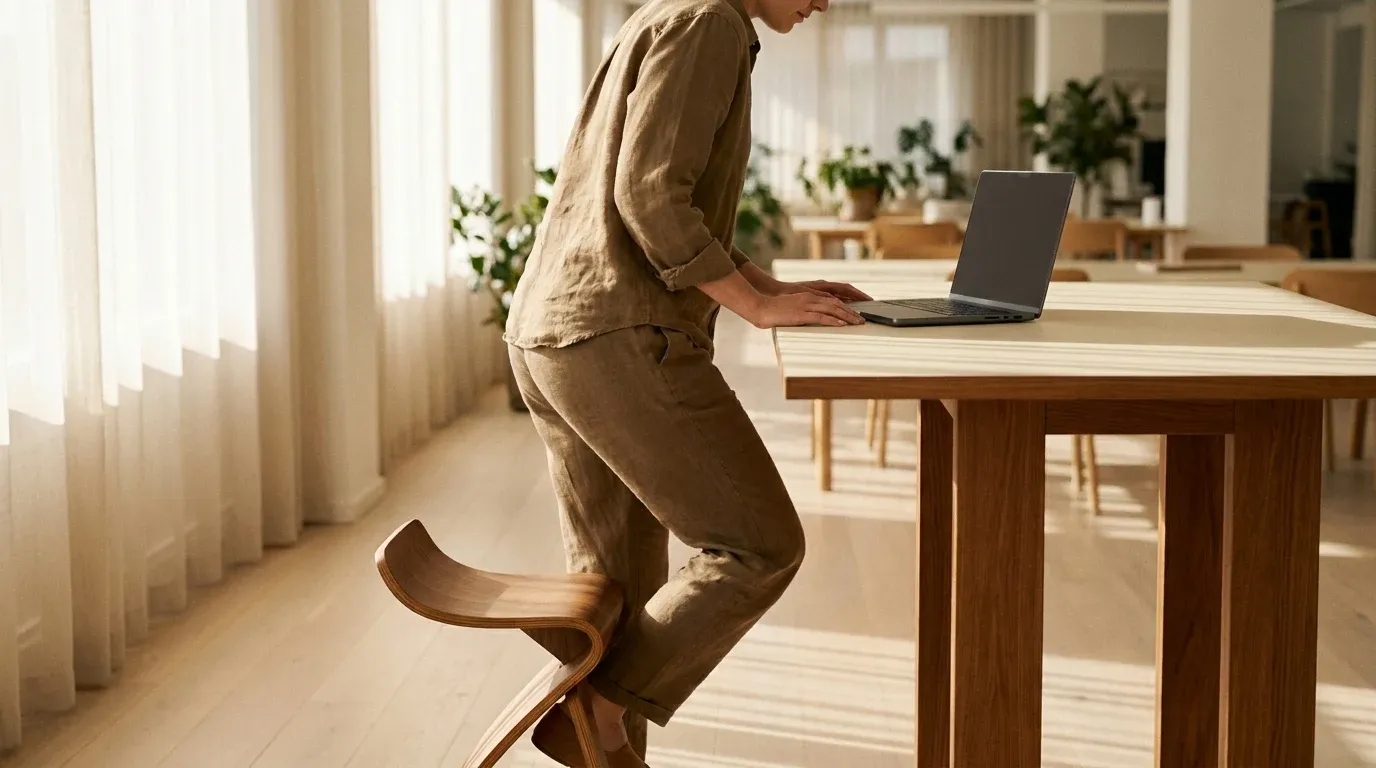
If you spend most of your workday seated, you already know the problem. What you probably don't know is exactly which digital tools have the evidence behind them. A major meta-review published October 12, 2026 in the Journal of Medical Internet Research analyzed 68 articles and catalogued 45 distinct digital interventions designed to reduce sedentary behavior in office workers. The findings are specific, and for HR leaders and EHS decision-makers, they're actionable.
The review doesn't just confirm that sitting too long is harmful. It maps the technological landscape with enough precision to help organizations make smarter investment decisions, and it points to where the next generation of solutions is heading.
Why This Review Matters Now
The evidence on prolonged sitting has been building for years. Research consistently links excessive sedentary time to elevated cardiovascular risk, metabolic dysfunction, and reduced cognitive performance. As 30 minutes of daily exercise won't offset the risks of sitting all day, the challenge isn't just getting people to move more outside work. It's changing what happens during the eight hours they're at a desk.
Digital interventions emerged as a scalable answer to that challenge. Wearables, desktop apps, smartwatches, and software-based nudging systems have all been tested in workplace settings. But until this review, no comprehensive synthesis had catalogued exactly which technological features drive results. Now there is one.
What the 68 Studies Found
Across the 68 articles reviewed, researchers identified six core technological features that appeared consistently in effective interventions:
- Passive sensing. Devices and software that automatically detect sitting posture or inactivity without requiring any input from the user.
- Personalized prompting. Systems that deliver reminders calibrated to an individual's activity history rather than generic fixed-interval alerts.
- Real-time feedback. Immediate visual or haptic signals that close the loop between behavior and awareness.
- Goal-setting interfaces. Tools that allow workers to set and track sedentary reduction targets, typically integrated with daily step or standing goals.
- Social and gamification elements. Leaderboards, team challenges, and progress sharing that leverage peer accountability.
- Environmental integration. Interventions linked to the physical workspace, such as height-adjustable desks connected to software prompts or occupancy sensors embedded in furniture.
No single feature worked in isolation. The most effective interventions combined passive sensing with personalized prompting and at least one form of real-time feedback. That combination consistently outperformed simple reminder apps or standalone wearables.
The Honest Limitations
The review is candid about what current tools don't do well. Most interventions were tested over short windows, typically four to twelve weeks. Behavior change held during the trial period, but long-term adherence data is sparse. The researchers describe this as a structural limitation of the field, not just the individual studies.
There's also a reactivity problem. The majority of existing systems prompt behavior change after the fact. They detect that you've been sitting for 45 minutes and then tell you to stand up. That model has value, but it doesn't account for your workload, your stress level, your posture quality in the preceding hour, or the meeting you're about to join. It treats all sedentary time as equivalent, which it isn't.
This is why the review's forward-looking section may be its most important contribution.
The Next Frontier: Ambient, Screenless, Adaptive Systems
The researchers argue that the next generation of effective interventions will share three defining characteristics: they'll be screenless, they'll use wireless communication across multiple data sources, and they'll adapt in real time to the user's physiological and contextual state.
Screenless means exactly that. Instead of pushing a notification to your phone or computer monitor, the intervention is embedded in the environment itself. Think smart flooring that vibrates subtly when you've been static too long, desk surfaces that shift temperature, or ambient lighting that changes color to signal a movement prompt. The goal is to reduce notification fatigue while keeping the behavioral cue alive.
This direction aligns with a broader movement in wearable design. Suunto's screenless tracker represents exactly this kind of interface shift, moving feedback from the screen to the body and the surrounding environment.
Real-time data fusion is the second pillar. Instead of relying on a single sensor, next-generation systems would integrate data from posture sensors, heart rate variability monitors, ambient temperature, calendar data, and even keyboard activity patterns. A system aware that you're in a high-focus writing sprint at 2:00 PM with elevated stress markers would prompt differently than one detecting passive reading before lunch. That contextual intelligence is what separates adaptive systems from reactive ones.
What Works Right Now
While ambient systems are still emerging, the review confirms that several already-available approaches show consistent evidence of effectiveness. If you're managing a team or an office environment, here's what the current evidence supports:
- Wearable activity trackers with vibration alerts. Devices set to notify after 45 to 60 minutes of continuous inactivity reduce sedentary bout duration across multiple studies. Smartwatches outperform basic pedometers in this context because of their richer feedback capability.
- Desktop break reminder software. Applications that prompt standing or movement breaks on a personalized schedule show measurable reductions in daily sitting time, particularly when paired with brief guided movement routines.
- Sit-stand desk integration. Height-adjustable desks alone show modest effects. Desks connected to software that tracks usage and prompts transitions show stronger results.
- Team-based digital challenges. Short-duration step or standing competitions via workplace wellness platforms consistently increase movement, though the effect tends to fade after the challenge ends without a follow-up structure.
Keedia's own reporting reinforces this picture. Five-minute movement breaks at regular intervals measurably reduce desk sedentary time when workers are given a structured nudge to take them. That's not anecdotal. It's consistent with the mechanisms the JMIR review identifies as most effective: passive detection plus timely, personalized prompting.
The Bigger Health Picture
Sedentary behavior at work doesn't exist in a vacuum. It compounds with poor sleep, chronic stress, and inadequate recovery. Workers who sit all day are also more likely to experience the kind of fatigue that disrupts sleep quality, and disrupted sleep feeds back into reduced motivation to move. It's a cycle that digital interventions at the desk level alone can't fully break.
That's worth keeping in mind as you evaluate any single tool. A sitting-reduction app is one layer. Stress management interventions, including mindfulness and CBT, address another layer that directly affects whether workers have the cognitive bandwidth to act on movement prompts at all. And the research on remote work and mental health suggests that home-based office workers face distinct sedentary patterns that on-site interventions may not translate to without adaptation.
Effective workplace wellness programs increasingly treat these layers together rather than in isolation.
What HR and EHS Teams Should Take From This
The JMIR review gives decision-makers a cleaner framework than most individual studies can offer. Here's how to apply it practically:
- Audit your current tools against the six features. If your existing platform only delivers fixed-interval reminders without any passive sensing or personalization, its effectiveness ceiling is low.
- Prioritize combinations over single solutions. The evidence favors multi-feature interventions. A wearable paired with a desk integration and a team challenge component will outperform any single one of those in isolation.
- Build in measurement from day one. The review's biggest criticism of existing studies is weak long-term data. If you deploy an intervention, track sedentary time metrics at three months and six months, not just at the end of an initial rollout period.
- Watch the ambient technology space. Systems integrating screenless feedback with real-time physiological data are moving from research labs toward commercial products. Early adoption of evidence-based versions will give your organization a competitive advantage in employee health outcomes.
The science of reducing sedentary time at work is more mature than most organizations realize. Sixty-eight studies across 45 interventions is a substantial evidence base. The tools to act on it are available today. The more sophisticated ones are coming. You don't need to wait for the next generation to start cutting sitting time. You need to choose the right combination from what's already proven.