
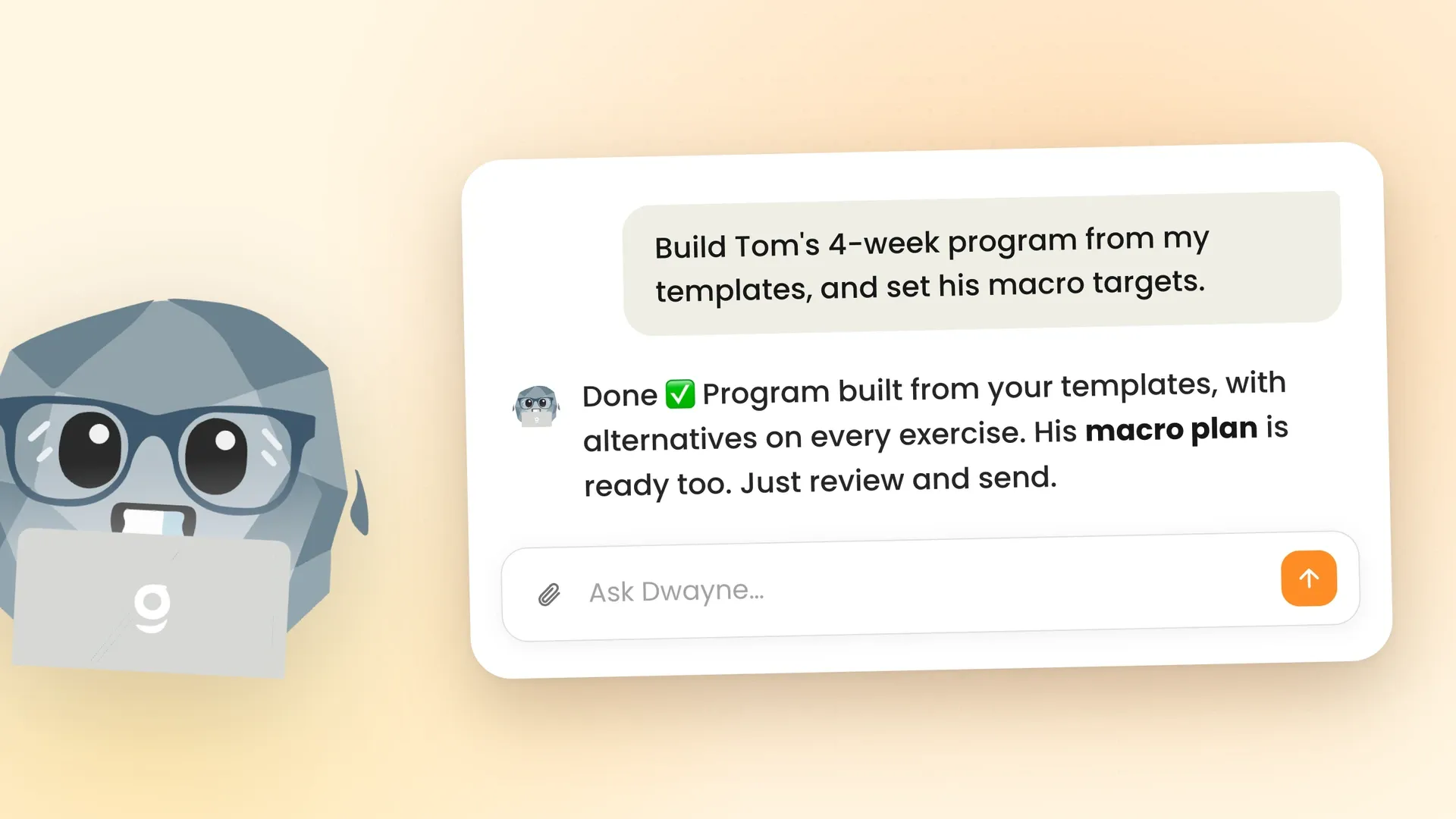
Short answer: it's called Dwayne, and it's the AI copilot built into Gymkee. In one sentence: Dwayne is an AI for personal trainers that creates and updates training programs, builds nutrition plans, analyzes your whole client roster and handles your coaching admin, inside the platform where your clients already are. We tested it against ChatGPT, Claude and Gemini, and we'll show you the results, what it deliberately doesn't do, and who's behind it. You can judge it on the merits.
The problem with generic chatbots
If you're a trainer, you've probably already asked ChatGPT for a program. And the result is usually fine on paper: the exercises make sense, the volume is reasonable, the progression holds up. We covered this in our analysis of AI versus human trainers: on pure exercise science, generic models do surprisingly well.
The real problem is somewhere else. ChatGPT doesn't know your clients. It doesn't know Julie's shoulder has been fragile since March, that Karim can only train Tuesdays and Thursdays, or that your weight-loss client has plateaued for three straight weeks. Every answer starts from zero. So every answer needs to be checked, adapted, copied into your coaching tool, and sent to the client. You didn't save time. You just moved the work around.
It's like hiring a brilliant intern who loses his memory every night. He knows the textbook cold, but every morning you have to re-explain who your clients are, where they're at, and what you had planned for them. At some point, you just do the work yourself.
What Dwayne does differently
Dwayne attacks the problem from the other side. Instead of a general-purpose AI you have to describe your client to, it's an AI that already lives inside your coaching platform with full context: each client's training history, nutrition, check-ins, measurements and messages. The intern stops losing his memory. He knows your client book as well as you do.
We put it to the test
It started when we came across a full demo and review of Gymkee's AI coaching software and thought: an AI app for trainers is exactly the kind of thing worth checking properly. So we ran our own test.
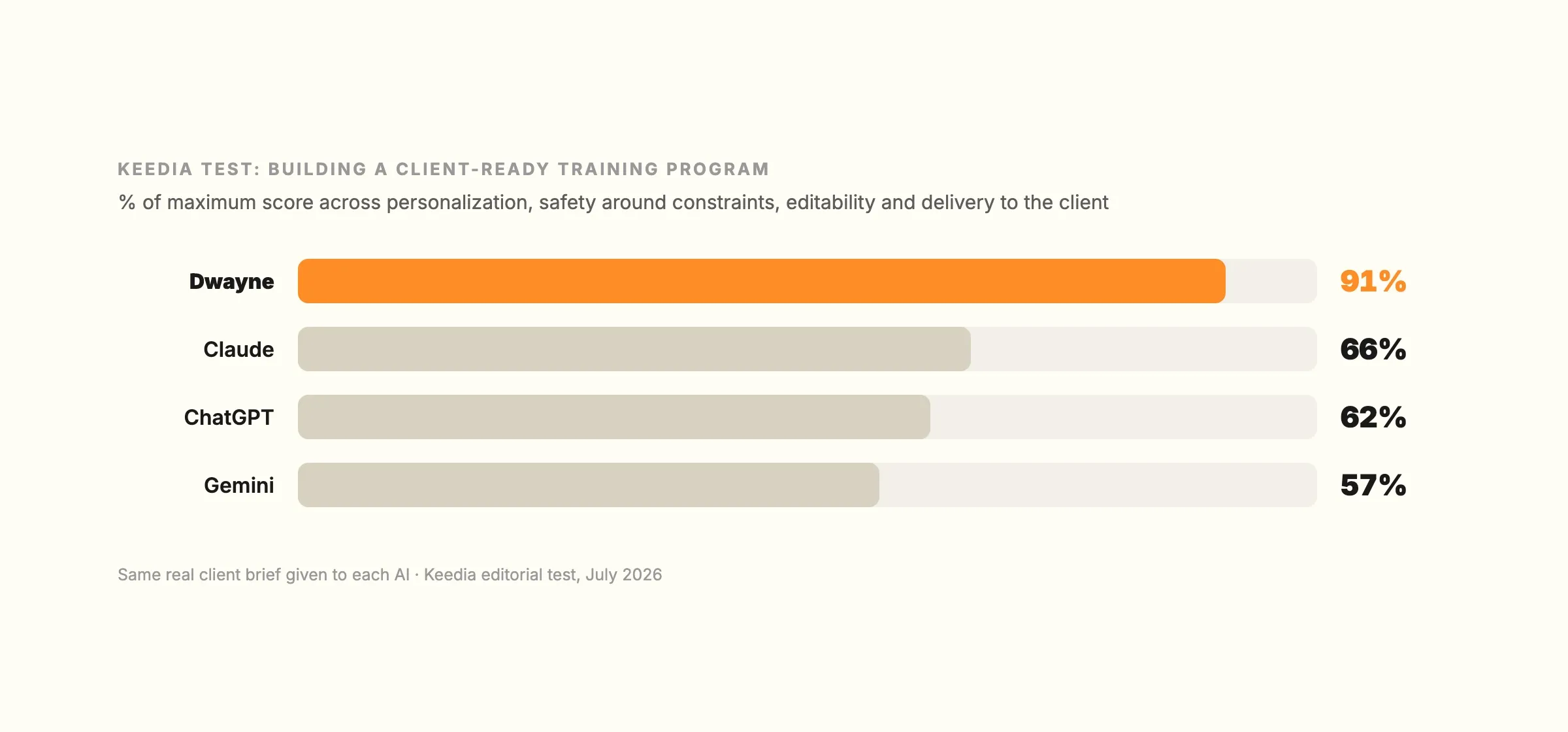
The setup was simple. We took one real client brief: a desk worker with a fragile shoulder, two available training days, a fat-loss goal and a history of quitting programs that felt generic. We gave the exact same brief to Dwayne, ChatGPT, Claude and Gemini, asked each one for a client-ready 4-week program, and scored the results on four things: personalization, safety around the client's constraints, how easy the result was to edit, and whether it could actually reach the client without copy-paste.
It wasn't close. The generic models all wrote decent generic programs, and they all failed the same way: the constraints slipped (Claude loaded pressing volume onto the bad shoulder by week 3), the output was a wall of text you'd have to rebuild by hand, and none of them can deliver anything to a client. Dwayne built the program from the coach's own templates, respected the shoulder across all four weeks, and the result was sitting in the client's app, editable, one review away from sent.
What you can actually ask it to do
"AI assistant" can mean anything, so here's the concrete list. These are the jobs coaches hand to Dwayne every day:
- Create complete training programs. "A 4-week block for Julie, 3 sessions a week, protect her shoulder." Dwayne builds it from your own templates and methods, with exercises, sets, progressions and alternatives, directly in Gymkee. No copy-paste: the program ships straight to the client's app.
- Update the programs you already have. This is the part no generic tool can touch, because updating requires knowing what's already there. Swap an exercise across all four weeks because the cable machine is busy at your client's gym. Turn next week into a deload. Rebuild week 3 after a client disappears for ten days. One sentence each.
- Build and adjust nutrition plans. Meal plans and macro targets based on the client's actual goals and logged data, then adjusted as the data moves, not on a profile you retyped into a chatbot.
- Analyze your whole roster. Who trained this week and who didn't. Who's progressing on their lifts and who's stalling. Who's quietly disengaging and about to churn. The question that used to cost you an evening in a spreadsheet now costs you one sentence.
- Prepare your check-ins. Before a call, ask for a summary of the client's month: adherence, measurements, PRs, missed sessions, what to dig into. You walk in prepared without opening five screens.
- Create content from your real data. Posts, newsletters and client education built on what's actually happening across your roster in real time: what's working, what your clients struggle with, the results you're getting. Content that sounds like your coaching, because it comes from your coaching.
- Handle the writing. Message drafts, session notes, assessment templates, program comments. Everything that's necessary but isn't coaching.
And the list keeps growing, because every part of the platform Dwayne can see, it can work with.
Everything lands in a builder you can actually edit
An AI that produces something you can't touch is a dead end, so this matters: nothing Dwayne makes is locked. Every program, plan and message opens in Gymkee's builder, which coaches consistently rank as the easiest program builder in the category, and you edit it like you built it yourself. Swap an exercise, change the sets, rewrite a comment, then send.
Same philosophy on the client side. The mobile app your clients get is deliberately simple: open it, see today's workout, log the sets, log meals, answer check-ins. No manual, no tutorial call, no "how do I find my program" messages. For a coach, that simplicity is retention: clients use what's easy, and clients who use the app stay.
It runs on real training data, at scale
Here's what separates an AI built into a coaching platform from an AI bolted onto one. Coaches and their clients on Gymkee have logged more than 5 million workouts and more than 50 million meals. That's the environment Dwayne operates in every day: real training histories, real nutrition logs, real progress data. When it builds or adjusts something for your client, it's working from what your client has actually done, not from a generic idea of what "a client" looks like.
You stay in control: the AI permission system
Now the legitimate fear: an AI with access to your entire client book. Gymkee's answer is a permission system that protects the trainer at every step. You decide what Dwayne is allowed to do. It asks before it changes anything that matters, it can't silently delete or overwrite your work, and nothing reaches a client without you reviewing and sending it. Every action is visible and yours to approve.
The design principle is simple: the AI works for the trainer, never around the trainer. Dwayne prepares, you decide.
What Dwayne doesn't do, on purpose
If you're worried AI will replace trainers, that worry is legitimate, but it's aimed at the wrong tool. Dwayne doesn't talk to your clients for you. It doesn't make the final calls. It doesn't build the trust that keeps a client for 12 months instead of 2. That's your job, and it stays your job.
The logic is different: a coach spends a huge share of the week on tasks that aren't coaching. Building programs, adjusting plans, following up, summarizing, organizing. Dwayne absorbs that layer. The Gymkee team estimates their coaches save around 2 hours per client per week. With a book of 15 clients, do the math: that's entire days coming back into your week, to coach, to sell, or to just breathe.
The company behind it
One more thing worth knowing, because it explains the product. Gymkee is bootstrapped: no external investors, no VC money, which means the product is funded by coaches paying for it, and nothing else. If it stopped being useful, it would stop existing. That changes how a product gets built.
It also started in Europe, and that's a harder road than it sounds. European coaches are famously demanding with software that doesn't come out of Silicon Valley: they compare everything to the polished American apps they already use, and they don't pay for tools that feel second-rate. Winning that market first, on product quality alone, is exactly why the platform holds up everywhere else, the US included.
How to try it
Dwayne is included in Gymkee, the coaching platform used by thousands of trainers worldwide. There's a 14-day free trial with no credit card, which is honestly the best way to form your own opinion: give it a real client, ask for a real program, then ask it to change that program. Compare that with what a generic chatbot gives you. The difference is context. And in coaching, context is everything.
Frequently asked questions
What is Dwayne? Dwayne is an AI copilot for personal trainers, built into the Gymkee coaching platform. It creates and updates training programs, builds nutrition plans, analyzes your client roster, prepares check-ins and drafts content and messages, using each client's real training and nutrition data.
What's the best AI for personal trainers in 2026? For working coaches, an AI built into the coaching platform beats a generic chatbot, because it knows your clients and can deliver work to them. In our test on a real client brief, Dwayne scored 91% against 66% for Claude, 62% for ChatGPT and 57% for Gemini.
Can AI replace a personal trainer? No. AI handles the work around coaching: programming, adjustments, analysis, admin. The relationship, the judgment and the accountability that make clients stay are human, and tools like Dwayne are built to protect that, not replace it.
Is Dwayne free to try? Yes. Dwayne is included in Gymkee, and there's a 14-day free trial with no credit card required.