
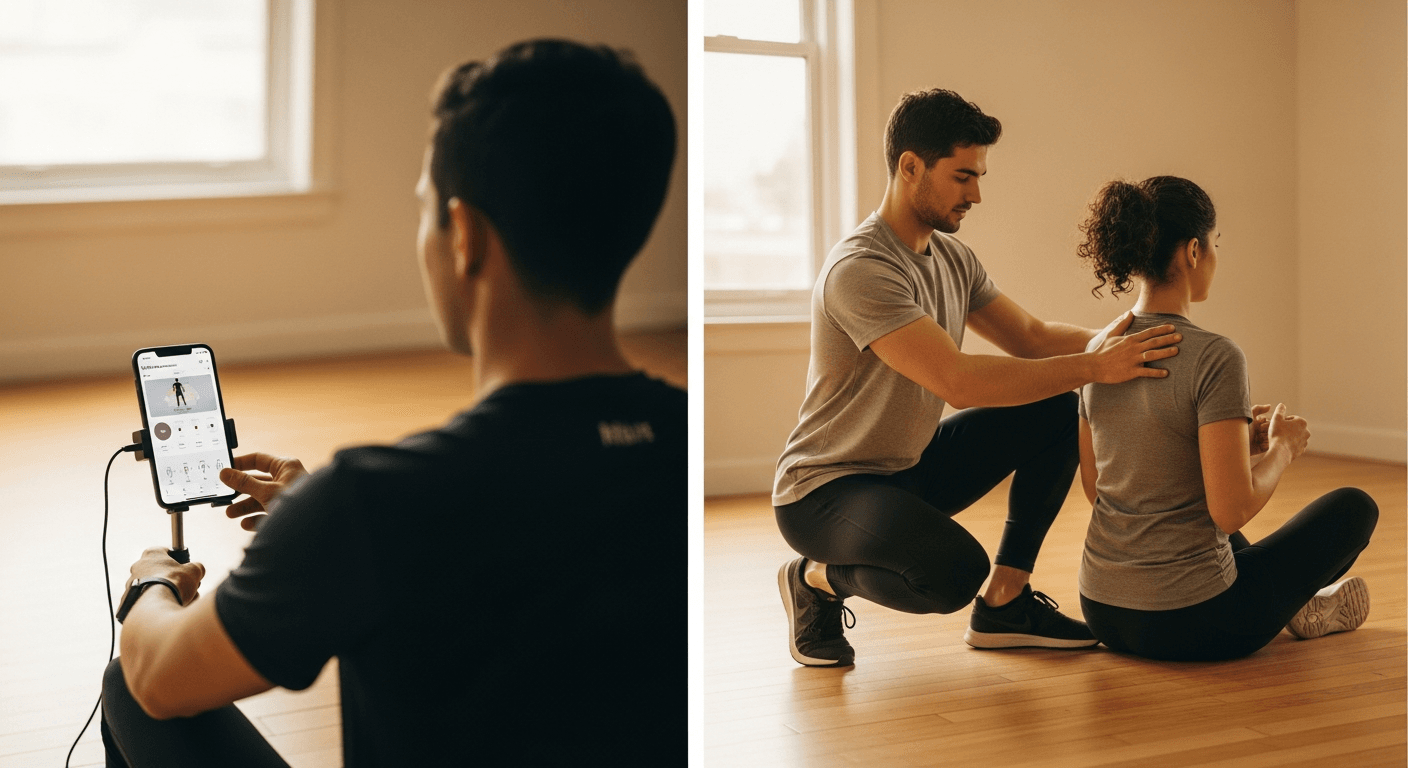
The debate has shifted. It's no longer whether AI coaching works. Research published July 8, 2026 in the Journal of Medical Internet Research (JMIR) confirms that AI-driven fitness platforms can generate genuinely personalized programs, deliver real-time movement feedback, and outperform generic gym routines on several measurable outcomes. The real question is more specific: what does AI coaching actually fail to do, and when does that failure matter for you?
Here's a practical framework for making that call, without dismissing either side.
What the JMIR Research Actually Found
The July 8 JMIR study examined adherence patterns across users on AI-only coaching platforms versus those working with human trainers. The headline finding wasn't about workout quality. It was about dropout rates. Participants relying solely on AI coaching showed significantly lower long-term adherence. Not because the programs were poorly designed, but because the accountability structure was fundamentally different.
AI can track your sessions, flag missed workouts, and adjust load progression automatically. What it can't replicate is the social contract that forms between a person and a coach who knows their name, remembers their bad week, and notices when something is off. That relational layer, the JMIR study argues, is what keeps most people consistent beyond the 12-week mark.
This isn't a reason to dismiss AI. It's a reason to be precise about what you're actually buying when you choose one model over the other.
Where AI Coaching Genuinely Delivers
AI tools have moved well beyond generic workout generators. The current generation of platforms offers real-time movement correction through computer vision, progressive overload logic that adjusts based on your recovery metrics, and integration with wearable data that most human trainers don't have time to analyze session by session.
For a specific type of user, this is more than enough. If you're already self-motivated, have a baseline understanding of training principles, and primarily need structure and consistency, AI coaching can deliver serious results at a fraction of the cost. A subscription to a premium AI coaching platform typically runs $30 to $80 per month. A qualified personal trainer in a major US city averages $80 to $150 per session.
AI also excels in domains that benefit from continuous data. When you're tracking body composition changes, sleep quality, or recovery trends, an AI system can cross-reference inputs across weeks of data without cognitive fatigue. That kind of pattern recognition, applied consistently, is genuinely useful. This is part of the same shift happening in nutrition, where tools now use blood biomarkers as part of personalized nutrition protocols rather than relying on static population averages.
Where AI Coaching Falls Short
The JMIR research identified three consistent failure points for AI-only coaching: emotional volatility, complex physical presentation, and goal drift.
Emotional volatility is the most underestimated one. When a client's adherence crashes because of a divorce, a job loss, or a health scare, AI platforms respond with nudges and schedule adjustments. Human coaches respond to the actual person. That distinction sounds soft, but it's the difference between someone staying in the program or quitting entirely.
Complex physical presentation is the other hard limit. AI movement correction works well for standard bilateral patterns and exercises with clear visual markers. It struggles with asymmetries, post-injury compensations, and cases where pain science needs to inform programming decisions in real time. A human trainer with verifiable credentials, specific to your situation, whether that's a Certified Strength and Conditioning Specialist (CSCS), a licensed physical therapist, or an NASM-certified coach, brings judgment that isn't pattern-matched from training data.
Goal drift is subtler. Most people's training goals change over time. A 28-year-old running their first marathon will want something different at 32 after their first child. AI systems can be reprogrammed, but they don't proactively challenge you to reconsider what you're actually chasing. A good human coach does that as a matter of practice. It's one of the core competencies the coaching industry, now a $5.34 billion industry globally, has built its professional standards around.
The Credentials Question
One area where the human advantage is non-negotiable is verifiable accountability. When you hire a trainer, you can check their certification body, their insurance, their continuing education record. If something goes wrong, there's a professional and ethical framework around the relationship.
AI platforms have terms of service. That's not the same thing.
This matters most in three scenarios: you're returning from injury, you're working around a chronic condition, or you're training at an intensity where programming errors have real physical consequences. In all three cases, human oversight isn't optional. It's risk management.
The Hybrid Model Is Becoming the Default
The most practical answer for most people in 2026 isn't a binary choice. It's a tiered structure that uses each tool for what it does best.
Here's how that typically looks:
- AI handles daily programming and tracking. The platform manages session structure, progressive overload, and recovery monitoring between your check-ins. This runs automatically and doesn't require scheduling.
- Human sessions happen monthly or bi-weekly. These aren't for following a script. They're for form assessment, goal recalibration, and catching the things AI flags but can't interpret. A coach reviewing your movement patterns once a month is far more cost-effective than weekly personal training, and still provides the accountability layer that drives long-term adherence.
- Nutrition is managed in parallel. Many hybrid programs now integrate AI nutrition tracking with human oversight for dietary strategy. If you're doing any serious body composition work, the nutrition variable is often more consequential than the training split itself.
The fitness industry is already moving this direction. Major platforms are acquiring nutrition tech and integrating coaching layers, a trend that's reshaping what coaches offer and how they price their services, as outlined in the analysis of hybrid coaching as the new baseline for 2026.
A Decision Framework by User Profile
Rather than recommending a single path, here's how to match the model to where you actually are:
AI-only coaching is likely sufficient if: you've been training consistently for more than two years, you're not managing any injury or chronic condition, your primary goal is maintenance or moderate progression, and you're self-directed enough to train without external accountability.
Human trainer is worth the investment if: you're a beginner with no baseline movement competency, you're recovering from injury or surgery, your goals require periodization complexity (competitive athletics, powerlifting, physique competition), or your previous attempts at self-directed or AI-only training have ended in dropout.
Hybrid model makes sense if: you want cost efficiency without sacrificing oversight, your schedule makes consistent in-person training impractical, or you're in a stable phase but want periodic expert calibration. This is where most recreational athletes, working professionals, and fitness-focused individuals over 35 will land.
The Performance Variables That Don't Live in the App
One thing both AI platforms and many human trainers underweight is the role of recovery and nutrition in determining whether any training program actually works. You can have the most sophisticated periodization model in the world and still plateau if your sleep is fragmented or your protein intake is inconsistent.
There's growing evidence that cognitive load from chronic screen exposure affects physical recovery, with research showing that exercise serves as a critical defense mechanism against the cognitive effects of screen-heavy lifestyles. That's not a wellness abstraction. It's a variable that affects how well you recover between sessions, how consistently you execute in the gym, and how sustainable your program is over a 12-month arc.
Similarly, supplement decisions made without context can undercut solid programming. Research on collagen peptides and resistance training outcomes is one example of an evidence base that's easy to misapply without understanding the specifics of the RCT findings. A human coach with current continuing education is far more likely to apply that nuance correctly than an AI system trained on generalized fitness content.
The Bottom Line
AI coaching in 2026 is not a downgrade. For the right user, it's a serious tool that can produce real results at a significantly lower cost than traditional personal training. The JMIR study doesn't discredit it. It clarifies its limits.
Those limits center on one thing: the relational accountability that keeps people consistent over time, and the nuanced human judgment required for complex, individual cases. When those factors matter for you, a human trainer isn't a luxury. It's the right tool for the job.
The smartest approach isn't loyalty to one model. It's knowing which version of you is showing up to train, and choosing the structure that gives that version the best chance of staying in the game long enough to actually see results.