
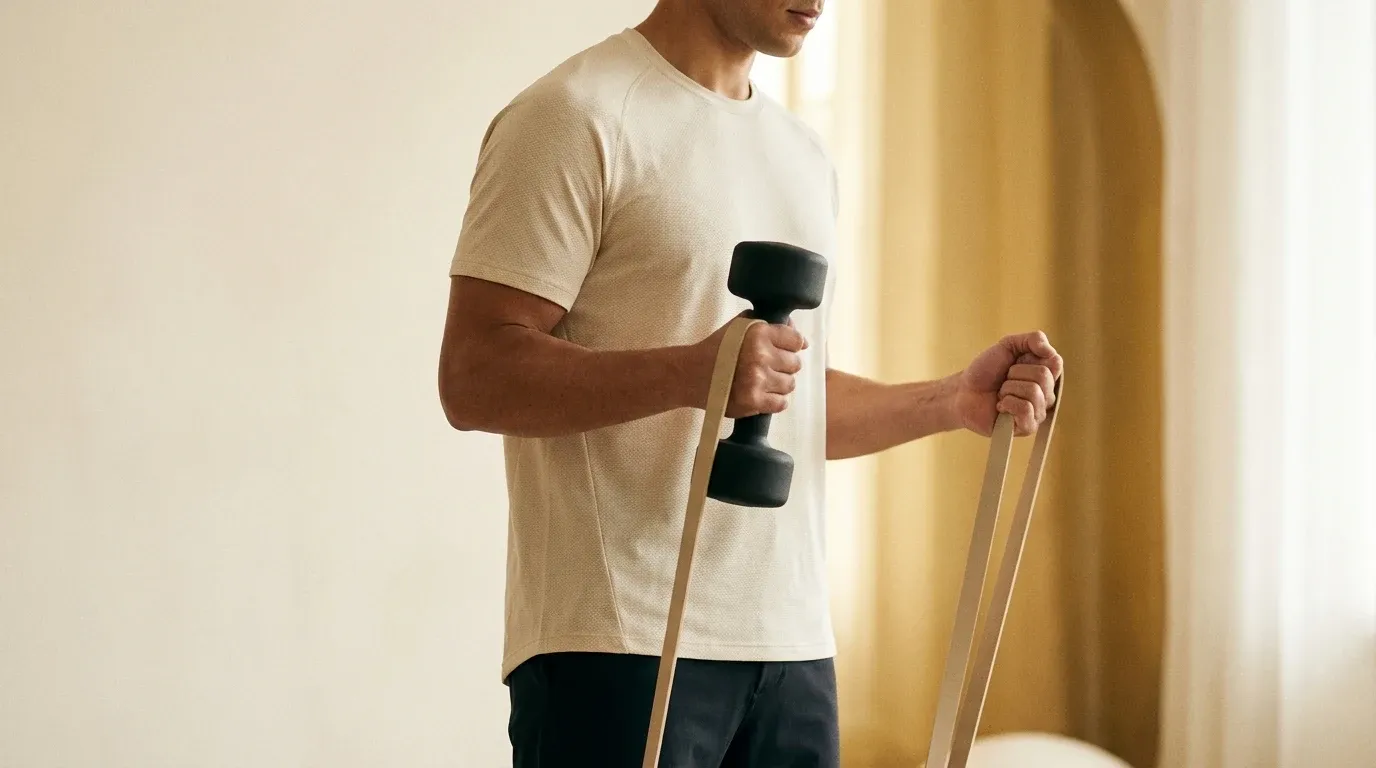
If you've ever debated whether to invest in a set of dumbbells or a bundle of resistance bands, you're not alone. It's one of the most persistent arguments in strength training, and for years the answer has leaned heavily on anecdote and gym culture rather than hard data. A study published October 14, 2026 finally puts the two head-to-head with enough rigor to give you a science-backed answer.
What the New Research Actually Found
The study, published in a peer-reviewed sports science journal on October 14, 2026, recruited healthy adults across a range of training experience levels and split them into two groups. One group trained exclusively with free weights. The other used resistance bands. Both groups followed matched protocols in terms of volume, frequency, and progressive overload. Muscle cross-sectional area and strength gains were measured at 8 and 16 weeks.
The headline finding: both groups produced statistically comparable gains in muscle hypertrophy. There was no significant difference in muscle size outcomes between the band group and the weight group when the training stimulus was equated. Strength improvements tracked similarly as well, with minor variations depending on the specific movement tested.
What the researchers emphasized wasn't which tool won. It was the mechanism that made the difference. Progressive overload, applied consistently, was the variable that drove growth in both conditions. The equipment was secondary.
Why Resistance Bands Can Build Real Muscle
The skepticism around bands is understandable. They look lightweight. They're associated with rehabilitation and beginner circuits. But the physiology doesn't care what the tool looks like.
Muscle growth is triggered by mechanical tension, metabolic stress, and muscle damage. Resistance bands generate all three. What makes bands unique is their ascending resistance curve. As you stretch a band further through a range of motion, the resistance increases. This contrasts with free weights, which deliver constant load regardless of joint angle.
That ascending curve means bands create peak tension at the top of a movement, where muscles are typically shortest and most activated. In exercises like lateral raises, rows, or squats, this translates to meaningful tension at the end range where free weights often feel easiest. The 2026 study noted this mechanical difference but confirmed it didn't produce inferior hypertrophy. Different stimulus profile, similar outcome.
Bands also keep muscles under continuous tension throughout the movement. There's no moment of slack at the bottom of a curl or the top of a press. That sustained time under tension is a recognized driver of hypertrophy, and it's something bands deliver naturally.
Where Free Weights Still Have the Edge
Bands don't win every category. Free weights offer more precise load management. You know exactly how many pounds you're lifting. Progression is clear, measurable, and easy to document. With bands, resistance varies by manufacturer, stretch distance, and anchor point, which makes tracking progressive overload more complex in practice.
Free weights also dominate in low-repetition, high-load work. If your goal is maximal strength expression, powerlifting, or building the kind of dense neuromuscular efficiency that comes from heavy compound loading, barbells and dumbbells remain the superior tool. The 2026 study population trained in moderate rep ranges. Extrapolating the findings to true strength sport contexts would be premature.
There's also the matter of specificity. Athletes training for sport often need to simulate real force outputs. A sprinter building hip extension power or a swimmer reinforcing shoulder stability will eventually need load profiles that bands alone can't replicate at higher levels of performance.
The Case for Bands: Accessibility, Cost, and Real-World Use
Here's where bands make a genuinely compelling argument beyond the lab data. A complete set of resistance bands costs between $20 and $80 at most retailers. A comparable set of dumbbells covering the same effective resistance range runs $150 to $400 or more. A cable machine or functional trainer, which most closely replicates band mechanics in a gym setting, can cost $1,000 to $3,000 for a home unit.
For home trainers, travelers, people recovering from injury, or anyone training in a small space, bands remove nearly every logistical barrier. You can anchor them to a door frame, a squat rack, or a sturdy post and replicate most functional movement patterns within a few square feet.
This accessibility matters especially for populations where consistency is the primary challenge. If you're navigating life after having a baby and rebuilding your training routine, as covered in Returning to Exercise After Birth: A Coach's Guide, bands offer a low-barrier entry point that doesn't require a gym membership or a full equipment setup at home.
The same logic applies as you move through different life stages. For older adults managing joint sensitivity, bands allow you to load movements with less compressive force on joints than heavy free weights. How a Trainer Would Coach You in Your 60s outlines exactly why load management and movement quality take priority over raw tonnage at that stage, and bands fit naturally into that framework.
Progressive Overload With Bands: How to Make It Work
The 2026 study's core message is that progressive overload is non-negotiable regardless of tool. The challenge with bands is applying that principle systematically. Here's how to do it:
- Increase band thickness. Moving from a light to a medium to a heavy band is the most direct progression, similar to adding weight plates.
- Shorten your anchor distance. The closer you stand to the anchor point, the greater the starting tension on the band. Adjusting your position is a subtle but effective way to increase load without changing bands.
- Stack bands. Doubling up two bands on the same movement increases resistance significantly and gives you finer control over progression increments.
- Manipulate tempo and time under tension. Slowing down the eccentric phase or adding pauses at peak contraction increases training stimulus without requiring heavier load.
- Track reps to failure. If you're completing sets well short of muscular failure, you're not maximally stimulating growth regardless of the equipment. Train close to failure to drive adaptation.
These methods work. The study participants using bands weren't just looping elastic around their ankles and calling it training. They followed structured progressive programs, and the results matched the weight group because of it.
Which Tool Should You Choose?
The honest answer is that your constraints should drive the decision more than the equipment's theoretical ceiling.
If you train at home, travel frequently, are working around a joint issue, or simply don't want to invest in heavy equipment, bands are a fully legitimate path to meaningful muscle development. The 2026 data confirms you won't be leaving significant gains on the table, provided you're applying progressive overload and training with sufficient effort.
If you have gym access, enjoy tracking precise loads, or have performance-specific goals that require heavy loading, free weights remain the more versatile and scalable tool over a long training career. Combining both isn't just acceptable. It's often optimal. Many coaches now program bands alongside free weights to exploit the complementary tension curves of each.
It's also worth noting that muscle building doesn't exist in isolation. Sleep quality, for instance, plays a direct role in recovery and protein synthesis. Research covered in 10 Minutes of Daily Exercise Unlocks Deeper Sleep reinforces that even modest training volumes support the kind of sleep that makes muscle growth possible. And on the cellular side, the mechanisms behind muscle adaptation across age are becoming clearer. Exercise Reverses Muscle Aging. Scientists Now Know Why. unpacks the gene-level research showing that consistent training, regardless of modality, preserves and rebuilds muscle tissue well into later decades.
The Bottom Line
The October 2026 research settles what gym culture has debated for years. Resistance bands and free weights produce comparable muscle growth when training is structured, progressive, and consistent. The equipment matters less than the principles governing how you use it.
If you've been holding off on building a training habit because you don't have a full gym setup, the data now gives you permission to start with what you have. A set of bands, a clear program, and a commitment to progressive challenge is enough to build real muscle. That's not a compromise. It's a strategy.