
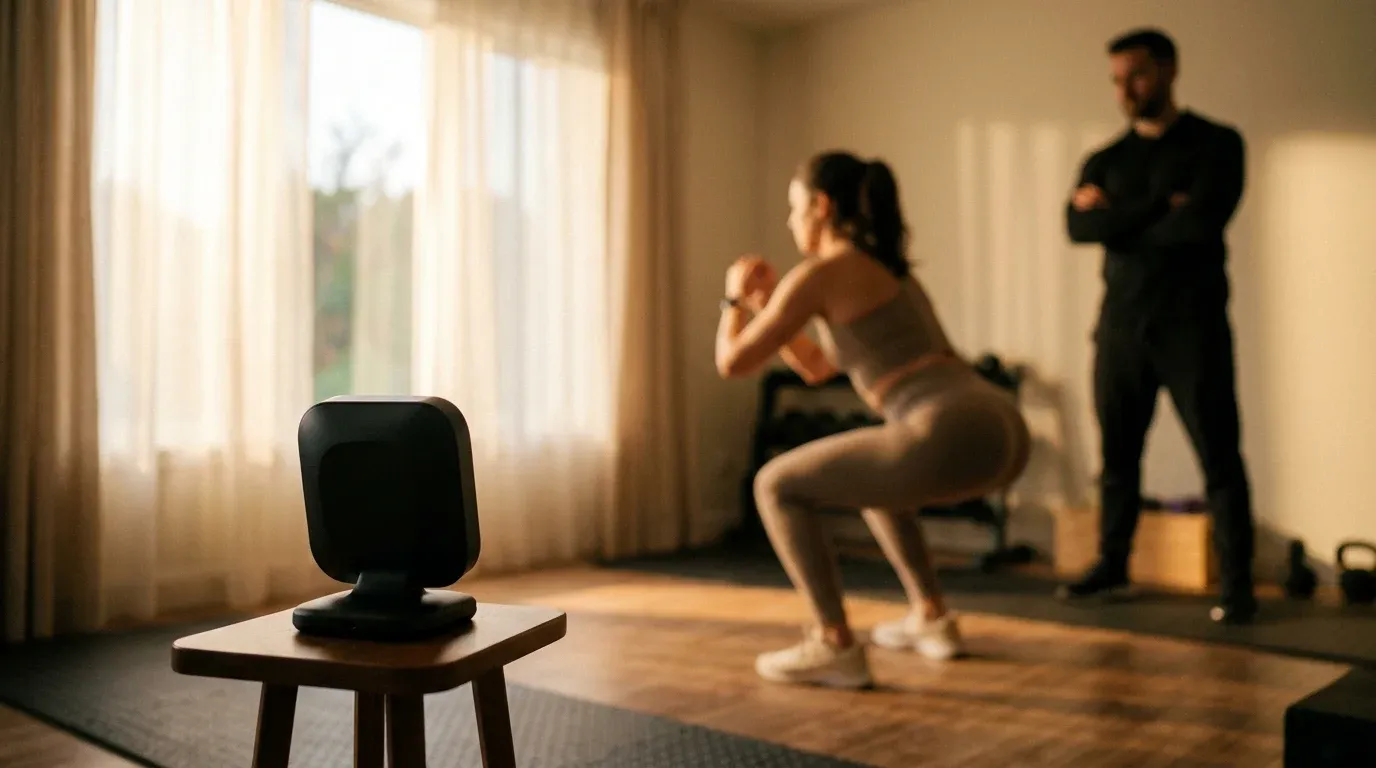
The BodyPark Atom landed quietly earlier this year, but fitness reviewers have been anything but quiet about it. The wearable device uses body-mapping technology to analyze your movement in real time, flagging compensations, tracking range of motion, and delivering audio cues during workouts. At a price point well under $300, it's drawing serious attention. And with it comes a question that's been building for years: does a device like this make a human trainer optional?
The honest answer is that it depends entirely on who you are and what you actually need from coaching. AI-powered movement tools have genuine strengths. They also have hard limits. Here's how to tell which side of that line you're standing on.
What the BodyPark Atom Actually Does Well
The Atom's core feature is real-time feedback on movement quality. Sensors map your body position during exercises and compare it against a movement model, then alert you when your form drifts. In testing, reviewers noted that its squat and deadlift detection was surprisingly accurate, catching knee cave and forward lean at a level that would take a trainer several sessions to identify consistently in a group class setting.
The device also runs structured sessions, progressing you through warm-up, work sets, and cool-down with guided cues. For someone training alone in a home gym or traveling frequently, that structure has real value. You're not just lifting and hoping. Something is watching.
That "something watching" effect matters more than it sounds. Research on exercise adherence consistently shows that external accountability, even from a non-human source, improves training consistency. The Atom delivers a version of that at a fraction of the cost of regular one-on-one sessions, which in the US market typically run between $60 and $150 per hour depending on location and trainer experience.
For form refinement in foundational patterns, the device holds its own. If you want to go deeper on technique principles before your next session, what your trainer actually wants you to know about squat form gives you the biomechanical context that makes AI feedback easier to act on.
Where AI Coaching Hits a Hard Ceiling
Here's where the honest conversation starts. A movement sensor can tell you your knee is caving inward. It cannot tell you why. And the why is often the whole story.
Knee cave during a squat might signal weak hip abductors. It might also come from limited ankle dorsiflexion, poor motor control under fatigue, an old knee injury you've been quietly compensating around for three years, or simply that you're at rep eight of ten and your nervous system is done. A device gives you the same cue regardless. A good trainer reads the context and responds differently each time.
Program adaptation is another ceiling. AI tools can adjust volume and intensity based on simple inputs, but they can't factor in that you slept four hours, that you're entering a stressful period at work, that your shoulder started clicking last Thursday, or that you're getting married in six weeks and your goal priorities just shifted. Human coaches do this continuously, often without being explicitly told. They notice. They adjust. They ask the right question at the right time.
Motivation is the third gap. Studies on long-term exercise behavior show that the trainer-client relationship is one of the strongest predictors of sustained adherence. That relationship involves trust, personality fit, and the kind of nuanced encouragement that knows when to push and when to back off. A device giving you a green checkmark does not replicate that dynamic, no matter how well-designed the interface is.
There's also a safety dimension worth naming. If you're returning from injury, managing a chronic condition, or working through pain patterns, AI feedback is not a safe substitute for qualified human assessment. The Atom is not a physiotherapist. It's not monitoring your nervous system fatigue or watching how you compensate across an entire movement session the way a skilled eye does.
Three Profiles: Who Gets What From AI Coaching
Rather than asking whether AI coaching is good or bad, a more useful question is: good or bad for whom? Here are three profiles that map the range.
Profile 1: The Self-Directed, Experienced Mover
You've been training consistently for at least two to three years. You understand basic programming principles. You know what a hip hinge feels like and you've had enough coaching in the past to have a body awareness baseline. Your goals are maintenance, continued progress, and accountability rather than fundamental skill acquisition.
For you, a device like the Atom delivers strong value. You're using it as a check system, not a primary teacher. The real-time feedback reinforces what you already know and catches the drift that creeps in when no one's watching. You're getting accountability and structure at a fraction of the cost of ongoing personal training. This is the profile where AI tools perform closest to their marketing.
Profile 2: The Motivated Beginner or Goal-Specific Athlete
You're either new to structured training or you're working toward a specific outcome that requires genuine program design. Maybe you want to run your first half marathon. Maybe you're trying to add 20 pounds to your deadlift in four months. Maybe you're 45 and navigating hormonal shifts that are changing how your body responds to training.
A hybrid approach makes most sense here. Use an AI device for your solo sessions during the week. Work with a human coach once a week or every two weeks for program review, technique checks, and strategic adjustment. You get the accountability of daily AI monitoring without paying for training frequency you may not need.
This approach also lets you maximize each human session. Come in having already identified where you're struggling, with video or device data to show your trainer. That's a more productive hour than starting from scratch every time. If recovery and sleep are factors in your performance. and they almost always are. research on sleep quality after 50 is worth understanding before you build your program around intensity.
Profile 3: The Complex or High-Stakes Client
You're dealing with injury history, chronic pain, a significant health condition, or a performance goal at a competitive level. You may also be someone who has tried to train independently multiple times and stopped, where the pattern itself is the problem worth addressing.
For you, skipping straight to a qualified human trainer isn't a luxury. It's the efficient choice. Every dollar spent on an AI device before your mechanics and history are properly assessed is money that might delay real progress or, in the worst case, reinforce a compensatory pattern that becomes harder to unwind later.
The US personal training market offers a wide range of options. Independent coaches, gym-based trainers, physical therapists with performance backgrounds, and online coaches who provide real programming with video review are all viable depending on your specific situation. The cost is higher than an AI device, but so is the ceiling of what's possible.
The Honest Cost Comparison
Let's put numbers to this. A device like the Atom runs under $300 as a one-time purchase, with potential subscription fees for premium features. Compare that to in-person personal training at $60 to $150 per session, or online coaching programs that typically run $100 to $350 per month depending on access level and coach reputation.
For someone training four days a week, replacing all four sessions with AI-guided training versus twice-weekly in-person coaching saves significant money monthly. But savings are only meaningful if the outcome is comparable. For experienced, self-aware movers, it often is. For beginners building foundational patterns, the savings can cost more in wasted time, ingrained errors, and stalled progress.
The strongest value proposition for AI coaching tools isn't replacement. It's extension. You get more training days under some form of oversight without a proportional cost increase. And for the right person, that's a meaningful upgrade to what they'd otherwise be doing, which is training alone with no feedback at all.
What to Actually Look For in an AI Coaching Device
If the Atom's review has you considering this category seriously, here's what to evaluate before buying any device in this space.
- Movement library breadth. How many exercise patterns does it actually recognize accurately, not just claim to track? A narrow library limits usefulness quickly.
- Feedback specificity. Does it tell you what's wrong and offer corrective guidance, or does it just flag an error? Specificity determines whether the feedback is actionable. For a sense of what good cueing looks like in practice, the squat coaching cues that work across different client types illustrate the standard you're comparing against.
- Program logic. Does it adapt based on your history and performance, or does it follow a static template? True adaptation matters more over weeks and months than on day one.
- Integration with recovery data. The best training decisions account for how well you're recovering. Devices that pull from sleep or HRV data are making smarter recommendations than those operating on training data alone.
- Exit cost. What happens if you stop? Some platforms lock your history or require ongoing subscriptions to access features that should be standard. Read the terms before committing.
The Bottom Line
The BodyPark Atom represents a genuinely useful category of product, not a replacement for human expertise. It's a tool that performs well within a specific range of client needs and training contexts. Outside that range, it has real limits that aren't fixed by better software or more sensors.
Your decision should start with an honest self-assessment, not with the device's marketing. What's your training history? What's the complexity of your goal? What's your track record with independent training? The answers point you toward AI-only, hybrid, or human-first without ambiguity.
Movement quality is also inseparable from the broader picture of how you're managing your body. If mobility is a gap you're trying to close alongside coaching, a structured daily mobility routine addresses the kind of tissue and joint preparation that directly affects how accurately any device reads your patterns.
AI coaching tools are getting better every year. Right now, the smartest use of them is alongside human expertise, not instead of it.