
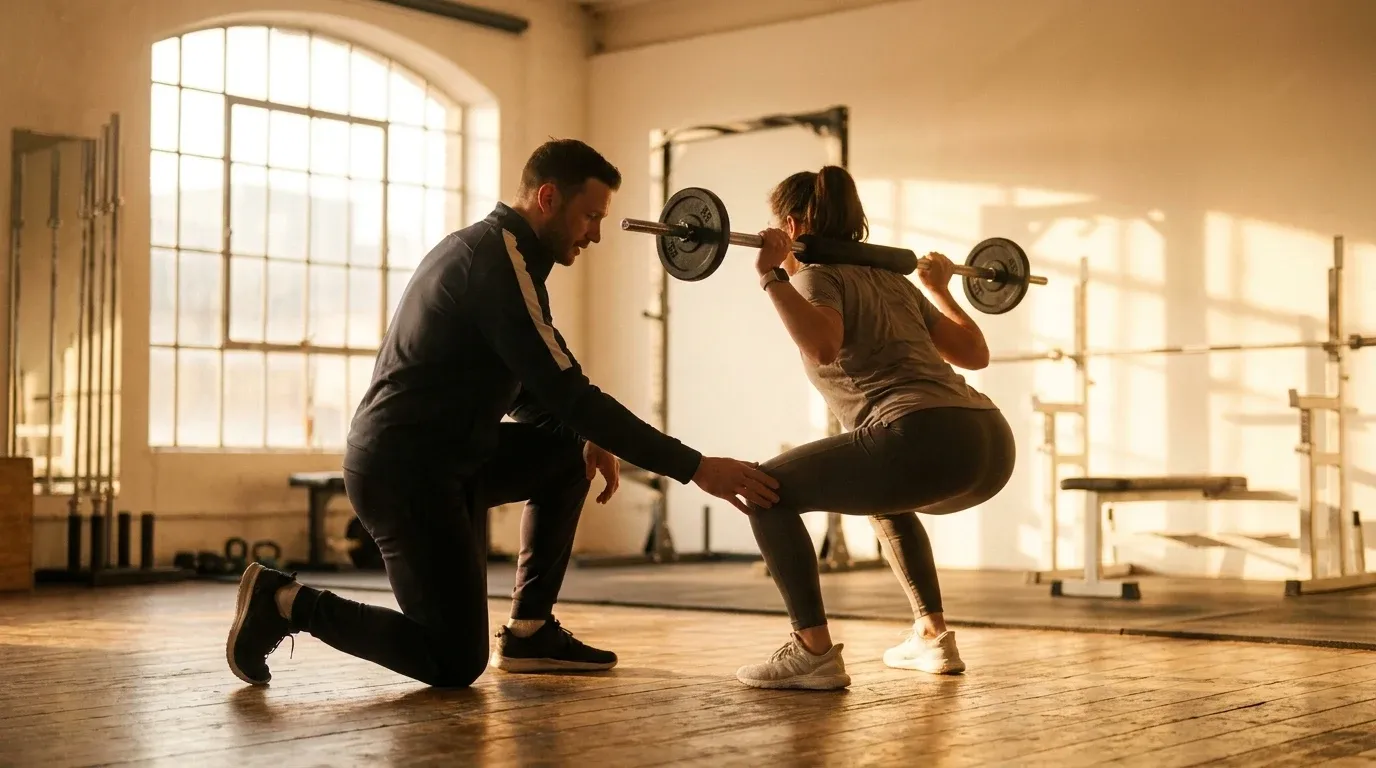
Walk into almost any gym and you'll hear the same handful of squat cues repeated on loop. Chest up. Knees behind toes. Drive through your heels. These instructions aren't wrong exactly, but applied universally, they cause real problems. Clients compensate, coaches get frustrated, and nobody quite understands why the movement still looks off.
The truth is that squat mechanics are deeply individual. A cue that unlocks one client's pattern can completely derail another's. If you're coaching squats, or trying to fix your own, an anatomy-first approach isn't optional. It's the baseline.
Why Generic Squat Cues Fall Short
Most standard squat cues were designed for a mythical average body. In reality, human anatomy varies significantly at the hip joint alone. The angle of the femoral neck, the depth of the acetabular socket, and the orientation of the hip socket itself differ from person to person in ways that directly dictate how a squat should look.
A client with a shallow hip socket and a more anteverted femur will naturally squat with a narrower stance and more forward knee travel. A client with a deep socket and retroversion needs a wider stance and externally rotated feet to access depth without impinging. Applying the same cue to both of these people produces predictably poor results.
Research consistently shows that movement variability between individuals is not a coaching failure. It's anatomy. The job of a skilled coach is to identify what pattern serves the client's structure, then reinforce it, not to impose a textbook template. For a broader look at what this kind of individualized approach looks like in practice, Squat Form: What Your Trainer Actually Wants You to Know is worth your time.
Stance Width and Toe Angle: Assess First, Prescribe Second
The single most effective thing you can do before coaching a single squat rep is assess hip structure. You don't need imaging. A simple standing hip rotation test tells you a lot. Have your client stand with feet together and rotate each hip inward and outward. The direction that produces more range and less pinching indicates the natural orientation of that hip socket.
From there, stance width and toe angle follow logically. Here's a practical framework:
- Hip-width to slightly wider stance works for most clients with neutral hip anatomy. Toes can be 15 to 30 degrees out.
- Wider stance with significant toe flare (30 to 45 degrees) suits clients who feel anterior hip pinching in a narrow position, or who show greater external rotation range.
- Narrower stance with less toe out is appropriate for clients with anterior femoral head orientation who have more natural internal rotation range.
The goal in every case is the same: the client should be able to reach depth without their lower back rounding, their heels lifting, or their hips shifting laterally. If any of those compensations show up, the stance hasn't matched the anatomy yet.
Coaches who assess first and adjust second report fewer client complaints of hip discomfort and better long-term adherence to lower-body programming. It also removes the psychological friction that comes when a client is told they're doing it wrong when they're actually just built differently.
The Knees-Over-Toes Myth Needs Retiring
Few cues have caused more unnecessary confusion than "knees behind toes." The concern behind it is understandable. It came from early biomechanics research suggesting that forward knee travel increases patellofemoral stress. The problem is that this research studied the knee in isolation, not in the context of a full squat pattern, and it's been significantly misapplied ever since.
Subsequent research has clarified the picture. Yes, allowing the knees to travel forward over the toes does increase compressive force at the knee joint. But artificially restricting that forward travel simply transfers the load elsewhere, specifically to the hip and lumbar spine, which are often less equipped to handle it under load. You're not reducing stress. You're relocating it.
For most clients, some degree of knee travel past the toes is not only acceptable but mechanically necessary to reach full squat depth while keeping the torso upright. Taller clients, clients with longer femurs relative to their torso, and clients with limited ankle dorsiflexion will show more forward knee travel as a natural consequence of their proportions.
The more useful coaching cue isn't "knees behind toes." It's "knees tracking over the second and third toe." This keeps the joint aligned without arbitrarily restricting range of motion. If the knees are caving inward or flaring excessively outward, that's where intervention is needed. Forward travel within a neutral tracking pattern is biomechanically sound.
Improving ankle dorsiflexion mobility can also reduce compensatory forward lean and excessive knee travel in clients who genuinely need it. A consistent mobility practice pays dividends here. Daily Mobility: The 10-Minute Routine That Actually Matters outlines an accessible starting point.
Foot Pressure: The Heel Cue That's Only Half Right
Cueing clients to "drive through the heels" became popular as a corrective for the tendency to rise onto the toes during a squat. As a correction, it has its place. As a universal instruction, it creates a different problem.
When clients focus exclusively on heel pressure, they often unload the forefoot entirely. This reduces the total contact area with the ground, which actually decreases stability rather than improving it. A stable squat requires a tripod foot: pressure distributed across the heel, the base of the big toe, and the base of the little toe simultaneously.
The research on foot pressure during loaded squats supports this. Studies using force plate analysis consistently show that elite lifters distribute pressure across the full foot, with load shifting slightly toward the heel during the descent and redistributing toward the midfoot and forefoot during the drive phase. This isn't conscious. It's what happens when the foot is allowed to function as it's designed to.
A more effective cue is "grip the floor with your whole foot" or "spread the floor beneath you." These instructions activate the intrinsic foot muscles and encourage full-foot contact without coaching clients into a rigid, heel-heavy position that actually limits power production.
For clients who habitually rise onto the toes, the issue is usually ankle mobility or footwear, not a lack of heel awareness. Heel-elevated squats using a wedge or plate can be a useful temporary tool while ankle mobility is being addressed, but the goal is always to develop the capacity to squat with a flat foot under load.
Building a Cue Library That Scales
The best coaches don't rely on a single cue for each fault. They have a library of options and they read which one will land for a given client at a given moment. Some clients respond to tactile cues. Others need visual feedback or an analogy. Here are categories worth developing:
- Positional cues: Describe where you want a body part to be. "Knees in line with your second toe." "Chest facing the wall in front of you."
- Movement cues: Describe the action you want. "Push the floor away." "Sit between your heels."
- Imagery cues: Use a mental image to produce the pattern. "Imagine you're sitting into a chair just behind you." "Screw your feet into the ground as you stand."
- Tactile cues: Use physical feedback where appropriate and permitted. A light touch on the knee to cue tracking, or a band around the knees to provide feedback on cave.
Rotating through cue types when one isn't working is a sign of coaching competence, not inconsistency. Not every client processes verbal instructions the same way, and the movement pattern you're after is the goal, not loyalty to any one phrase.
This is particularly relevant when squats are part of a larger programming structure. As clients build confidence with the pattern and begin adding load progressively, the cues that helped them learn the movement may no longer be the ones that help them perform it under fatigue. Progressive Overload: The One Principle That Drives All Gains covers how to layer challenge onto a movement pattern in a way that builds strength without breaking down mechanics.
When the Cue Isn't the Problem
Sometimes a client can't execute a squat pattern not because they're misunderstanding your cue but because they're missing a physical prerequisite. Thoracic mobility, ankle dorsiflexion, hip flexor length, and hip external rotator strength all influence squat quality significantly. If these are limiting factors, no amount of verbal cueing will fully solve the pattern.
Identifying whether the issue is motor learning or physical capacity changes your intervention entirely. A simple screen: can the client perform a bodyweight squat with the same fault they show under load? If yes, it's likely a physical limitation. If no, it's more likely motor control or load management.
This distinction also matters for how you structure sessions. A client working on ankle mobility alongside their squat training has a different recovery profile than one who's simply building strength. Managing fatigue between sessions becomes part of the picture. Rest Between Sets: What the Science Says You Actually Need is a useful reference for structuring that recovery appropriately.
Good squat coaching isn't about having the right cue. It's about having the right cue for the right person at the right time. That takes assessment, observation, and the willingness to adapt. Clients who feel seen in that process move better, train harder, and stay longer. That's the outcome worth coaching toward.