
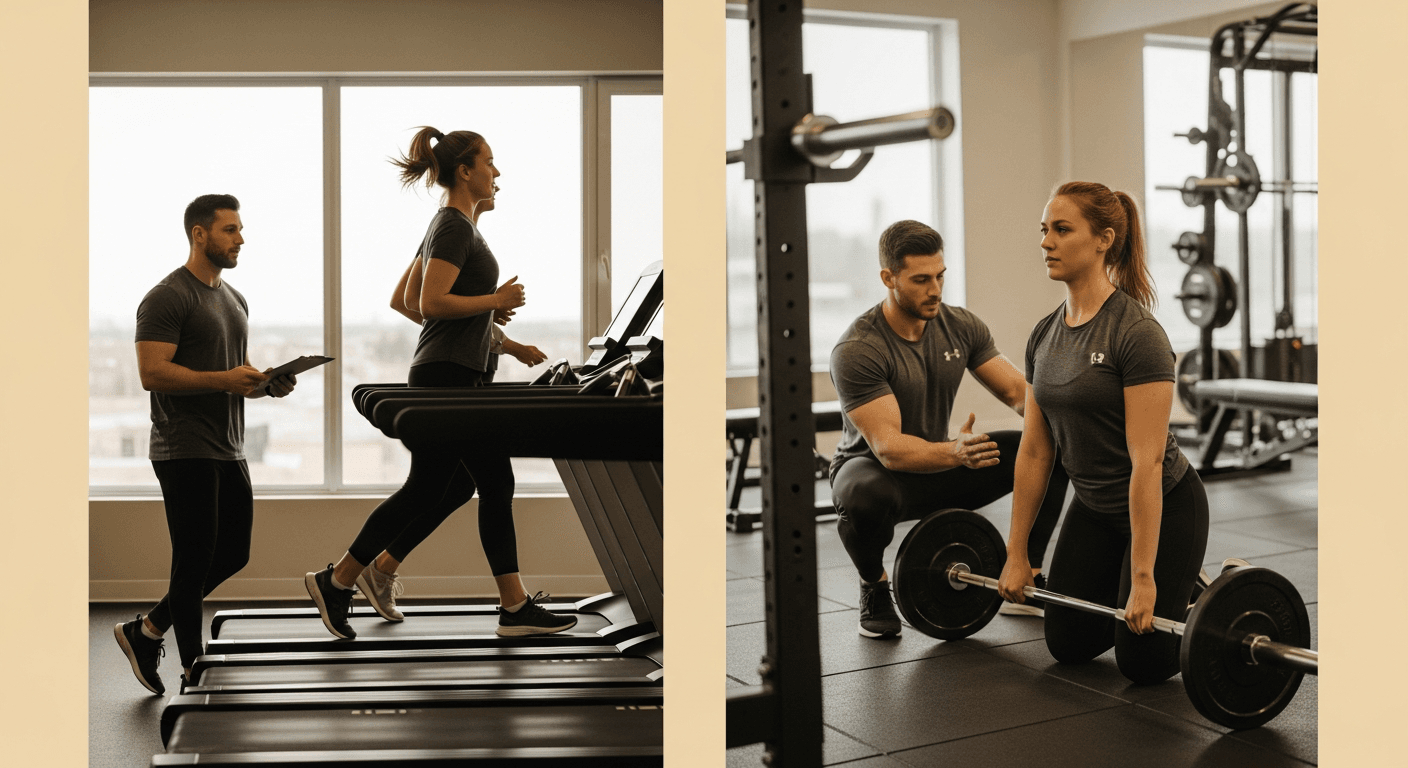
Most people choose a personal trainer based on proximity, price, or personality. Those are reasonable filters, but they miss the most important question: does this coach actually specialize in what you're trying to achieve? A trainer who builds competitive powerlifters and a trainer who helps clients lose 40 pounds operate with fundamentally different skill sets. Hiring the wrong one doesn't just slow your progress. It's one of the primary reasons people quit training within the first 90 days.
Here's how to read those differences clearly before you sign anything.
Fat Loss Coaching Is a Behavioral Science, Not Just a Workout Plan
The fitness industry has spent decades selling fat loss as an exercise problem. It isn't. Research consistently shows that nutrition accounts for the majority of body composition change, and adherence to that nutrition is the real limiting factor, not the specific protocol. A qualified fat loss coach understands this and structures their service accordingly.
What that looks like in practice: weekly or biweekly check-ins focused on eating patterns, not just training logs. Caloric accountability systems, whether that's food journaling, photo tracking, or structured meal planning. Honest conversations about stress, sleep, and lifestyle habits that directly influence hunger hormones like ghrelin and cortisol. These aren't soft add-ons. They're the core product.
A fat loss specialist should also understand protein targets well enough to guide you through them. The latest evidence, including the updated framework covered in Protein: Why the New 2025-2030 Guidelines Target 1.2 to 1.6 g/kg, positions protein intake as a central lever for preserving lean mass during a caloric deficit. A coach who can't speak to this in concrete terms isn't fully equipped for fat loss work.
Red flags to watch for in a so-called fat loss coach:
- They send you a generic workout plan with no nutritional guidance at all
- They focus exclusively on cardio without addressing diet structure
- Check-ins are rare or purely performance-based, with no behavioral component
- They can't explain how they'd adjust your plan if you stall for three consecutive weeks
Fat loss coaching at the premium end of the US market typically runs $300 to $700 per month for online coaching, with in-person specialists in major metros charging $100 to $200 per session. If a coach at that price point can't articulate a behavior change strategy, that's a mismatch.
Strength Coaching Requires a Completely Different Technical Foundation
Strength-focused training is built on three pillars: progressive overload, periodization, and technique precision. A strength coach who's serious about their craft will track your numbers session by session, design training blocks that peak your capacity over months, and spend significant time coaching movement quality under load. These are teachable skills, but they take years to develop and require specific practical experience.
Progressive overload means systematically increasing the demand placed on your muscles over time, whether through added weight, more volume, reduced rest, or improved range of motion. Periodization is the art of organizing those demands into phases so your body peaks at the right time without burning out. Neither concept is complicated to explain, but applying them well to an individual with specific weaknesses, asymmetries, and scheduling constraints requires a real skill set.
Technique feedback is where many generalist trainers fall short. A squat correction for someone with limited ankle mobility looks completely different from one for someone with hip impingement. A strength coach should be able to diagnose those patterns by watching a few reps, not just cueing the same generic fix everyone gets.
When evaluating a strength coach, ask these questions directly:
- What does your periodization model look like for a new client over the first 12 weeks?
- How do you track progress beyond the scale?
- What certifications or continuing education have you completed specifically in strength and conditioning?
- Can you show me examples of how you've adjusted programming when a client plateaued?
Credentials worth looking for include NSCA-CSCS (Certified Strength and Conditioning Specialist), USAW (USA Weightlifting), or StrongFirst certifications. A general personal training cert, while useful, doesn't signal the same depth of strength-specific training.
Injury Recovery Changes Everything. Don't Skip This Step.
If you're coming back from a herniated disc, a torn rotator cuff, or chronic knee pain, neither a fat loss specialist nor a strength coach is your first call. You need someone with corrective exercise or rehabilitation credentials, and that's a non-negotiable distinction.
Corrective exercise specialists are trained to assess movement dysfunction and build programming around it. They understand how compensation patterns develop, how to reduce pain provocation during training, and when a client needs to be referred back to a physical therapist rather than pushed harder. Training through unaddressed dysfunction is one of the fastest ways to turn a minor issue into a serious one.
Look for credentials such as NASM-CES (Corrective Exercise Specialist), FRC (Functional Range Conditioning), or a background that includes direct collaboration with physical therapy or sports medicine teams. Some coaches hold both a strength certification and a corrective exercise credential, which is ideal if you're in recovery but also want to build toward performance goals.
The mistake most injured clients make is hiring a general trainer who claims they "work with injuries." That's not the same as being trained to manage them. Ask specifically how they assess movement, what tools they use, and what their referral policy looks like when something is beyond their scope.
Why Mismatched Coaching Kills Motivation Within 90 Days
The 90-day dropout window is well-documented in the fitness industry. A significant portion of new clients disengage within three months, and coach-to-goal mismatch is consistently cited as a primary driver. When your trainer is programming for performance while you're desperately trying to lose body fat, the disconnect becomes demoralizing fast.
You're doing everything you're told. The scale isn't moving. Your coach is proud of your deadlift numbers. Those are different conversations, and if nobody's bridging them, you start to feel like training isn't working for you. That's when people quit, and they often blame themselves rather than the structural mismatch that caused the problem.
This dynamic also shows up in tracking systems. A fat loss coach should be monitoring your body weight trends, circumference measurements, dietary compliance, and energy levels. A strength coach should be tracking your lifts, volume load, and recovery quality. If your coach is only doing one and you need the other, the data that matters most to your goal is invisible to both of you.
Understanding the coaching industry from the inside can also help you ask smarter questions as a client. The landscape has shifted considerably, as outlined in 80% of Coaches Say Client Acquisition Is Harder in 2026: What Actually Works Now. Coaches who are specializing and building genuine expertise in one area are the ones who are growing. Generalists are competing on price, not outcomes.
How to Actually Vet a Trainer Before You Commit
Before signing a contract or paying a deposit, treat the initial consultation as an interview, not a sales pitch. You're evaluating whether this person's background, methods, and tracking systems align with your specific goal.
Start by stating your primary goal explicitly and asking how their coaching model addresses it. A fat loss coach should immediately talk about nutrition strategy, behavioral check-ins, and how they handle plateaus. A strength coach should ask about your training history, current movement quality, and what lifts or benchmarks you're working toward. If their answer is vague or sounds identical to what they'd say to any client, that's a signal.
Ask to see a sample training week. Ask what their check-in system looks like. Ask what happens if you're not progressing after six weeks. These aren't aggressive questions. They're the minimum standard for a service that costs hundreds of dollars per month and directly affects your health.
Also consider whether your goals have a recovery or wellness layer that needs to be addressed alongside training. Managing sleep quality, stress load, and recovery properly can meaningfully affect both fat loss and strength outcomes. Resources like How to Build a Real Recovery Routine in 2026 provide a useful baseline for understanding what a complete approach actually looks like, and they give you better language for the conversations you should be having with any coach you're considering.
The Right Coach Is a Specialist First
Generalist trainers can absolutely produce results, especially for beginners who need foundational movement education and basic habit building. But as your goals become more specific, or as your situation becomes more complex, specialization matters more. A coach who's spent five years working exclusively with fat loss clients has seen patterns you'll never encounter in a general practice. The same is true for strength coaches and corrective exercise specialists.
Your goal is specific. Your training history is specific. Your body is specific. The coach you hire should be specific too. Don't settle for someone who checks the proximity and price boxes but can't demonstrate real expertise in the outcome you're actually chasing.