
Most people hire a personal trainer the same way they pick a sandwich from a meal deal. They grab whoever's available in the place they already are. If you belong to a large health club, you sign up with the trainer at the front desk. If a boutique studio opens near your office, you book a session because it looked clean on Instagram. Neither approach is wrong, but it leaves out the most important variable: the setting itself shapes the coaching you receive, sometimes more than the trainer's credentials do.
Before you commit to a trainer. and before you assume the gym you already pay for is automatically the right place to train. it's worth understanding what each environment actually delivers and where each one structurally fails.
What a Private Studio Actually Gives You
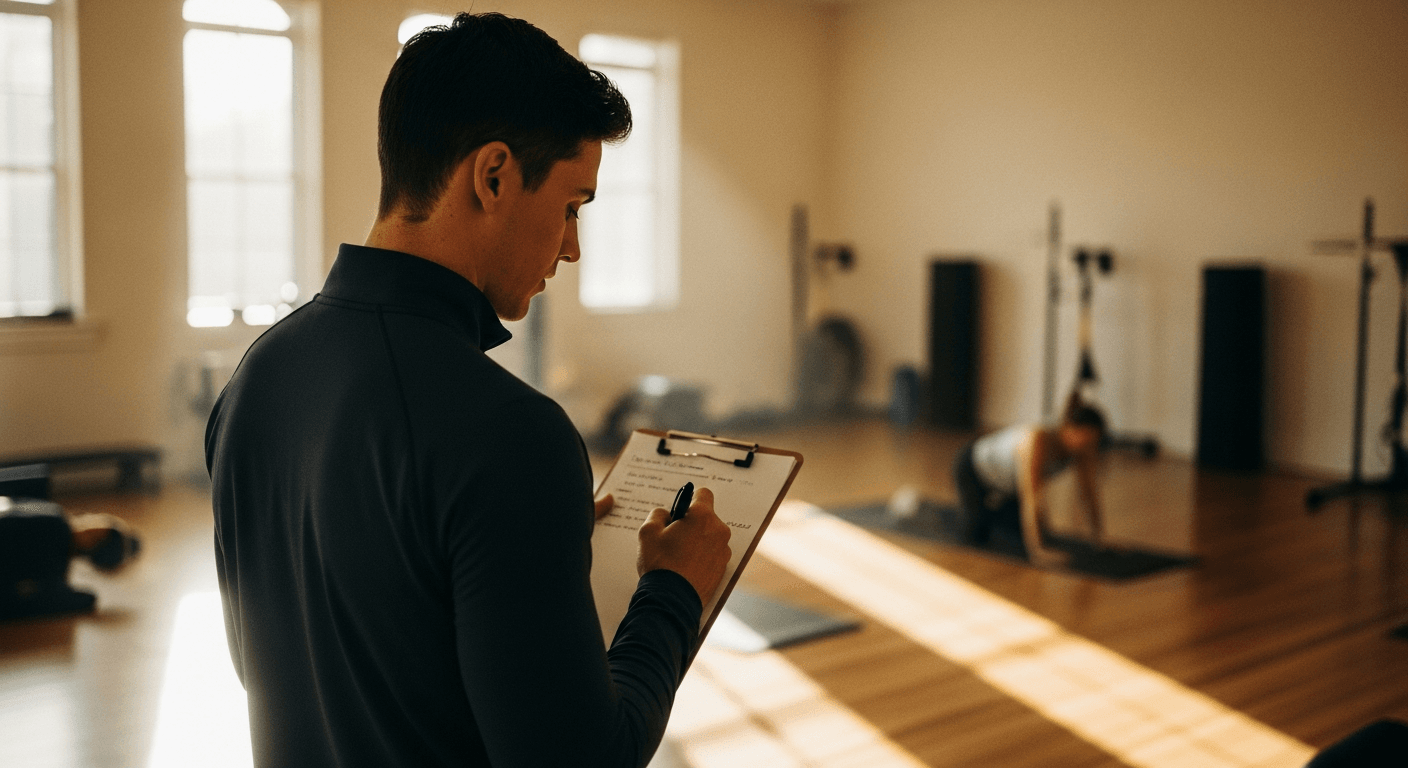
A private training studio is, by design, a controlled environment. You're not competing with thirty other members for a squat rack. The coach isn't watching three clients at once while simultaneously hoping the cable machine opens up. That structural simplicity changes the quality of what's possible in a session.
In a well-run private studio, the trainer controls the equipment layout, the timing of each exercise, and the level of distraction. That matters more than it sounds. Research on skill acquisition consistently shows that focused, low-noise practice environments accelerate technique learning. When you're a beginner trying to understand what a hip hinge actually feels like, a quiet room with a coach who can stop you mid-rep and correct your spine position is worth far more than the same instruction shouted across a busy gym floor on a Tuesday evening.
Private studios also tend to attract trainers who have chosen one-on-one coaching as their primary profession rather than a revenue stream attached to a facility job. That self-selection matters. The trainer running an independent studio has typically built their business on client results and retention. Their income depends on whether you come back, not on whether they hit a monthly session quota.
The tradeoff is cost. Private studio sessions in most US cities currently run between $90 and $180 per hour, with some high-end facilities in New York or Los Angeles reaching $250 or more. If budget is a hard constraint, a studio arrangement that stretches your finances thin will break down before the training produces meaningful results.
The Structural Problems Inside Health Club Training
Large commercial gyms are not bad places to train. They offer variety, social energy, and access to equipment that most private studios can't afford to stock. But the personal training department inside a health club operates under a specific set of business pressures that directly affect what you receive as a client.
Most health club trainers are employees, and their employers set session quotas. A trainer carrying a full client load at a major chain may be running back-to-back sessions from early morning to mid-afternoon. In that context, program customization gets compressed. Templates get recycled. The energy and focus that a trainer brings to your 7 a.m. session may look different by 11 a.m., not because the trainer is lazy, but because the structure demands volume over depth.
There's also the upsell dynamic. Many large gyms require trainers to sell packages, upgrades, and nutrition add-ons as part of their role. That creates a tension between what's genuinely right for your program and what the trainer is incentivized to recommend. It's not always cynical. Plenty of health club trainers are excellent coaches who navigate that pressure professionally. But the incentive structure exists, and you should know it does.
The floor environment compounds these issues. On a busy gym floor, a trainer managing your session is also managing unpredictability: equipment taken, members walking through your exercise path, noise levels that make coaching cues hard to land. A 2022 analysis of distraction and coaching effectiveness found that environmental noise significantly reduced an athlete's ability to retain and apply verbal instruction in real time. The open gym floor is not a neutral coaching environment. It's a variable one.
Matching the Setting to Your Goal
The choice between a private studio and a health club trainer isn't about prestige. It's about alignment between what you need and what each setting can reliably deliver.
If you're a beginner focused on technique and accountability, a private studio is almost always the better investment. The early phase of building movement patterns, whether that's a deadlift, a squat, or overhead pressing mechanics, requires consistent, undistracted feedback. Mistakes reinforced in the first six months become deeply embedded habits. Paying a premium for an environment where a coach can actually see you, cue you precisely, and adjust your position in real time is not an indulgence. It's the more efficient path.
If your goal is sport-specific conditioning, the setting matters less and the trainer's expertise matters more. An athlete preparing for a competitive season needs a coach who understands energy system development, periodization, and recovery management. That work can happen in a well-equipped health club just as effectively as in a private studio, provided the trainer has the programming knowledge and the floor space to execute it. Pair that kind of conditioning work with attention to recovery. Post-workout recovery timing can meaningfully affect adaptation, regardless of where the training itself takes place.
If your primary need is motivation and community, a large health club may serve you better. The energy of a busy gym, familiar faces, group fitness options alongside your PT sessions. these elements support consistency for people who are energized by social environments rather than focused solitude. Consistency, after all, is the actual driver of long-term results. The perfect program executed 40% of the time loses to a good-enough program executed 90% of the time.
Questions to Ask Before You Commit
Whether you're walking into a private studio or sitting down with a health club trainer, the pre-commitment conversation is where you protect yourself. Here's what you should ask directly:
- How many clients do you train per day? More than six back-to-back sessions is a red flag for attention and energy management.
- Do you write individual programs or use a template system? Neither is automatically wrong, but you deserve an honest answer.
- How do you handle it when a session plan isn't working for a client? The answer reveals whether they're reactive coaches or just session operators.
- What does your cancellation policy look like? Punishing cancellation terms in a health club package can trap you with a trainer who isn't the right fit.
- Are there performance assessments built into the program? Regular reassessment is the difference between programming and guessing.
These questions apply whether you're paying $75 a session at a chain gym or $200 at a studio. The answers will tell you more than the setting alone.
The Real Cost Comparison
People often assume private studios are categorically more expensive. The reality is more nuanced. A health club personal trainer in the US typically charges between $60 and $100 per session, but many clubs require you to purchase packages of ten or more sessions upfront, meaning you're committing $600 to $1,000 before you know whether the relationship works. A private studio trainer charging $120 per session with a flexible booking structure may deliver better value over three months if you can course-correct early when something isn't right.
Budgeting for training also means budgeting for the surrounding habits that determine whether training sticks. Understanding what supplements are actually evidence-based helps you avoid spending money on products a trainer or gym retail shelf is pushing that your program doesn't require. Similarly, knowing whether you actually need electrolyte products during training can save you from a recurring cost that's more marketing than physiology.
The broader coaching industry is also evolving in ways that affect this decision. Coaching as a profession is growing significantly, which means the supply of qualified independent trainers operating outside large club structures is expanding. You have more options now than you did five years ago, and the private studio model is increasingly accessible in mid-sized cities, not just major metros.
The Setting Is a Variable, Not a Guarantee
A private studio doesn't automatically produce a great trainer. A health club doesn't automatically produce a compromised one. What the setting does is create structural conditions that make certain outcomes more or less likely. Your job as a client is to recognize those conditions and factor them into your decision rather than defaulting to whatever's most convenient.
The trainer who knows your name, adjusts your program when your sleep is poor, and communicates clearly about what you're doing and why. that trainer exists in both environments. But finding them is easier when you understand what each environment selects for and what it makes harder to deliver.
Choose the setting that matches your goal. Then choose the trainer who can perform within it.