
Walk into any commercial gym and you'll find rows of machines, cable attachments shaped like medieval weapons, and influencer-driven routines promising results in six weeks. Most experienced coaches have seen this circus before. And most of them, regardless of certification, specialty, or client base, keep returning to the same short list of movements. Not because they lack imagination, but because they've watched the alternatives fail too many times.
The exercises that consistently appear across elite coaching programs aren't flashy. They're squats, hinges, carries, vertical pulls, and horizontal pushes. They've been proven across decades of practice, injury data, and long-term athlete tracking. If you're training without a coach right now, understanding why these patterns dominate professional programming is one of the most useful things you can do for your own results.
Why Coaches Prioritize Joint Integrity Over Impressive Movements
The fitness industry has a novelty problem. New exercises, new equipment, and new training systems generate engagement and revenue. But experienced coaches evaluate exercises differently. Their first question isn't "will this challenge my client?" It's "will this expose my client to unnecessary injury risk?"
Joint integrity sits at the center of that evaluation. Movements that place excessive shear force on the knee, load the spine in a compromised position, or demand shoulder mobility that most adults don't have are deprioritized regardless of their theoretical benefits. A pulled hamstring or a tweaked lower back doesn't just hurt. It removes weeks of training and often creates compensatory movement patterns that become their own problems.
Research consistently supports this conservative approach. Injury rates in resistance training are significantly lower when programming is built around compound movements performed through natural joint ranges, compared to programs heavy on machine-based isolation work performed at extreme end ranges. The best coaches know this and build programs accordingly.
The Five Movement Patterns That Build Everything Else
If you strip away the noise, nearly every coach working with general population clients organizes programming around five foundational patterns. These aren't exercises. They're categories. Within each category, there are dozens of variations suited to different ability levels, equipment availability, and individual anatomy.
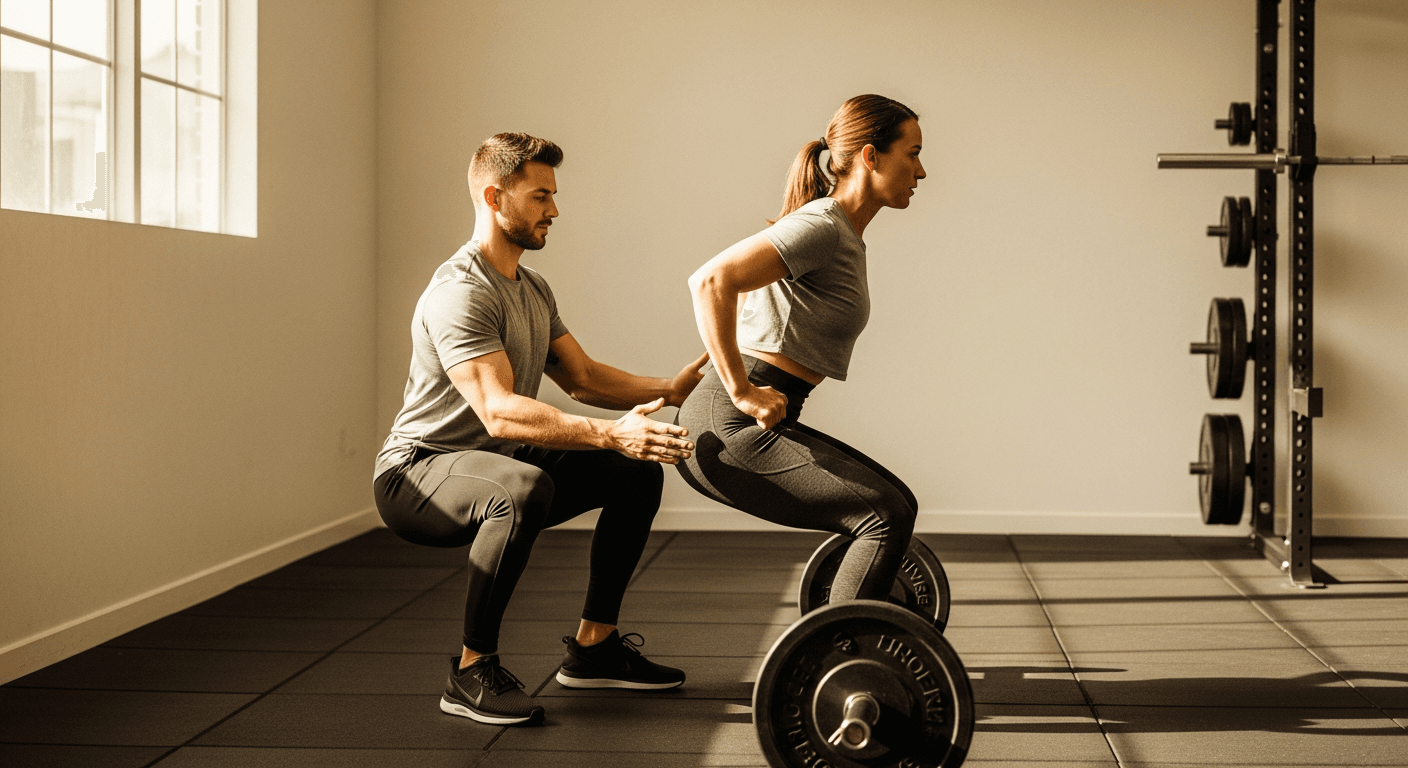
- Squat patterns: Goblet squats, box squats, front squats, and eventually back squats. These build quad strength, develop hip mobility, and train the body to manage load in a vertical position. Every lower-body goal, from athletic performance to everyday function, becomes easier once squat mechanics are solid.
- Hip hinge patterns: Romanian deadlifts, trap bar deadlifts, kettlebell swings, and conventional deadlifts. The hip hinge is arguably the most undertrained pattern in recreational fitness. It develops posterior chain strength, protects the lower back when learned correctly, and transfers directly to real-world movement.
- Carry patterns: Farmer's carries, suitcase carries, overhead carries. These are the most underrated category in general fitness. Carries build grip strength, train core stability under load, and develop the kind of full-body tension that no machine can replicate. Coaches who work with older adults are often evangelical about carries because the functional carryover to daily life is so direct.
- Vertical pull patterns: Lat pulldowns, assisted pull-ups, and eventually strict pull-ups. Vertical pulling builds the upper back and rear shoulder muscles that most desk workers desperately need. Strong vertical pulls also create the postural balance that reduces neck and shoulder pain over time.
- Horizontal push patterns: Push-ups, dumbbell bench press, and incline variations. These build pressing strength while keeping shoulder mechanics in a safer position than many overhead movements, particularly for clients who haven't yet developed the thoracic mobility that overhead pressing demands.
A program that includes at least one session per week touching each of these five categories is covering more ground than most trending routines. It's not complicated. It's just disciplined.
The Real Cost of Skipping the Basics
Many clients come to coaches after months or years of training that produced modest results at best. The pattern is familiar. They started with a machine-based routine, added isolation exercises they found online, followed a few trending programs, and made some early progress before plateauing. When a coach finally audits their movement quality, the gaps are obvious. They can't hinge without rounding their lower back. Their single-leg stability is almost nonexistent. Their thoracic spine is so stiff that any overhead work becomes a compensation chain.
Those gaps don't just limit performance. They quietly accumulate injury risk. The body is exceptionally good at masking weak links through compensation, right up until it can't. That moment usually arrives as a sudden "freak" injury doing something ordinary, which turns out to be the predictable end point of a long-developing dysfunction.
Rebuilding from basics costs time that could have been spent progressing, which is why coaches who specialize in long-term athlete development place such heavy emphasis on getting the foundation right from the start. The data from the professional coaching sector reflects this shift in thinking. With the health coaching market projected to add $10 billion in revenue by 2030, the fastest-growing segment isn't short-term transformation programs. It's long-term performance and injury prevention coaching, where foundational movement quality is the core product.
How Good Coaches Actually Evaluate Movement Before Programming Anything
Before a seasoned coach writes a single set or rep scheme, they watch you move. Not just the exercises you think you're good at. They want to see a bodyweight squat, a toe touch, a single-leg stance, and usually a simple hinge. What they're looking for isn't perfection. They're identifying which patterns are already functional, which ones need reinforcement, and which ones require corrective work before any load gets added.
This assessment phase is where the real coaching happens. Anyone can write a program. Identifying the specific movement deficits that will limit your progress and designing around them is what separates a $150-per-session specialist from a generic template. Certified trainers with recognized credentials earn measurably more in part because this diagnostic skill takes years to develop and clients who've experienced it understand its value immediately.
Complexity gets layered on only after the foundation is confirmed. A client who can't perform a solid Romanian deadlift doesn't need a single-leg version. A client whose push-up form breaks down after five reps doesn't need a loaded bench press. This sequencing isn't timid coaching. It's smart coaching. It's how you build clients who can train hard for decades without accumulating a list of chronic injuries.
The Nutrition Layer That Coaches Increasingly Address
Foundational training doesn't happen in isolation. The coaches who produce the most consistent long-term results in their clients are also paying attention to recovery, sleep quality, and nutrition. These aren't soft add-ons. They're the variables that determine whether foundational training actually builds the tissue it's supposed to.
Protein timing, micronutrient density, and recovery nutrition are increasingly central to how coaches build comprehensive programs. The professional side of this conversation is evolving fast. Elite athletes hiring nutrition-trained support staff represents one end of that spectrum, but the principles that drive performance at that level are the same ones that help everyday clients recover from compound training and show up ready to progress the following week.
It's also worth noting that while the supplement industry continues to promise shortcuts, the evidence base for most products remains thin. Coaches who've been in the field long enough have watched clients spend significant money on products that deliver far less than claimed, while underinvesting in basics like sleep and protein intake. The science on fat-burning supplements remains notably weak even as marketing budgets grow. The foundational principle holds in nutrition just as it does in training. Simple and consistent beats complex and inconsistent every time.
How to Audit Your Own Program Right Now
If you're training without a coach, you can apply a simple self-audit. Look at your current weekly program and ask five questions.
- Does your program include at least one squat pattern per week?
- Does it include at least one hip hinge pattern?
- Does it include at least one horizontal push?
- Does it include at least one vertical pull?
- Does it include at least one loaded carry?
If you answered no to any of these, you have a gap. That gap isn't necessarily causing problems right now, but it's limiting your potential and likely creating an imbalance that will surface eventually. The correction doesn't require overhauling your entire program. It requires adding one movement per missing pattern and giving those movements the same priority you give your preferred exercises.
Recovery quality matters here too. Training that builds real strength demands that your nervous system and connective tissue can actually repair between sessions. Factors like sleep consistency, which research increasingly links to better hormonal regulation and tissue recovery, directly affect how much you get from foundational training. Consistent sleep timing has a measurable impact on recovery outcomes that most self-coached athletes completely overlook.
The Simplest Proof That Foundational Training Works
The strongest argument for foundational movement isn't theoretical. It's the clients who stuck with basics for 12 to 18 months and then found that every other fitness goal they wanted to pursue became dramatically more accessible. Athletes who can squat well learn sport-specific movements faster. People who've built real posterior chain strength through hinging rarely experience the chronic lower back pain that sidelines their peers. Clients who've mastered carries show up to recreational sports and active vacations and realize they're more capable than they expected.
That's the actual outcome experienced coaches are engineering when they insist on basics. Not limitation. Capacity. The complexity and variety can come later, built on a foundation that makes it worth having.