
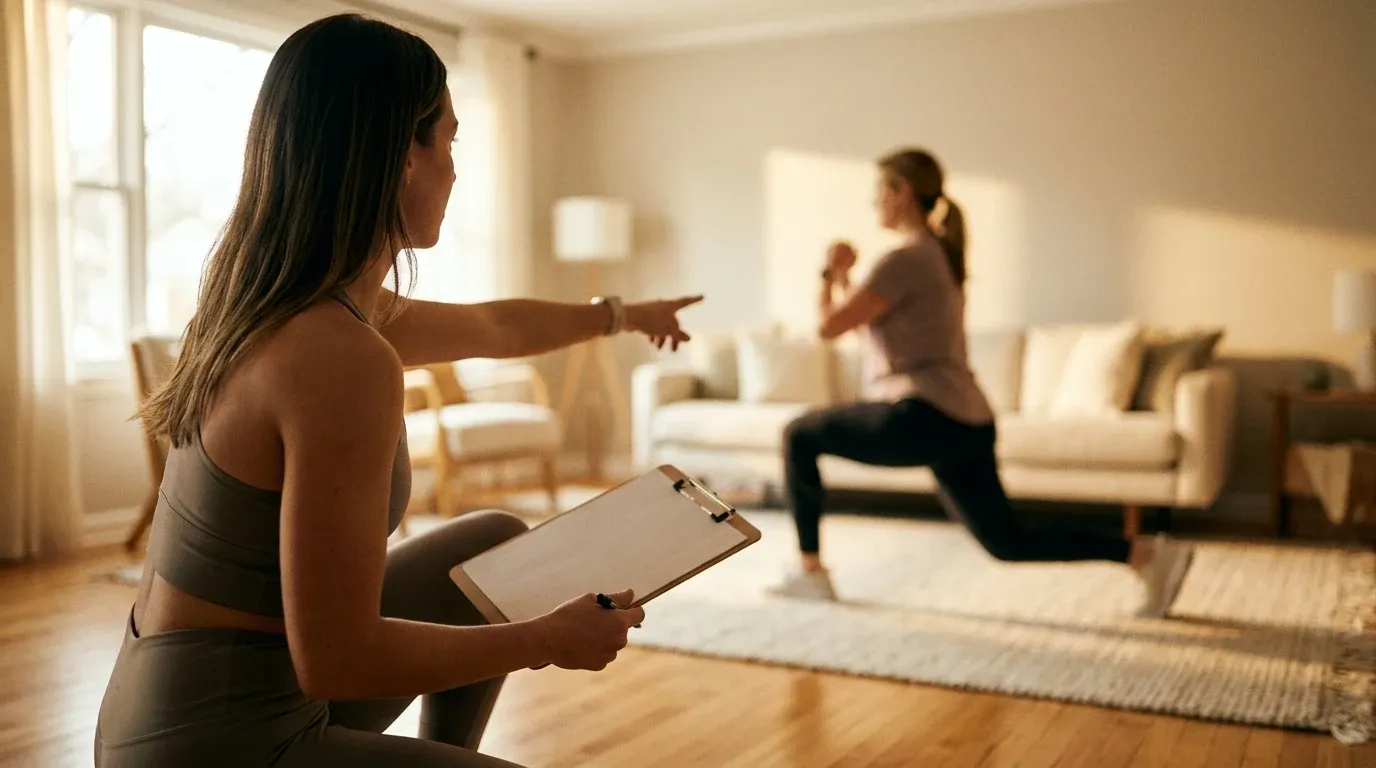
In-home personal training has been growing steadily since 2020, and the reasons aren't hard to understand. Gyms closed, habits shifted, and a significant share of people discovered that working out at home wasn't a compromise. For many, it was an upgrade. But most coverage of this format treats it like a convenience hack, something you do when the gym feels like too much effort. That framing undersells what it can actually deliver.
Done right, in-home training is a legitimate performance format with a specific set of strengths and real tradeoffs. Here's what you need to know before booking a trainer or building a client base around it.
Why the Commute Problem Is Bigger Than It Looks
Commute friction is consistently ranked among the top three reasons people cancel gym memberships, alongside cost and scheduling conflicts. It's not laziness. A round trip to the gym, including changing, travel, and the session itself, can easily consume two hours. For someone working long hours or managing family responsibilities, that's often the deciding factor.
In-home training eliminates that variable entirely. Your session starts when the trainer arrives. You don't lose 20 minutes to traffic or spend 10 minutes waiting for a squat rack to open up. That recovered time has a measurable effect on long-term adherence, which is ultimately the metric that matters most in any fitness program.
This is especially relevant for people with irregular schedules, mobility limitations, or young children at home who can't simply leave the house for an hour and a half. For these populations, in-home training isn't a convenience play. It's often the only format that's actually sustainable over months and years.
Vetting a Trainer Who Comes Into Your Home
Hiring a personal trainer for the gym involves some due diligence. Hiring one who comes to your home requires more. The standards are higher because the stakes are different. You're inviting someone into a private space, and that calls for a specific checklist before you commit.
Liability insurance. This is non-negotiable. A qualified in-home trainer should carry professional liability insurance (also called errors and omissions insurance) and, ideally, general liability coverage. If a client is injured during a session and the trainer isn't insured, the legal exposure can fall on both parties. Ask to see proof of coverage before the first session.
Verifiable certifications. Look for credentials from recognized bodies: NASM, ACE, CSCS, or equivalent. An in-home setting doesn't change the baseline qualification requirements. If anything, working without the safety infrastructure of a gym, no staff, no AED on the wall, no built-in spotter, means you want someone whose judgment under pressure is solid.
References and reviews. Ask for two or three client references you can actually contact. Online reviews help, but a five-minute phone call with a current or former client tells you more. Ask specifically how the trainer handles session structure, communication, and cancellations.
A clear cancellation policy. This matters more in the in-home format than it does at a gym. Travel time means a last-minute cancellation costs the trainer significantly more than it would in a studio setting. Both parties need written terms before sessions begin: how much notice is required, what the late cancellation fee is, and how rescheduling works.
Understanding how the relationship is structured from the start is what separates functional coaching arrangements from ones that fall apart in month two. The dynamics of a strong working partnership are covered in detail in What Makes a Trainer-Client Partnership Actually Work.
What Equipment You Actually Need
The biggest misconception about in-home training is that it requires a fully equipped home gym to be effective. It doesn't. A well-designed program can cover roughly 80 percent of training needs with three pieces of equipment.
- A resistance band set. Bands are versatile, inexpensive, and underestimated. They allow for variable resistance across a range of motion, which is useful for both strength work and rehabilitation. A set covering light to heavy resistance runs $20 to $50 and stores in a drawer.
- Adjustable dumbbells. A single pair of adjustable dumbbells can replace a full rack. Quality sets from brands like Bowflex or PowerBlock typically run $200 to $400 and allow you to train everything from light accessory work to heavier compound lifts.
- An exercise mat. Floor-based work, core training, mobility, stretching, and bodyweight progressions all require a non-slip surface. A decent mat costs $30 to $80 and lasts for years.
A trainer who knows how to program creatively can build effective progressive overload cycles using this setup. The limitation isn't the equipment. It's whether the coach has the programming depth to make it work without defaulting to endless variations of the same five exercises.
For clients managing conditions like joint pain or recovering from injury, this minimal-equipment approach pairs naturally with lower-intensity protocols. Research on moderate and gentle exercise has shifted considerably in recent years, and the evidence on gentle exercise's effectiveness is worth understanding before dismissing lighter sessions as insufficient.
When In-Home Training Outperforms a Gym
In-home training isn't the right format for every client. If your goals involve maximal strength, powerlifting, or Olympic lifting, you need equipment that simply isn't practical in a home setting. But there are specific contexts where in-home training consistently outperforms gym-based work.
Irregular schedules. Shift workers, frequent travelers, and people whose weeks don't follow a predictable pattern often find gym memberships don't justify the cost. In-home sessions can flex around unusual hours without depending on gym operating times.
Mobility limitations and injury recovery. A private setting removes the self-consciousness that can accompany rehabilitation work in a public gym. A trainer can build sessions specifically around what a client can do at that moment, without worrying about equipment availability or noise level.
Parents of young children. The logistics of leaving the house for a workout with a toddler or infant at home can make consistency nearly impossible. In-home training solves the childcare equation without requiring a gym with daycare facilities.
Older adults prioritizing functional fitness. For clients focused on strength maintenance, balance, and fall prevention rather than performance metrics, the home environment is often more relevant to their actual daily movement patterns. Research into how muscles change with age increasingly supports building training programs around real-world functional demands, a topic explored in depth in why aging muscles lose strength and what the latest neuromuscular research found.
Pricing: What Trainers Should Charge and What Clients Should Expect
In-home sessions should cost more than gym-based sessions, and that's not a premium without justification. Travel time, fuel or transit costs, the effort of transporting any equipment, and the reduced ability to serve back-to-back clients all affect a trainer's net income per session. Pricing in-home work 15 to 25 percent above standard gym-based rates is the industry norm in the US market, and it reflects real overhead rather than arbitrary markup.
In practical terms: if a trainer charges $80 per session at a gym, an in-home rate of $95 to $100 per session is reasonable. In higher cost-of-living markets like New York or Los Angeles, in-home rates of $120 to $200 per session are not uncommon, depending on the trainer's credentials and specialization.
For trainers building an in-home client base, geographic clustering matters. Booking sessions in the same neighborhood on the same day reduces travel overhead significantly and makes the per-session economics work. Scattered bookings across a city will erode your effective hourly rate faster than most new trainers anticipate.
Clients should also factor in session packages rather than per-session bookings. Most in-home trainers offer packages of 8, 12, or 20 sessions with a modest discount, which also signals a commitment to the process on both sides.
Making It Work Long-Term
The format sets up the conditions for success, but it doesn't guarantee it. Adherence over months still requires the same elements it does in any training context: a program that progresses logically, a client who sees and feels results, and a coach who communicates clearly between sessions.
Recovery is part of that equation. What happens between sessions determines how well the body adapts to training stress, and the first 24 hours after a session are particularly important. Understanding which recovery methods are most effective in that window can meaningfully affect how clients feel going into their next session, especially in a home training context where cool-down and recovery are entirely self-managed.
In-home training won't replace gyms, and it shouldn't try to. But framing it purely as a convenient alternative misses the point. For the right clients, with the right trainer and the right expectations, it's not a fallback option. It's the format that works.