
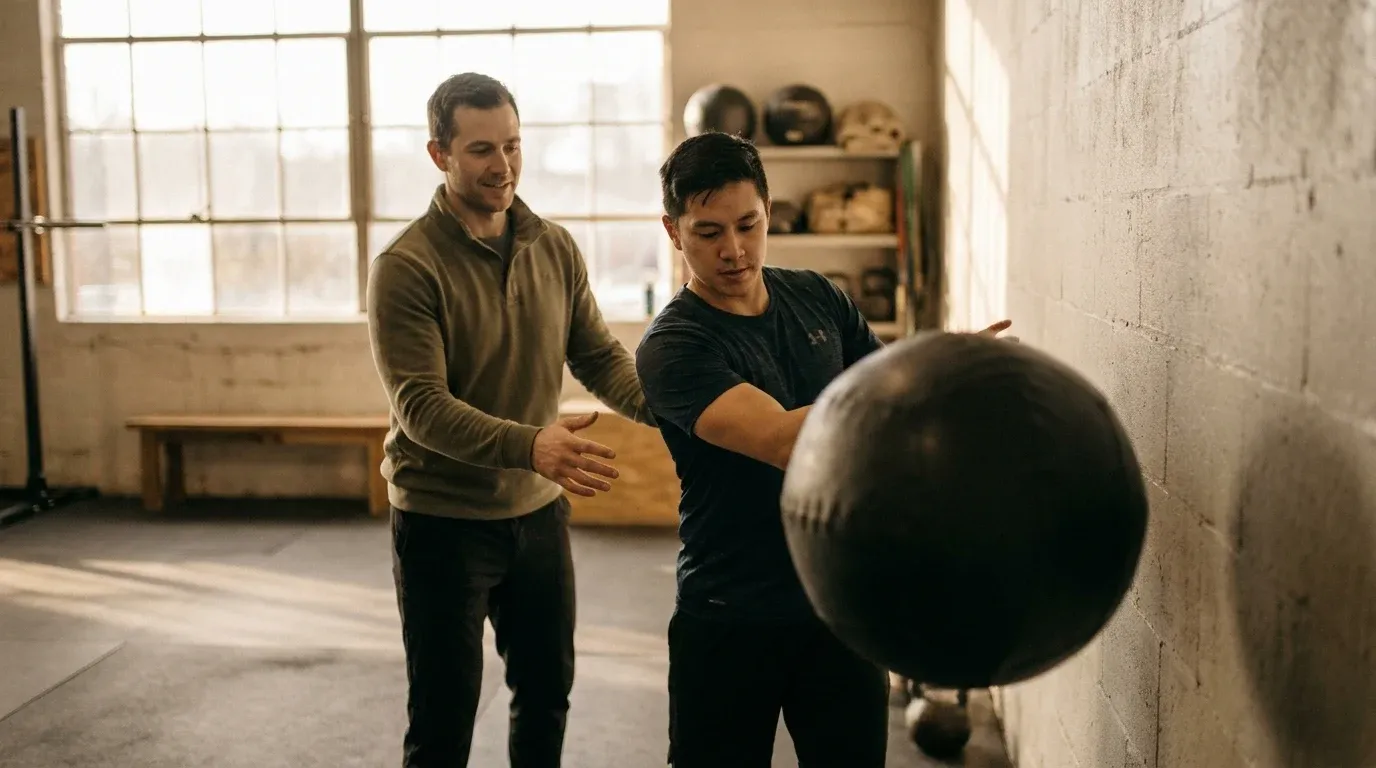
The medicine ball sits in the corner of most gyms, occasionally dusted off for a few sets of sit-and-throw. That's a missed opportunity. For coaches working with general population clients, the medicine ball is one of the most versatile and underused tools in a programming arsenal. It bridges strength and power in a way that barbells and cables simply can't replicate, and it does so at a fraction of the equipment cost.
This guide breaks down the science behind medicine ball training, lays out practical exercise progressions, and shows you how to integrate this tool across both personal training and small group formats without overcomplicating your sessions.
Why Medicine Ball Work Belongs in Your Program Design
Most general population clients train for health, function, and body composition. They're not competitive athletes, but that doesn't mean power development is off the table. In fact, explosive training has well-documented benefits for this population: improved neuromuscular coordination, greater caloric expenditure per unit of time, and meaningful carryover to everyday activities like lifting, throwing, and catching.
The medicine ball is uniquely suited here because it allows clients to express force at high velocity without the technical demands of Olympic lifting. A slam or rotational throw requires coaching, but it doesn't require years of practice before it becomes useful. That's a critical distinction when you're working with someone who has six months of training experience, not six years.
Traditional strength work builds the engine. Medicine ball training teaches clients how to use it. That relationship between force production and force expression is what coaches sometimes call the strength-power gap, and it's wider in general population clients than most coaches account for in their programming.
Core Activation: What the Research Actually Shows
One of the strongest arguments for medicine ball training is what it does to core musculature. EMG studies consistently show that rotational and overhead throwing patterns generate significantly higher activation in the obliques, transverse abdominis, and erector spinae than traditional exercises like crunches or planks.
A key reason for this is that the core must simultaneously generate force and resist unwanted movement. During a rotational chest pass against a wall, the obliques fire to produce rotation while the opposite side resists excessive counter-rotation. That co-contraction pattern is far closer to how the core actually functions in sport and daily life than any isolated ab exercise.
This also matters for injury resilience. A core trained through isolated exercises may be strong in one plane but underperforming in the rotational and anti-rotational demands clients face outside the gym. If you're not programming these patterns, you're leaving a significant training stimulus on the table.
It's worth noting that core training quality depends partly on how you structure the rest of the session. If you're rushing through loaded movements without attention to tempo and control, you're likely underloading the muscles that stabilize your clients during high-intensity work. The principles outlined in why the lowering phase matters for muscle growth apply here too. Controlled deceleration in medicine ball work, particularly on slams and overhead throws, adds meaningful eccentric stimulus that many coaches miss.
Exercise Progressions: Scaling Across Fitness Levels
The mistake coaches make with medicine ball training is jumping straight to partner throws and heavy slams with clients who haven't established movement competency. Here's a structured progression that works across fitness levels.
Level 1: Wall-Based Throws
Start every new client with wall throws. The wall provides immediate feedback, reduces the anxiety of coordinating with a partner, and allows you to adjust distance and ball weight easily. The two foundational patterns are:
- Chest pass to wall: Feet shoulder-width, slight knee bend, explosive push from chest. Catch and reset. Focus on full extension through the arms and controlled catch.
- Rotational side throw to wall: Stand perpendicular to the wall. Load into the hip away from the wall, rotate and release. This is where core activation starts to spike. Begin at 2-4 kg for most clients.
Program these at the start of a session before strength work, treating them as power primers rather than finishers. Three to four sets of five to eight reps per side is enough to get the neuromuscular system firing without accumulating fatigue.
Level 2: Slam Variations
Once clients demonstrate control in wall throws, introduce overhead slams. The bilateral overhead slam teaches full-body power expression from a stable base. Progress to alternating side slams, which add a rotational component and challenge lateral stability.
- Overhead slam: Raise the ball overhead with full hip extension, then slam down with maximal intent. The deceleration phase as you catch or retrieve the ball matters. Don't let clients collapse through the lower back on the descent.
- Rotational slam: Load into one hip, raise the ball diagonally, and slam across the body. This pattern trains the full kinetic chain through its natural diagonal firing sequence.
Use 4-6 kg for most general population clients at this stage. Heavier isn't always better. Velocity drops sharply with excessive load, and you lose the power training stimulus if the ball is too heavy to move explosively.
Level 3: Partner Drills
Partner work adds reaction time, unpredictability, and increased motivation. It also allows you to progress intensity without increasing ball weight, simply by reducing rest time or varying throw angles.
- Partner chest pass: Standing 2-3 meters apart. Increase distance to increase the demand for power output.
- Seated rotational pass: Both partners seated on the floor, back-to-back or side-by-side. Forces core rotation without lower body compensation.
- Drop and react slam: One partner drops the ball from shoulder height; the other catches and slams immediately. This introduces a reactive element that trains rate of force development more effectively than any self-initiated drill.
Programming Medicine Ball Work Into Real Sessions
The simplest integration strategy is to position medicine ball work as a power block at the start of a session, after a thorough warm-up but before heavy strength work. This sequencing aligns with the physiological principle of potentiation: high-velocity movement primes the neuromuscular system and can enhance subsequent strength performance.
A sample structure for a 60-minute personal training session might look like this:
- Warm-up with mobility and activation work: 8-10 minutes
- Medicine ball power block (2-3 exercises, 3-4 sets each): 12-15 minutes
- Main strength block: 25-30 minutes
- Accessory and core work: 10 minutes
For small group training formats, the medicine ball becomes even more valuable. A single set of balls in the $80-$150 range covers a full class of six to eight clients when you organize circuits around wall throws and slams. The per-client equipment cost drops to under $20, which is difficult to match with barbells or cable systems.
This format also scales well if you're managing session delivery through a digital platform. If you're evaluating tools to streamline programming and client communication, this breakdown of coaching platforms for 2026 covers the key factors worth considering.
Common Coaching Errors to Correct Early
Even straightforward medicine ball exercises break down when coaches don't address these patterns early:
- Using the arms instead of the whole body: Most clients default to arm-dominant throws. Cue hip rotation and ground contact before the hands release the ball.
- Passive receiving: Catching a medicine ball is not passive. The muscles decelerating the catch are under significant load. Teach clients to meet the ball actively, not absorb it passively into the joints.
- Breath holding through sets: Rotational throws require intra-abdominal pressure, but clients often hold their breath for entire sets. Cue exhale on release as a consistent breath pattern.
- Too heavy, too soon: A 6 kg ball that moves slowly is not a power exercise. It becomes a slow strength exercise. Keep loads low enough that the throw is fast and intent is maximal.
Pairing Medicine Ball Training With Recovery
High-velocity training, even at moderate volumes, creates meaningful neuromuscular demand. Recovery between sessions matters, particularly for older clients or those new to explosive work. Sleep quality, nutrition timing, and inflammation management all contribute to how quickly clients adapt.
If clients are asking about recovery support, evidence-based options are worth knowing. For example, the evidence on tart cherry for recovery suggests measurable reductions in muscle soreness and inflammatory markers, which may be relevant for clients doing two or more explosive sessions per week.
Recovery conversation is also an opportunity to flag habits that undermine adaptation. Some clients pre-train with high-caffeine energy drinks without understanding the cardiovascular load. The data covered in the link between energy drinks and cardiac event risk is worth having in your back pocket, particularly when working with clients who train at high intensity regularly.
The Case for Taking Medicine Balls Seriously
The medicine ball has never gone out of style in elite athletic development. It's the general population coaching space that underuses it. That's partly habit, partly unfamiliarity with progressions, and partly a tendency to reach for machines and cables when something simpler would produce better results.
Your clients don't need to throw heavy loads to benefit from power training. They need exposure to high-velocity movement patterns that develop the neuromuscular system in ways that slow, controlled strength work doesn't reach. The medicine ball delivers that stimulus with low technical risk, flexible programming, and genuine scalability across skill levels.
Start with the wall. Build the pattern. Progress with intention. The results will follow.