
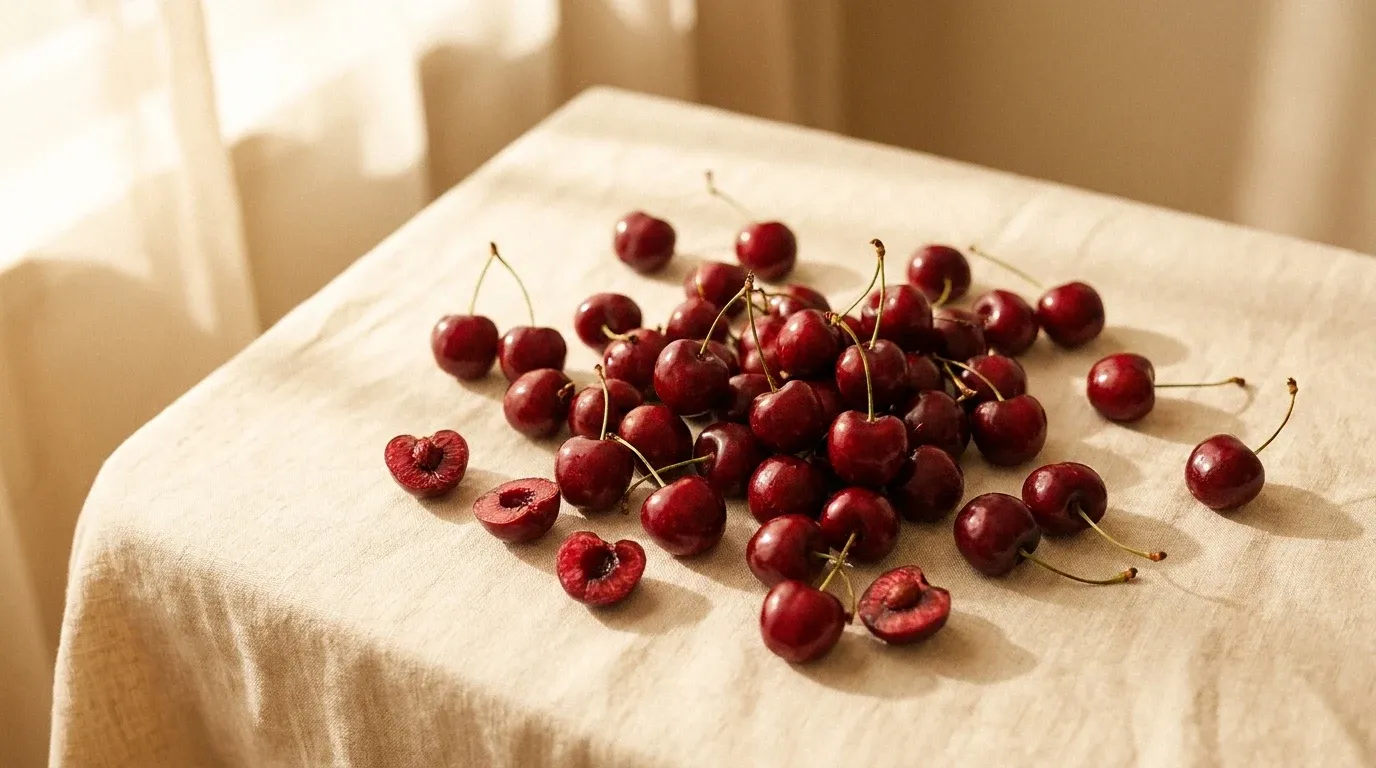
Crown Sport Nutrition's November 2026 launch of its Tart Cherry Complex has put a familiar ingredient back under the microscope. Tart cherry has been circulating in sports nutrition circles for over a decade, but it's often treated as a vague wellness add-on rather than a targeted recovery tool. That's worth correcting. The evidence is more specific, and more conditional, than most product marketing suggests.
What's Actually in Tart Cherry
Tart cherries, specifically the Montmorency variety, are unusually dense in two compounds that matter for recovery: anthocyanins and melatonin. Anthocyanins are polyphenolic pigments with well-documented antioxidant and anti-inflammatory properties. Melatonin, present in meaningful concentrations in tart cherry, has effects that extend beyond sleep regulation into oxidative stress modulation.
Together, these compounds work through several mechanisms: inhibiting pro-inflammatory enzymes (including COX-1 and COX-2, the same pathways targeted by ibuprofen), reducing markers like C-reactive protein and interleukin-6, and potentially blunting exercise-induced oxidative damage to muscle tissue. That's a credible biological story. The question is whether the clinical data matches it.
What the Research Actually Shows
The honest answer is: modest, real effects in specific contexts. Multiple randomized controlled trials show that tart cherry supplementation reduces self-reported muscle soreness and certain inflammatory biomarkers following intense exercise. A well-cited trial in marathon runners found that participants consuming tart cherry juice for five days before a race and two days after reported significantly less post-race muscle soreness and showed faster recovery of isometric strength compared to placebo.
Similar findings have emerged in studies on cycling, triathlon, and resistance exercise protocols. The effect sizes aren't dramatic. You're not looking at a compound that eliminates delayed onset muscle soreness. You're looking at reductions in peak soreness ratings of roughly 20 to 30 percent in the better-designed trials, alongside measurable but modest drops in inflammation markers.
That's genuinely useful if you're a competitive athlete doing repeated hard efforts over consecutive days. It's considerably less relevant if you're a recreational gym-goer training three times a week with standard rest periods between sessions.
Who Benefits Most (and Who Probably Doesn't)
The strongest evidence clusters around endurance athletes in repeated-bout scenarios: multi-stage cycling events, back-to-back race days, tournament formats, or heavy training blocks where recovery windows are compressed. In these contexts, even a modest reduction in inflammation and soreness can translate to better quality training in subsequent sessions.
The evidence for single-session recovery in casual or recreational exercisers is thinner. Studies in this population tend to show smaller effect sizes or fail to reach statistical significance. That's not surprising. Your body's natural recovery response handles moderate training load well on its own. Supplementation tends to show up more clearly when you're pushing beyond what normal recovery can fully absorb.
This distinction matters because most supplement marketing doesn't make it. If you're seeing tart cherry positioned as an everyday recovery essential for anyone who exercises, that's the kind of benefit-led framing that often outpaces the actual data. It's worth understanding how that framing works before you buy into it. Our piece on benefit-led supplement claims and what they actually mean for you is a useful reference point here.
Whole Food vs. Encapsulated Extract: Does Form Matter?
Crown Sport Nutrition's new product is a capsulated complex, which raises a reasonable question: does the delivery format change what you're getting?
Based on current bioavailability data, the answer is largely no. Studies comparing tart cherry juice, freeze-dried powder, and encapsulated extracts have not found meaningful differences in anthocyanin absorption or the downstream inflammatory response. What matters far more than format is the actual anthocyanin content per dose.
Tart cherry juice (typically a concentrate diluted to around 30ml twice daily) and dried tart cherries (around 45 to 60 grams per day in research protocols) deliver comparable outcomes to well-dosed capsule products when total anthocyanin intake is equivalent. If you prefer whole food sources for cost or convenience reasons, the evidence doesn't penalize you for that choice.
That said, capsulated products do offer dosing precision and portability, which matters for athletes traveling or in-competition. The tradeoff is price and the risk of underdosing, which is a real issue in this category.
The Dosing Problem Nobody Talks About
This is where a lot of tart cherry products quietly fall apart. The most studied and replicated protocols use approximately 480mg of anthocyanins per day, or roughly 30ml of a high-quality Montmorency concentrate taken twice daily. That's a specific, meaningful threshold that the research has consistently worked around.
Many mainstream products, including some well-marketed capsule supplements, don't disclose anthocyanin content at all. They list tart cherry extract by weight without specifying polyphenol concentration. A 500mg capsule of a low-standardized extract might deliver a fraction of the anthocyanins in a properly formulated dose. Without that transparency, you have no way of knowing whether you're taking a research-relevant amount or an effectively decorative one.
When evaluating Crown Sport Nutrition's Tart Cherry Complex or any comparable product, the first question to ask is: what's the anthocyanin yield per serving? If that number isn't on the label or the product page, that's a signal worth taking seriously.
This same principle applies across the supplement stack. When compounds are combined, the interaction between doses becomes even harder to track. For a broader look at how stacked formulas handle this transparency problem, the breakdown of creatine, HMB, and electrolyte all-in-one stacks covers the same terrain in a different context.
The Sleep Angle You Might Be Overlooking
One underreported aspect of tart cherry's recovery profile is its melatonin content and the downstream effect on sleep quality. Several trials have found that tart cherry supplementation increases both total sleep time and sleep efficiency, with one study reporting an average gain of around 34 minutes of sleep per night compared to placebo.
For athletes, this matters because sleep is arguably the most potent recovery stimulus available. If tart cherry improves sleep architecture even modestly, that benefit compounds alongside its direct anti-inflammatory effects. The two mechanisms aren't independent. Better sleep drives better hormonal recovery, better muscle protein synthesis rates, and improved pain perception thresholds.
If you're already addressing sleep as part of your recovery strategy, tart cherry fits coherently into that picture. If you're not, that's the higher-leverage place to start. Behavioral approaches to sleep, particularly CBT-I as an evidence-based alternative to sleep medication, tend to produce larger and more durable improvements than any supplement currently on the market.
How It Fits Into a Broader Recovery Stack
Tart cherry works best when it's doing a specific job, not when it's the whole plan. Athletes who are already dialing in protein timing, sleep, hydration, and training load management will see more benefit from adding tart cherry than those who haven't addressed those fundamentals first.
It's also worth being clear about what tart cherry doesn't do. It's not a substitute for structured recovery. It doesn't replicate the adaptation-signaling effects of compounds like creatine, which has its own distinct and well-established evidence base. If you're weighing which supplements actually earn their place in a performance nutrition plan, understanding the mechanistic differences between anti-inflammatory compounds and performance-enhancing ones matters. The research on creatine's cognitive effects alongside its physical performance benefits illustrates how differently these two categories of compounds operate.
Non-supplement recovery inputs also deserve a mention here. The evidence supporting low-intensity movement, structured sleep, and simply reducing unnecessary sedentary time between sessions is at least as strong as the evidence for tart cherry. Everyday movement accumulates real recovery and health benefits that isolated supplements can't replicate.
The Bottom Line
Tart cherry isn't hype, but it's not universal either. The evidence supports its use for endurance athletes in high-volume training blocks or multi-day competition formats, particularly when dosed at or near the 480mg anthocyanin threshold studied in clinical trials. The sleep quality data adds a secondary benefit that's plausible and consistent across studies.
For recreational exercisers doing moderate training, the case is weaker. And for anyone buying a tart cherry product without knowing its anthocyanin content per serving, the case for spending money on it is weaker still.
Crown Sport Nutrition's launch is a good prompt to revisit this ingredient with clear eyes. If the product's formulation holds up to scrutiny on dose transparency, it could represent a well-designed entry in a category that's historically been cluttered with underpowered products. But the burden of proof sits with the label, not the marketing copy.