
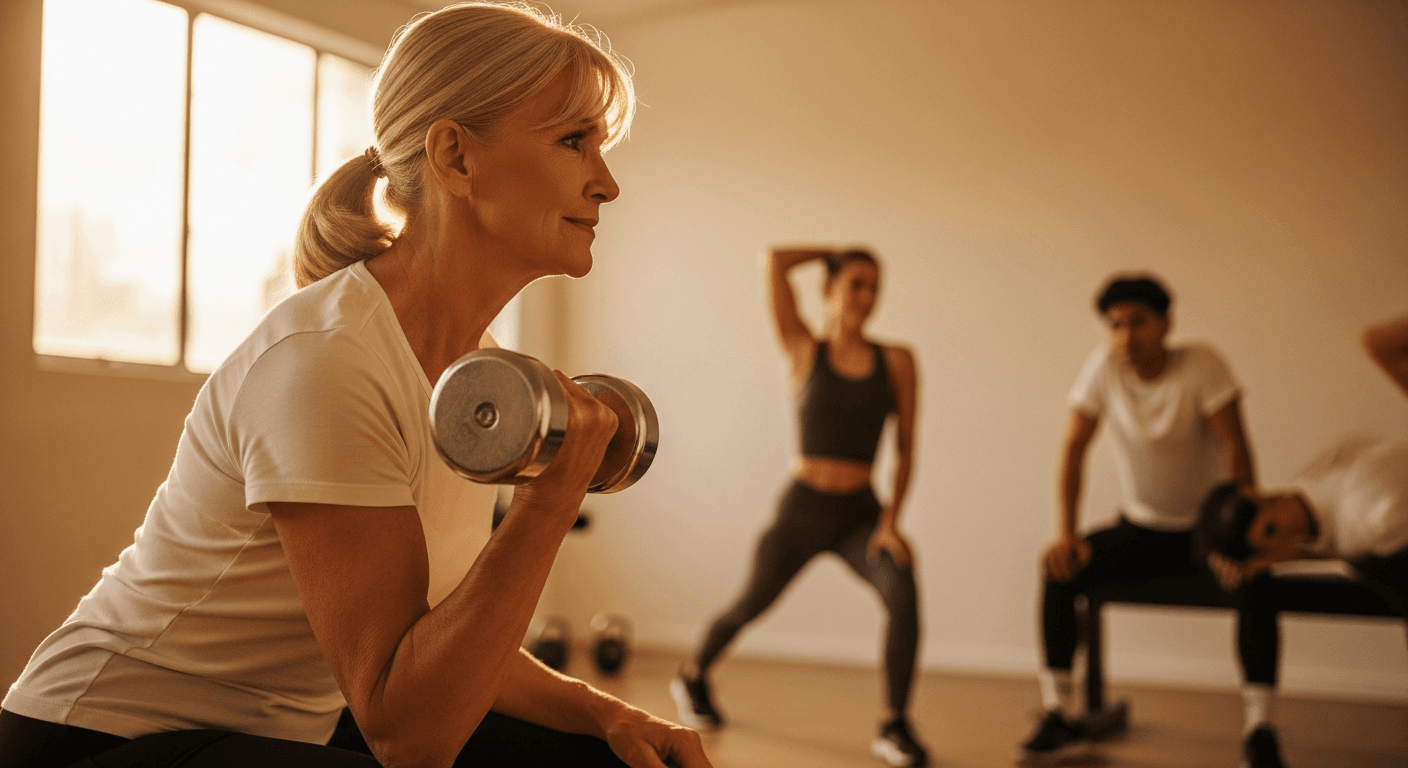
If you picture the most dedicated person in your gym, you probably imagine someone in their twenties or thirties. Data increasingly suggests you're wrong. Baby Boomers, those born between 1946 and 1964, have quietly become the most consistently active generation in the US and across other English-speaking markets. They're showing up more often, dropping out less frequently, and in many cases, putting younger lifters to shame on the fundamentals.
That's not an inspirational anecdote. It's a measurable trend that carries real implications for how gyms operate, how trainers coach, and how younger athletes approach building a fitness life that actually lasts.
The Data That Flips the Script
Recent physical activity surveys across the US and UK consistently find that adults aged 60 and older report higher rates of regular structured exercise than Gen Z (born 1997 to 2012) or Millennials (born 1981 to 1996). According to the Physical Activity Council's annual participation report, older adults in the Boomer cohort have shown steadily increasing gym participation over the past decade, while participation among 18-to-34-year-olds has plateaued or declined in several categories.
A 2023 analysis from the International Health, Racquet and Sportsclub Association found that gym members over 55 have the lowest dropout rates of any demographic. They renew memberships at higher rates, attend more sessions per week on average, and are more likely to work with a personal trainer over an extended period.
Meanwhile, data from the US Centers for Disease Control and Prevention shows that only about 24% of American adults between 18 and 34 meet both aerobic and muscle-strengthening guidelines. Among adults aged 55 to 64, that number is lower in absolute terms, but the gap narrows significantly when you control for consistent participation rather than peak performance metrics.
The picture isn't that Boomers are lifting heavier or running faster. It's that they keep coming back. And in fitness, that's the variable that matters most.
Purpose-Driven Training Versus Performance-Driven Training
Here's where the psychology gets interesting. Younger gym-goers are far more likely to train for aesthetic outcomes. Research published in the Journal of Health Psychology found that appearance-based motivation, while effective in the short term, is one of the weakest predictors of long-term exercise adherence. When results don't arrive on schedule, or life gets in the way, aesthetic motivation collapses.
Boomers, by contrast, tend to train with what researchers call autonomous motivation. They exercise because it controls blood pressure, maintains bone density, reduces the risk of cognitive decline, and keeps them independent. Those goals don't fluctuate with how they look in a mirror on a Thursday morning. They're structural, biological, and deeply personal.
This isn't speculation. Studies consistently show that health-based motivation produces significantly stronger long-term adherence than appearance-based motivation across all age groups. Boomers have largely arrived at health-based motivation by necessity, because the stakes are visible and immediate for them. Younger athletes typically have to choose it deliberately.
The practical takeaway: if you're 28 and training primarily to look better in photos, that's fine for now. But building a secondary layer of purpose rooted in long-term health is what's going to keep you in the gym at 60.
What Consistency Actually Looks Like at Scale
When you look at how Boomers structure their training weeks, several patterns emerge. They tend to prioritize lower-intensity, higher-frequency movement over high-output, infrequent sessions. Walking, swimming, resistance training two to three times per week, and yoga or Pilates are disproportionately popular in this cohort. None of those are flashy. All of them compound over decades.
They also tend to be better at recovery. Whether that's because they've learned the hard way or because they simply have more time is debatable. But recovery, sleep quality, and stress management are consistently undervalued by younger athletes chasing intensity metrics. If you haven't looked at 5 Simple Recovery Habits That Actually Work, it's worth understanding how these fundamentals quietly determine whether your training builds you up or breaks you down.
Nutrition habits among active Boomers also tend to be more stable. They're less likely to cycle through extreme protocols and more likely to eat consistently across weeks and months. That stability compounds alongside training consistency in ways that are difficult to replicate with aggressive short-term approaches.
What This Means for Gym Culture and Programming
Gym culture has a youth problem. Marketing campaigns default to images of shredded twenty-somethings. Class schedules are built around HIIT formats that appeal to younger demographics. Programming logic is often built around performance peaks rather than sustainable progression.
That's starting to shift. Forward-thinking gym operators are expanding functional fitness programming, adding longevity-focused resistance training blocks, and rethinking class formats that implicitly exclude older members. The Boomer demographic also has significant spending power. A gym that retains a 62-year-old member for 15 years generates far more revenue than one that cycles through 24-year-olds who cancel after six months.
For personal trainers, this data is particularly relevant. If you're unsure whether your approach is actually serving your clients' long-term needs, understanding what drives someone to seek professional coaching can help clarify how to position yourself for clients of all ages. The most effective trainers are increasingly the ones who understand movement quality, recovery, and behavior change as much as they understand programming intensity.
The rise of digital coaching tools adds another layer of complexity. The debate between AI and human trainers is worth following closely for anyone in the coaching space, particularly because older clients often respond better to relationship-based accountability that automated platforms struggle to replicate.
Lessons Younger Athletes Can Actually Use
You don't have to wait until your fifties to train the way Boomers train. In fact, adopting some of these principles earlier is precisely what separates lifelong athletes from people who go hard for three years and quietly disappear from the gym by 35.
Here's what the data suggests you borrow from the most consistent generation in the gym:
- Train for health first, aesthetics second. Define at least one non-appearance reason for every training block you run. Longevity, cardiovascular health, stress management, bone density. These motivators hold under pressure when mirror goals don't.
- Measure consistency, not just intensity. A training log that shows up three times per week for five years is worth more than six months of daily sessions followed by burnout. Track your attendance as seriously as you track your lifts.
- Respect recovery as part of training. Sleep quality, in particular, drives adaptation, hormone regulation, and injury resilience. Chronic sleep problems don't just make you tired. They actively undermine training outcomes over time.
- Build nutritional habits that are sustainable, not optimal. The perfect protocol you abandon in three months does less for you than the good-enough protocol you follow for three years. Simple, consistent dietary shifts tend to outperform complex systems that require constant management.
- Invest in coaching at key inflection points. Boomers are disproportionately likely to work with trainers. Not because they don't know how to exercise, but because they understand that accountability and expertise compound over time the same way training does.
- Don't ignore the cognitive upside. Exercise isn't just physical. Regular movement is one of the most evidence-backed tools for maintaining cognitive function across the lifespan. The relationship between sedentary digital behavior and cognitive decline is a growing area of concern, especially for younger demographics spending more time in front of screens.
A Different Metric for Success
The fitness industry has spent decades optimizing for visible outcomes: muscle mass, body fat percentage, race times, PR lifts. Those metrics aren't worthless, but they're incomplete. They capture a snapshot, not a story.
Baby Boomers are winning on a different metric: cumulative training years. The research is unambiguous that the health benefits of exercise are dose-dependent over time. Thirty years of moderate, consistent exercise beats five years of intense training in almost every long-term health outcome that matters, from cardiovascular function to cognitive preservation to metabolic health.
That's the metric younger athletes should start tracking. Not just what their numbers look like now, but whether the habits they're building today are ones they'll actually sustain for the next four decades.
The Boomers didn't get here by accident. They got here by deciding, at some point, that fitness wasn't a phase. If you're in your twenties or thirties, that decision is still available to you. Make it now, and the math compounds in your favor in ways that are difficult to overstate.