
Walk into any supplement store or scroll through fitness content online, and you'll notice a new category of product quietly taking shelf space: all-in-one powders that combine creatine, HMB, and electrolytes in a single daily scoop. The pitch is clean. One product, one habit, three evidence-backed benefits. But the science of supplementation rarely rewards convenience over precision, and this stack deserves a closer look before you commit your wallet and your physiology to it.
What's Actually in These Products
The core idea behind these formulas is sound in principle. Creatine supports strength and lean mass. HMB, short for beta-hydroxy beta-methylbutyrate, helps preserve muscle tissue during stress. Electrolytes support fluid balance and neuromuscular function. All three have genuine research behind them. The question isn't whether these ingredients work. It's whether they work when bundled together in fixed doses designed to fit inside a single, marketable scoop.
These products are positioning themselves as a daily anchor for training nutrition, something you take every morning or around your workout regardless of what else you're doing. That framing is smart from a marketing standpoint. It's less clear that it's smart from a physiological one.
Creatine: The Dosing Baseline You Can't Compromise On
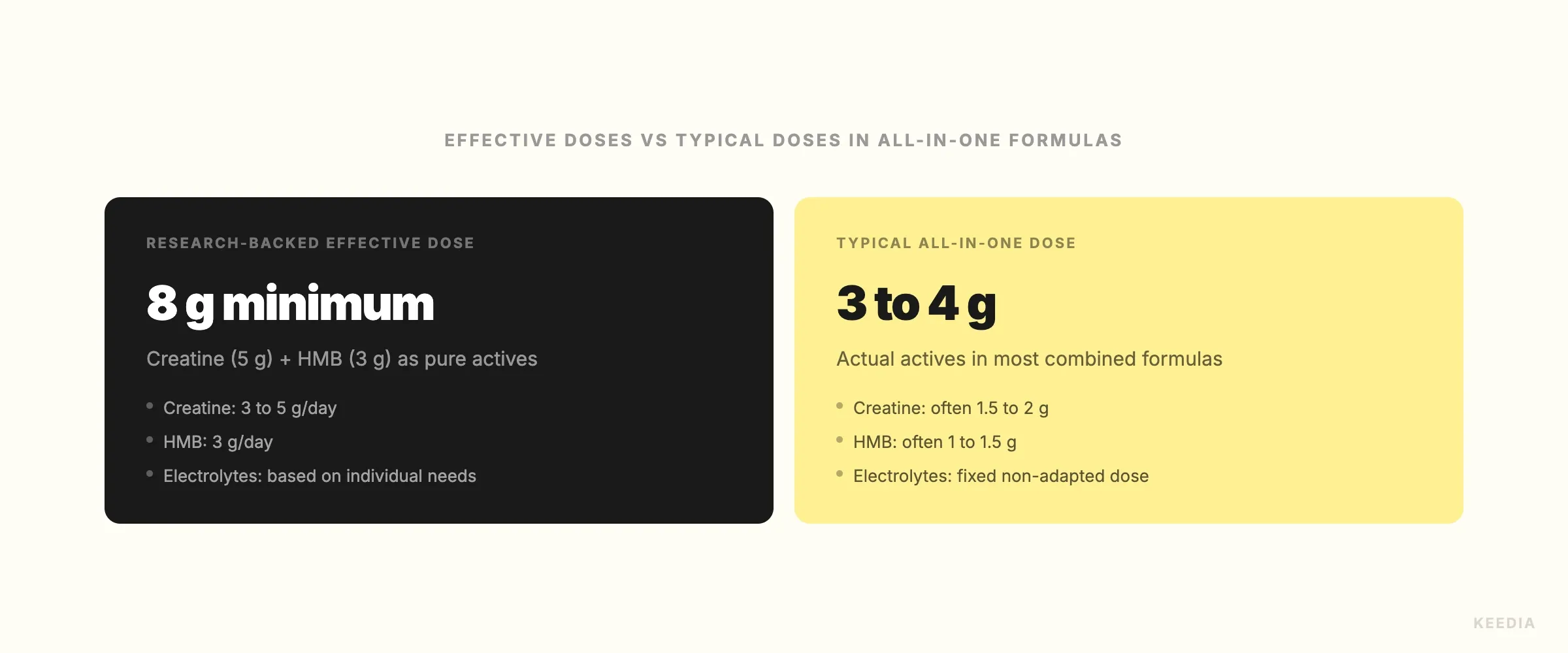
Creatine monohydrate is one of the most rigorously studied supplements in sports nutrition. The research consistently points to 3 to 5 grams per day as the effective maintenance dose for most adults, following an optional loading phase. At that dose, creatine increases phosphocreatine availability in muscle, which translates to improved performance on short, high-intensity efforts and, over time, greater lean mass gains.
This is not a supplement where less does something meaningful. Studies using doses below 2 grams per day show minimal benefit. The effective range is narrow enough that any product that cuts corners on creatine to make room for other ingredients will simply not deliver the expected results. If you're building a strength block and relying on creatine to support your performance, the dose has to be right. How to Structure Your Strength Block This Winter outlines why this kind of precision matters across your full training plan.
HMB: Real Benefits, Specific Populations, Exact Dosing
HMB is derived from leucine metabolism and works primarily by reducing muscle protein breakdown rather than directly driving muscle protein synthesis. The evidence base is most compelling for two groups: older adults at risk of sarcopenia, and trained or untrained individuals in a caloric deficit where muscle preservation becomes a priority.
The effective dose established in research is 3 grams per day, typically split across two or three servings. That number matters because the research at lower doses is underwhelming, particularly in well-trained populations. Some studies on resistance-trained athletes using HMB show modest benefits at best, and the magnitude of effect is smaller than what you'd see with creatine in the same population.
So for HMB to earn its place in your stack, you need 3 grams daily, ideally timed around meals or training. Anything less and you're paying for a label claim, not a physiological effect.
The Underdosing Problem Is the Core Issue
Here's where the all-in-one concept starts to strain. A typical single-scoop serving in these products weighs between 8 and 15 grams. If the formula includes creatine at 3 to 5 grams, HMB at 3 grams, electrolytes at a meaningful dose, plus flavoring, flow agents, and any additional ingredients listed on the label, the math gets tight very quickly.
Many of these products disclose proprietary blends rather than individual ingredient amounts, which is a red flag. When you can't verify the per-serving dose of each active, you can't know whether you're getting a therapeutic amount of anything. And even when brands do disclose doses, compromises are common. Products frequently include creatine at 2 grams, HMB at 1.5 grams, and electrolytes at amounts too small to matter. Each individual ingredient is technically present. None of them is at a level supported by the research.
This isn't a hypothetical concern. It's a structural problem inherent to combining multiple ingredients that all require gram-level dosing in a single serving intended to stay palatable and affordable.

Electrolytes: The Variable You Can't Standardize
Electrolyte needs are among the most variable physiological parameters in exercise science. Sweat rate, sweat sodium concentration, training duration, ambient temperature, acclimatization status, and individual kidney function all influence how much sodium, potassium, and magnesium you actually need on any given day.
A fixed-dose electrolyte formula in a strength supplement is designed around a hypothetical average user. That person may not be you. Someone training in a hot, humid environment who sweats heavily may need 1,000 to 2,000 mg of sodium during a single session. The electrolyte content in a creatine-HMB blend is unlikely to come close to that. Someone training in an air-conditioned gym for 45 minutes may not need electrolyte supplementation at all beyond what they get from food.
Electrolytes bundled into a strength supplement aren't necessarily harmful. They're just often irrelevant, and their inclusion drives up cost and serving complexity without reliably solving the problem they're marketed to address.
Timing Conflicts That Compound the Problem
Creatine doesn't have a strict timing requirement. Research shows that taking it close to your workout, either before or after, may have a slight edge over other times, but the effect is small and consistency matters far more than timing precision. HMB, by contrast, benefits from split dosing across the day to maintain stable plasma levels. Electrolytes are most useful around or during activity when sweat losses are actually occurring.
When you bundle all three into a single daily dose, you're making one compromise after another. You're not necessarily getting creatine at the right time, you're not splitting your HMB effectively, and your electrolytes may arrive hours before or after any meaningful sweat loss. The convenience comes at the cost of optimization on every dimension.
Who Might Still Benefit From an All-in-One
It's worth being fair here. For some users, an all-in-one product that gets them taking creatine consistently for the first time is better than the perfect protocol they never follow. If you're new to supplementation, the habit formation value of a single daily product is real. The same logic applies to why diet and exercise together beat either one alone: consistency and adherence often matter more than perfection.
Older adults looking to combine creatine and HMB for muscle preservation, a genuinely well-supported combination for that population, may find the simplicity worth the trade-offs, especially if they're not competitive athletes with highly specific performance targets. If you're in that demographic, the evidence on strength training and longevity makes a compelling case for getting both ingredients on board in any form that you'll actually sustain.
But if you're a trained athlete with real performance goals, using a single product as your primary creatine and HMB source while hoping the dosing is adequate is a gamble you don't need to take.
The Case for Separate Supplementation
Buying creatine monohydrate, HMB, and electrolytes as separate products is more work. You're managing three containers instead of one. But the advantages are significant.
- You control the dose. Creatine monohydrate in bulk form costs roughly $20 to $30 for a month's supply at the correct dose. HMB is more expensive, typically $30 to $50 monthly for 3 grams per day, but you know you're getting it.
- You control the timing. You can split your HMB, take creatine post-workout, and use electrolytes only on days or at times when you actually need them.
- You can adjust independently. If you decide to cycle off HMB or change your electrolyte strategy, you don't have to overhaul your entire supplement routine.
- Label transparency is easier to verify. Single-ingredient products have nowhere to hide a proprietary blend.
The all-in-one format is designed to make your decision simpler at the point of purchase. That's a commercial objective. Your training objective is different, and the two don't always align.
Reading Labels Before You Buy
If you're evaluating one of these combined products, here's a practical checklist. First, verify that creatine is listed at a minimum of 3 grams per serving. Second, confirm that HMB is dosed at or close to 3 grams per day across the product's recommended serving. Third, check whether the electrolyte profile matches your actual training demands, not a generic recommendation. Fourth, look for a fully disclosed supplement facts panel with no proprietary blends hiding individual ingredient amounts.
If a product doesn't meet those criteria, it's not delivering on its core promise, regardless of how the marketing frames it. Understanding how nutrition interacts with your exercise output, as explored in how exercise rewires your metabolism through one hormone, is part of building a supplement strategy that actually maps onto your biology.
The Bottom Line
The concept of combining creatine, HMB, and electrolytes is physiologically coherent. These ingredients don't conflict with each other, and there's a logical rationale for taking all three. The problem is execution. Fixed doses, compressed serving sizes, and the commercial pressure to keep products affordable and palatable consistently result in formulas where one or more actives fall short of the evidence-based threshold.
If you're serious about what these ingredients can do, you're better served by sourcing them separately at verified doses. If you're new to supplementation and an all-in-one gets you started, check the label carefully and treat it as a starting point, not an end state. Convenience is worth something. But it shouldn't come at the cost of actually getting the dose right.