
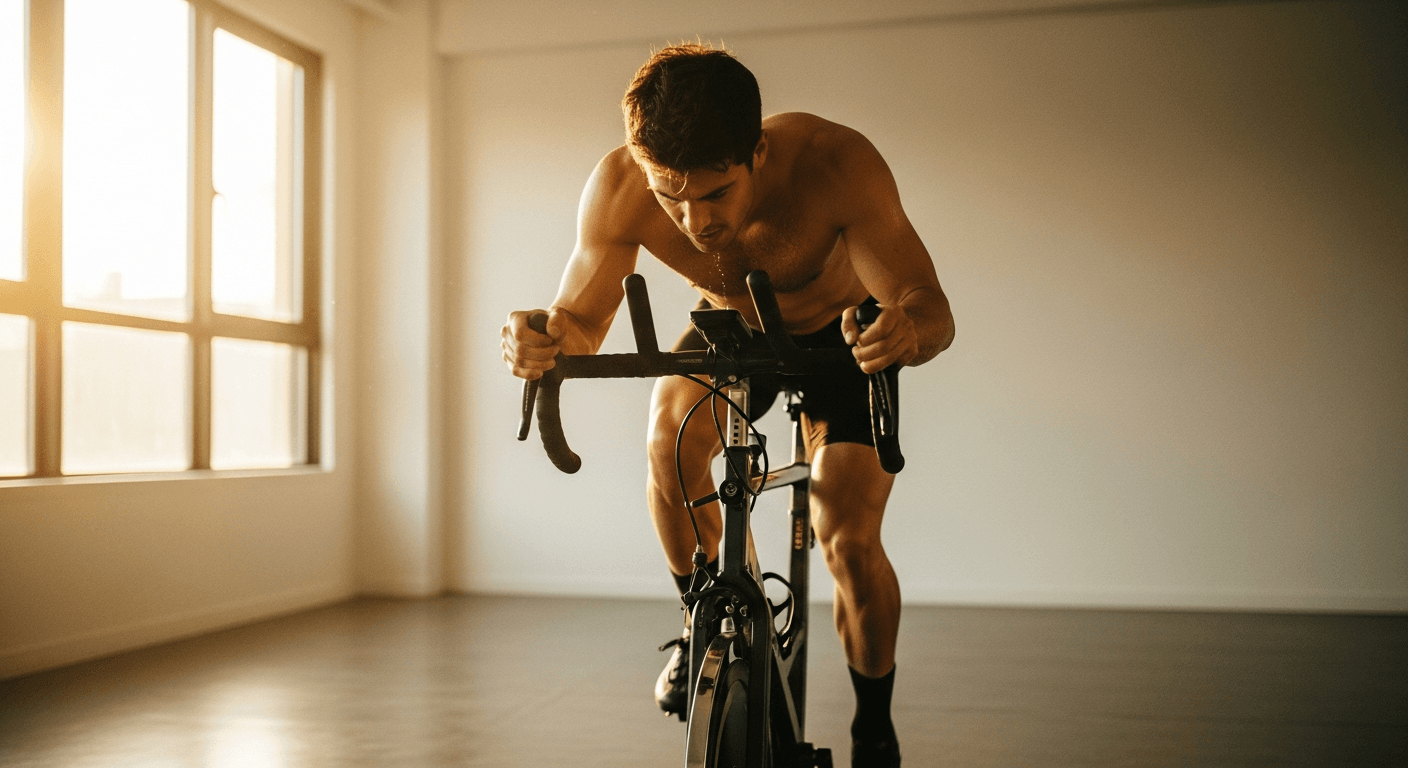
Most people who own an exercise bike ride at the same comfortable pace, day after day, and then wonder why the scale refuses to move. The problem isn't effort. It's protocol. The way you structure your sessions determines whether you're burning fat efficiently or just putting in time.
This guide breaks down the two dominant cardio approaches on a stationary bike, what the research actually supports, and how to apply both strategically depending on your goals, fitness level, and recovery capacity.
What HIIT and LISS Actually Mean on a Bike
HIIT stands for High-Intensity Interval Training. On a bike, this means alternating short bursts of maximum or near-maximum effort with active recovery periods. A classic format is 20 to 40 seconds of hard sprinting followed by 60 to 90 seconds of easy pedaling, repeated for 20 to 30 minutes.
LISS stands for Low-Intensity Steady-State cardio. This is the consistent, moderate-pace ride most people default to. You're working at roughly 50 to 65% of your maximum heart rate for a sustained period, typically 30 to 60 minutes. Your breathing is elevated but you can hold a conversation.
Both methods burn calories. But they do so through very different physiological mechanisms, and that distinction matters enormously for fat loss.
The EPOC Effect: Why HIIT Burns More Fat Over Time
The core advantage of HIIT comes down to something called Excess Post-Exercise Oxygen Consumption, or EPOC. After an intense interval session, your body doesn't simply return to baseline the moment you stop pedaling. It continues burning calories at an elevated rate for hours afterward as it works to restore oxygen levels, clear metabolic byproducts, and repair muscle tissue.
Research consistently shows that a 30-minute HIIT session can burn up to 30% more total calories than a steady-state session of the same duration when you account for this afterburn effect. That gap compounds meaningfully over weeks and months.
HIIT also triggers greater hormonal responses, including a sharper spike in growth hormone and catecholamines, both of which accelerate fat oxidation. Your resting metabolic rate stays elevated for up to 24 hours post-session in well-designed HIIT protocols.
For anyone who's time-constrained, that's a significant return on investment. A 25-minute HIIT ride on Monday morning can outperform an hour of steady cycling in terms of total fat burned by end of day.
LISS Still Has a Role. Here's When to Use It
LISS isn't ineffective. It's just often misapplied as the primary fat-loss tool by people who are capable of more.
Where LISS genuinely excels is in three specific contexts. First, recovery days. After a heavy strength session or a hard HIIT ride, a 30 to 40-minute easy spin increases blood flow to fatigued muscles without adding systemic stress. It's active recovery, not wasted time. You can read more about structuring this kind of session in how to build a real recovery routine in 2026.
Second, beginners. If you're new to structured exercise, jumping straight into interval training before you've built a basic aerobic foundation increases injury risk and dropout rates. Four to six weeks of consistent LISS builds cardiovascular capacity and movement patterns, making HIIT far more effective when you do introduce it.
Third, high-volume training weeks. When you're already training hard across multiple modalities, adding HIIT on top can push your total stress load past what your nervous system can absorb. LISS lets you maintain caloric expenditure without digging a recovery hole.
The Mistakes That Kill Your Calorie Burn
Even athletes who understand HIIT and LISS theory make execution errors that significantly blunt results. These are the most common ones on the bike specifically.
- Static resistance throughout the session. Riding at the same resistance level from warm-up to cool-down removes the intensity gradient that drives adaptation. Your "hard" intervals need to actually be hard, which usually requires bumping resistance by 3 to 5 levels above your cruising setting.
- Poor posture and seat position. A seat set too low forces your knees into excessive flexion, reduces power output, and increases injury risk over time. A seat set too high causes hip rocking, which bleeds power and strains the lower back. Spend two minutes dialing in your setup before every session.
- Going through the motions during "work" intervals. If you can comfortably breathe through your nose during your HIIT sprint, you're not working hard enough. True high-intensity means 85 to 95% of maximum heart rate. Anything below that is moderate-intensity cardio, which is fine, but it's not HIIT.
- Neglecting warm-up and cool-down. Jumping cold into hard intervals limits your peak power output and elevates injury risk. A 5-minute progressive warm-up raises core temperature and prepares your cardiovascular system for the load ahead.
Progressive Overload Applies to Cardio Too
Most people apply progressive overload religiously to their strength training but treat cardio as a fixed routine. That's a mistake. Your cardiovascular system adapts to stress just like your muscles do, and if you never increase the challenge, your body stops changing.
On the bike, progressive overload looks like this: if week one has you doing 8 intervals at resistance level 10, week three should push you to 10 intervals or resistance level 12. The principle is the same as adding weight to a barbell. Gradual, systematic increases in either volume or intensity keep your body in an adaptive state rather than a maintenance one.
A practical approach is to add one interval per week for three weeks, then hold volume steady while increasing resistance for the following two weeks. That five-week cycle drives consistent adaptation without burning you out. The same thinking applies broadly to fitness testing and benchmarking, which is why structured assessments like those covered in The Presidential Fitness Test Is Back: What It Actually Measures can serve as useful periodic checkpoints for tracking real progress.
Heart Rate Monitoring: Your Most Practical Tool
The single most underused tool in most home cardio setups is a heart rate monitor. Without one, you're essentially training blind. You might feel like you're working hard, but subjective effort is notoriously unreliable, especially as fitness improves and sessions that once felt brutal start to feel manageable.
Here's the framework that matters for fat loss on a bike:
- Zone 2 (60-70% max HR): The optimal LISS zone. Fat oxidation is high, fatigue accumulation is low, and you can sustain this for long durations. This is your recovery ride and aerobic base-building zone.
- Zone 4 (80-90% max HR): Where your HIIT work intervals should land. Breathing is labored, conversation is not possible, and your body is burning through both glycogen and fat rapidly.
- Zone 5 (90-100% max HR): True maximum effort. Used in shorter sprint intervals (10 to 20 seconds). Highly effective but requires adequate recovery between efforts and shouldn't dominate a full session.
A chest strap monitor gives you the most accurate real-time data. Wrist-based optical monitors work reasonably well for steady-state sessions but tend to lag during rapid heart rate changes, which makes them less precise for interval work.
Knowing your zones also allows you to train smarter around other lifestyle variables. Sleep quality, stress levels, and nutrition all affect heart rate response on any given day. If your resting heart rate is elevated or you're struggling to hit your usual Zone 4 output, that's a signal to drop intensity rather than push through. 5 Nutrition Lessons From April 2026 Worth Keeping covers how fueling choices directly affect training output, which connects directly to how well you perform during high-intensity sessions.
Nutrition: The Variable Most Cyclists Underestimate
No bike protocol outpaces a consistently poor diet. But beyond the basics, two nutritional factors specifically affect fat loss outcomes on a bike.
Protein intake is the first. When you're in a caloric deficit and doing regular cardio, adequate protein preserves muscle mass, which keeps your resting metabolic rate from dropping. Current evidence supports a target of 1.2 to 1.6 grams per kilogram of body weight daily for active individuals. Why the New 2025-2030 Guidelines Target 1.2 to 1.6 g/kg explains the research behind that updated range.
Pre-session fueling is the second. For LISS sessions, training in a fasted state can modestly increase fat oxidation during the ride. For HIIT, fasted training typically reduces peak power output, which means your intervals are less intense and your EPOC response is blunted. A small carbohydrate source 30 to 45 minutes before a HIIT session generally produces better performance and therefore better results.
Building Your Weekly Bike Protocol
For most people aiming at fat loss with a stationary bike as their primary cardio tool, a well-structured week looks something like this:
- 2 HIIT sessions per week: 20 to 30 minutes each, with at least 48 hours between them for recovery. These are your primary fat-loss drivers.
- 1 to 2 LISS sessions per week: 30 to 45 minutes in Zone 2, ideally after strength training days or on designated active recovery days.
- At least 1 full rest day: No structured exercise. Adequate sleep and recovery are not optional accessories to training. They're where adaptation actually happens.
That structure gives you the EPOC benefits of HIIT without accumulating so much fatigue that your form and intensity deteriorate. Consistency over weeks, not any single session, is what produces visible body composition change.
The bottom line: stop riding at the same resistance at the same pace and expecting different results. Apply intensity, apply progression, monitor your heart rate, and use LISS strategically rather than by default. Your bike is a powerful fat-loss tool. You just have to use it like one.