
The organ no one thinks to train
When you hit the gym, you're thinking about muscles, cardio, maybe nutrition. You're probably not thinking about your 100 trillion gut bacteria. But 2026 research is making it increasingly clear that exercise is one of the most powerful tools for reshaping their composition — and that this reshaping has real effects on your performance, recovery, and long-term health.
A review published in Gastroenterology in 2026 pulls together what we now know: exercise physically changes the gut environment, stimulates motility, improves blood flow to the intestinal lining, and directly alters which bacterial species thrive in your digestive tract.
Which training types have the biggest impact?
Not all exercise affects your gut microbiome equally. Recent research draws a pretty clear picture.
Endurance training — running, cycling, swimming, rowing — shows the most consistent and beneficial effects. Endurance athletes consistently test higher in three particularly important species: Prevotella, Akkermansia muciniphila, and Faecalibacterium. All three are linked to stronger gut barrier integrity, lower systemic inflammation, and better insulin sensitivity.
A study covered by ScienceDaily in February 2026, looking at elite rowing athletes, found something especially interesting: it wasn't just regular training that shifted gut markers — it was training load specifically. As training volume went up, levels of short-chain fatty acids (SCFAs) in the gut followed. More training, better gut health markers.
The minimum threshold for real results
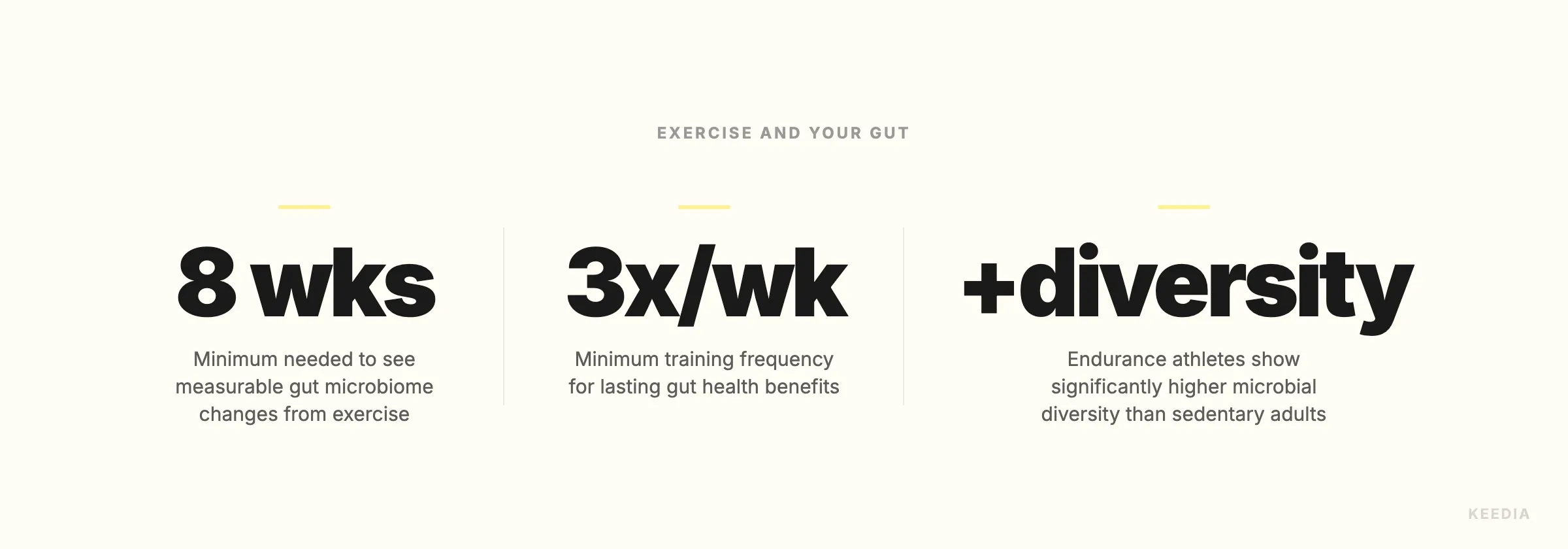
Good news if you're not training twice a day: the positive effects on gut microbiome start showing up at 30-90 minutes of moderate-to-vigorous exercise, at least 3 times per week, sustained over 8 weeks or more. Below that threshold, changes are minimal or undetectable.
Translation: if you're already training 3-4 times a week at decent intensity, you're already doing something positive for your gut — even if you can't feel it directly.
The performance loop
The most compelling aspect of this research is that the relationship runs both directions. A healthier microbiome doesn't just reward your training — it actively improves it.
Here's how it plays out:
- A more diverse microbiome improves nutrient absorption, particularly protein and carbohydrates needed for recovery.
- Higher levels of Akkermansia are associated with better body composition and improved insulin sensitivity — which directly improves how your body uses carbohydrates during exercise.
- SCFAs produced by gut bacteria, especially butyrate, serve as direct fuel for intestinal lining cells and reduce systemic inflammation — a key factor in recovery between hard sessions.
What you can actually do with this
Research isn't yet at the point where anyone can prescribe a training protocol specifically optimized for gut microbiome. But some practical takeaways are emerging.
Consistency beats intensity when it comes to gut benefits. Moderate training four times a week does more for your microbiome than one brutal session per week. It's the sustained stimulus that maintains beneficial bacterial populations.
Combining cardio and resistance training appears to produce the best gut outcomes. The ongoing GUTFIT randomized trial (2026) suggests combined aerobic-resistance training generates larger shifts in microbial diversity than cardio alone.
What you eat post-workout can amplify or reduce the gut benefits of exercise. Fermentable fibers — found in legumes, leafy vegetables, fruits — feed exactly the bacteria that exercise promotes. An intense training session followed by a fiber-rich meal creates a compounding effect researchers are only beginning to document. Your gut is more involved in your fitness than you've ever given it credit for.