
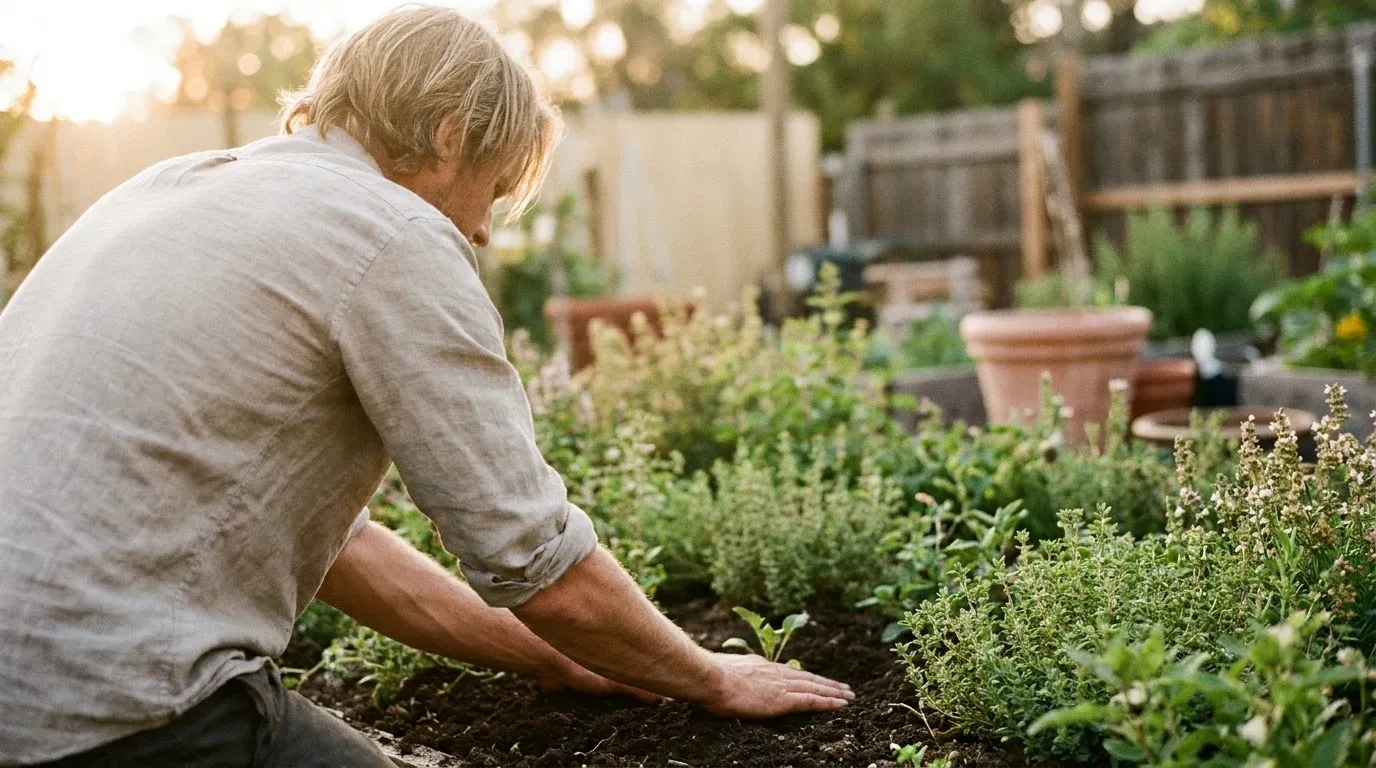
Rest days can feel like a productivity void. You've trained hard, your legs are cooked, and lying on the couch sounds both necessary and deeply unsatisfying. So when researchers start suggesting that digging up weeds and watering tomatoes might be a legitimate recovery strategy, it's tempting to dismiss it as content noise. It isn't.
Recent fitness research has taken a serious look at low-intensity, unstructured physical activity on rest days. What they found challenges the default assumption that the best recovery is no movement at all.
What "Active Recovery" Actually Means
Active recovery isn't a walk on a treadmill because you feel guilty about resting. It refers to deliberate, low-intensity movement that promotes blood flow to fatigued muscle tissue without imposing additional mechanical load that could disrupt the repair process.
The mechanism is straightforward. After hard training, metabolic waste products accumulate in muscle tissue. Elevated blood flow helps clear them. Passive rest does eventually achieve this, but it's slower. Light movement accelerates the process without adding the kind of contractile stress that actually damages muscle fibers.
The challenge has always been getting people to do it consistently. Structured active recovery sessions, like easy cycling or pool work, require planning, equipment, and displacement. Most people skip them. That's where gardening enters the picture in an unexpectedly relevant way.
The Research Behind Gardening and Muscle Soreness
Studies examining low-intensity, non-repetitive physical tasks have found that they can outperform passive rest on two specific outcomes: reducing delayed onset muscle soreness (DOMS) and improving long-term exercise consistency.
DOMS typically peaks 24 to 72 hours after intense exercise. It reflects a combination of micro-damage to muscle fibers and localized inflammation. Passive rest lets this process run its course. Active recovery interventions, including unstructured activity, appear to blunt peak soreness without interfering with the underlying repair process.
What makes gardening specifically interesting is its structural profile. It involves varied, low-intensity movement across multiple planes. You squat, reach, carry, stand, kneel, and walk. None of these movements are particularly intense, and because you're constantly switching tasks, no single muscle group sustains prolonged mechanical stress. That's close to an ideal active recovery stimulus.
One area of research worth noting involves perceived exertion and adherence. When people engage in activities that feel purposeful rather than purely remedial, they're significantly more likely to maintain them over time. Gardening scores highly on this dimension. You're not recovering. You're doing something. The recovery happens as a byproduct.
Why Consistency Matters More Than Any Single Session
The long-term training consistency finding deserves more attention than it typically gets. Individual recovery sessions don't move the needle much in isolation. What matters is the cumulative effect of better recovery across weeks and months of training.
When rest days involve genuine low-intensity movement rather than pure inactivity, training quality in subsequent sessions tends to improve. You arrive at your next workout less stiff, with better neuromuscular readiness, and without the psychological drag that prolonged sedentary recovery can create. Over a 12-week training block, those marginal improvements compound significantly.
This is consistent with broader research on non-exercise activity and training outcomes. Athletes who maintain moderate daily movement on rest days consistently report better session quality and lower dropout rates compared to those who rest completely. The movement doesn't need to be structured. It just needs to happen.
If you track your recovery metrics carefully, this is the kind of variable worth paying attention to. Research into how biometric tracking informs training decisions increasingly highlights rest-day activity quality as a meaningful predictor of readiness scores, not just sleep and nutrition.
The Physiology: Why Low-Intensity Beats Rest for Blood Flow
To understand why gardening-level activity works, you need to understand what passive rest doesn't do well. When you're sedentary, blood flow to peripheral muscle tissue drops. Lymphatic circulation, which is entirely dependent on muscle movement, essentially stalls. The clearance of metabolic byproducts slows accordingly.
Low-intensity movement reverses this without adding mechanical cost. Even light activity raises cardiac output modestly, dilates capillaries in working muscles, and stimulates lymphatic return. At gardening-level intensity, you're moving enough to trigger these benefits without creating any meaningful additional protein breakdown or inflammatory signaling.
Compare this to the opposite extreme. Cold water immersion, for instance, achieves blood flow manipulation through a different mechanism entirely, with its own specific trade-offs depending on training phase. The evidence on ice baths after training is more nuanced than popular use suggests, particularly for hypertrophy-focused athletes. Gardening sidesteps those trade-offs entirely.
There's also a sleep dimension here worth flagging. Light physical activity during the day has consistently been associated with improved sleep quality, which is where the majority of actual tissue repair occurs. Sleep's role in cellular repair extends well beyond muscle tissue, and anything that supports sleep architecture on rest days is contributing to recovery in a broader sense.
Practical Application for People Who Actually Train Hard
Here's the most useful framing: gardening works as active recovery not because there's anything uniquely therapeutic about soil and plants, but because it reliably produces the right movement profile on a rest day.
The key characteristics are:
- Low intensity throughout. Heart rate stays well below any meaningful aerobic threshold. You're never breathing hard.
- Non-repetitive movement patterns. You're not performing the same mechanical action for 45 minutes. The load is distributed constantly.
- Intrinsic motivation. You continue because you want to finish something, not because a timer says so.
- Duration in a productive range. Most gardening sessions naturally fall between 30 and 90 minutes, which is enough to deliver circulatory benefits without accumulating fatigue.
If you have a garden, the application is obvious. But the principle generalizes. A slow walk through a city, light housework, visiting a farmers' market, wandering a hardware store for a project. Any activity that keeps you gently moving, engages you enough to prevent you from sitting down, and doesn't require significant muscular effort qualifies.
The mistake would be to treat this as an excuse to do more. You shouldn't be doing structured yoga flows, long hikes, or casual basketball games and counting them as recovery. Zone 1 means genuinely easy. If you're getting warm and your legs are starting to feel it, you've crossed a line that matters for recovery quality.
What This Means for Lifters Specifically
Strength athletes often have the most to gain here and are also the most resistant to this kind of advice. If your identity is built around lifting heavy things, spending a Sunday afternoon deadheading roses feels both trivial and vaguely embarrassing.
Set that aside and look at the functional reality. After a heavy lower-body session, your quads, hamstrings, and glutes are dealing with significant micro-damage. Passive rest over 48 hours will get you ready for the next session, but active recovery at the right intensity will likely get you there faster and with less residual stiffness.
The key word is "likely." Individual response to recovery interventions varies, and anyone selling you a universal protocol is oversimplifying. But the direction of the evidence is consistent. Easy movement beats stillness for DOMS reduction and training continuity. That's a narrow but reliable finding.
Nutrition plays a supporting role here too. Blood flow improvements from low-intensity movement work better when substrate availability is adequate. Getting enough niacin from food sources supports both vascular function and energy metabolism during recovery, two things that matter when you're trying to clear soreness efficiently.
The Bigger Picture on Rest Day Strategy
Recovery science has moved away from the binary of "train or rest" toward a more granular understanding of how different types of activity affect different recovery pathways. Active recovery occupies a specific and valuable niche in that framework.
What gardening research adds to this is a proof of concept: you don't need a structured, planned, equipment-based recovery session to achieve the blood flow and soreness benefits of active recovery. You just need to be gently, non-strenuously active in a way that feels worth your time.
That's a genuinely useful insight for anyone who trains seriously but doesn't have the schedule, the facility access, or the motivation to build formal recovery sessions into their week. The movement is what matters. The format is almost irrelevant.
One thing to watch for in this space is the tendency of fitness culture to rapidly convert any evidence-backed behavior into a product or protocol. The pattern of wellness trends becoming marketing vectors is well-established, and "recovery gardening" is exactly the kind of concept that could easily get packaged and sold back to you in a form that misses the entire point.
The point is simplicity. Get off the couch. Do something easy and purposeful. Let the biology handle the rest.