
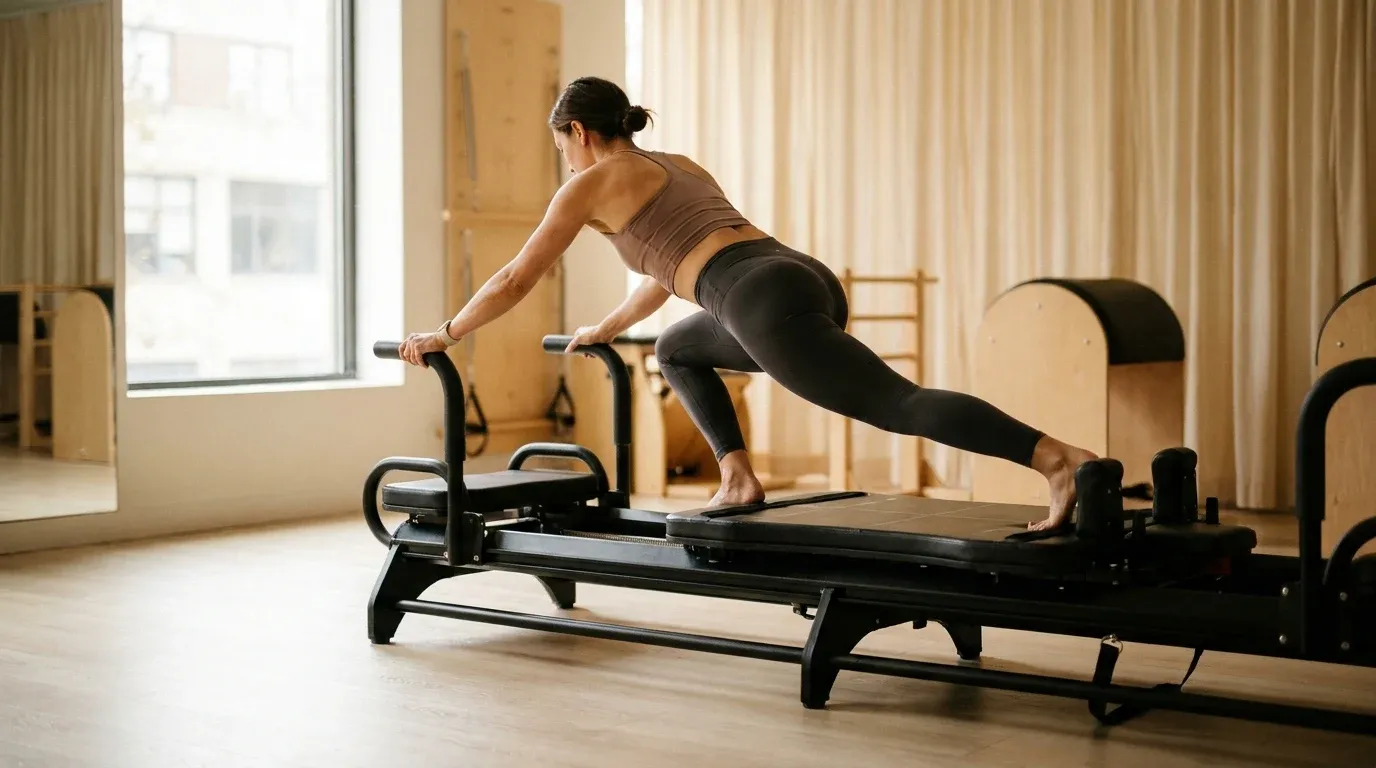
If you've walked past a studio window and seen people shaking uncontrollably on a machine that looks like a Reformer crossed with a sled, you've witnessed the Lagree method in action. It's not Pilates. It's not a spin-off. And it's not as gentle as it looks.
The Lagree method has quietly built a loyal following among people who want the low-impact feel of a mat class with the muscle fatigue of a serious strength session. Here's what it actually is, how it stacks up against Pilates, and whether it's worth adding to a lifter's weekly routine.
What Is the Lagree Method?
Developed by fitness trainer Sebastien Lagree in the early 2000s, the Lagree method is built around a machine called the Megaformer. It looks similar to a Pilates Reformer but it's significantly heavier, more complex, and designed for a different kind of intensity.
The Megaformer uses spring-loaded resistance combined with an unstable moving carriage. That instability is the point. Every movement forces your stabilizer muscles to engage constantly, turning what looks like a slow lunge into a full-body challenge for your core, glutes, and deep postural muscles.
The defining characteristic of Lagree is its tempo. Movements are performed at an intentionally slow pace, typically taking four to six seconds per phase. That sustained time under tension keeps the target muscle loaded far longer than a standard gym rep. The result is deep muscular fatigue without the joint stress that comes from heavy external loads.
Unlike traditional strength training, Lagree sessions are also designed to elevate heart rate. That cardio component is embedded into the structure of the workout, not added on. You're doing cardiovascular work and muscle conditioning simultaneously, which is part of what makes a 45-minute Lagree class feel disproportionately hard.
How It Differs From Pilates
This is where most people get confused, partly because the machines look related and partly because studios sometimes market Lagree alongside Pilates. They are distinct methods with different goals.
Pilates, particularly Reformer Pilates, emphasizes mobility, alignment, and controlled movement. It's rooted in rehabilitation principles and tends to favor precision over intensity. The resistance levels are generally moderate, and sessions are designed to be restorative as much as challenging.
Lagree is not restorative. It's progressive and demanding. The spring resistance on a Megaformer can be adjusted to make exercises dramatically harder, and the class format is designed to push you to muscular failure within specific time intervals. The shaking you see through the studio window isn't technique breakdown. It's muscle fatigue working as intended.
- Pilates: Rehabilitation origins, mobility focus, moderate intensity, suitable for injury recovery
- Lagree: Strength and conditioning focus, high time under tension, cardiovascular demand, designed for muscular overload
- Both: Low-impact on joints, core-centric, require precision, accessible without prior lifting experience
Calling Lagree "advanced Pilates" undersells the difference. It's closer to slow-tempo strength training on an unstable surface with built-in cardio. The methodology is genuinely distinct.
The Science Behind Slow Tempo Training
The effectiveness of Lagree leans heavily on one well-established physiological principle: time under tension. Research consistently shows that prolonging the duration a muscle spends under load increases metabolic stress, which is one of the primary drivers of muscle adaptation and hypertrophy.
When you slow a movement down to four to six seconds per phase, you're preventing the muscle from using momentum to complete the rep. Every millimeter of movement demands actual muscular effort. That's why Lagree produces significant fatigue from what looks, from the outside, like a moderate movement.
The unstable surface adds another layer. Working on a moving carriage recruits smaller stabilizer muscles that standard gym machines often bypass entirely. Those muscles, particularly in the hips, pelvis, and spinal column, are responsible for posture, injury prevention, and functional strength. Training them directly has real-world carryover.
The cardiovascular demand is also physiologically meaningful. Keeping large muscle groups under continuous tension elevates heart rate in a way that mimics aerobic conditioning without the repetitive impact of running. For people who want cardiovascular fitness without high-impact movement, that's a practical advantage.
Toning Without Bulking: Who Is This For?
One of the most common reasons people are drawn to Lagree is the promise of muscle definition without significant size increase. That framing resonates with a lot of people, particularly those who are hesitant to enter traditional weight rooms. And it's not entirely marketing language.
The method does build strength and improve body composition. But the rep structure, resistance loads, and movement patterns are designed to develop muscular endurance and tone rather than the maximal hypertrophy you'd pursue with heavy compound lifts. You'll get stronger and leaner. You're unlikely to add significant muscle mass.
For people who feel intimidated by gym culture or have absorbed unrealistic expectations from social media. it's worth reading Is GymTok Warping Your Body Image? before setting expectations about any training method. The goal of a sustainable fitness practice should be function and long-term health, not a specific aesthetic template.
Lagree is genuinely accessible as an entry point. The machine handles joint stress, the instructor controls the tempo, and the class format removes the guesswork that can make traditional weight training feel overwhelming for beginners. That lower barrier to entry is real and worth acknowledging.
How Often Should You Train Lagree?
This is where discipline around recovery becomes critical. Because Lagree sessions drive genuine muscular fatigue, particularly in the core, glutes, and legs, the same recovery rules that apply to weight training apply here.
Most certified Lagree instructors and exercise physiologists recommend two to four sessions per week, with at least 48 hours of rest between sessions that target the same muscle groups. That window allows the muscle repair process to complete before you load the same tissue again.
Training too frequently without adequate recovery doesn't accelerate results. It increases injury risk and leads to overreaching, the state where performance plateaus or declines despite continued effort. If you're doing Lagree three times a week, spacing those sessions out matters more than stacking them in consecutive days.
Recovery quality matters as much as rest duration. Sleep, in particular, is non-negotiable. Research on sleep and recovery consistently links poor sleep with impaired muscle protein synthesis and elevated cortisol. Good sleep shields your brain even with heart disease, and that same nightly restoration is what allows your muscles to actually adapt to the work you're putting in.
Some athletes also use cold exposure protocols post-session for muscle recovery, though the evidence is nuanced. Ice baths after training: when they help, when they hurt breaks down when cold therapy supports adaptation and when it may actually blunt it.
Lagree and Traditional Lifting: Complementary or Competing?
If you're already lifting weights, the question isn't whether to swap Lagree in. It's whether it adds something your current program is missing.
For lifters, Lagree fills a specific gap: stabilizer muscle development, core endurance, and active recovery that still produces a training stimulus. A heavy lifting program typically doesn't emphasize slow eccentric movements on an unstable surface, so there's low overlap and genuine complementarity.
One to two Lagree sessions per week alongside three to four lifting days is a structure that many performance-oriented athletes have found productive. The key is treating Lagree sessions as a training load, not as rest days. They count toward your weekly volume and need to be programmed accordingly.
If you're using wearables to track training load and recovery metrics, monitoring how Lagree affects your readiness scores can help you find the right balance. WHOOP and F1: What Their Shared Data Reveals offers a useful look at how biometric data can inform programming decisions across different training modalities.
What to Expect in Your First Session
Your first Lagree class will feel awkward and probably humbling. The machine has a learning curve, the tempo will feel unnaturally slow, and you'll likely be surprised by how quickly your muscles fatigue.
Expect delayed onset muscle soreness in places you don't typically feel it from gym work, particularly in the hip flexors, inner thighs, and deep core. That soreness reflects muscles that are being loaded in new ways, which is exactly the point.
Pricing varies by market, but in major US cities, Lagree studios typically charge between $30 and $45 per class, with monthly memberships ranging from $150 to $350 depending on session frequency and location. It's a premium format and priced accordingly.
Three sessions is a fair trial. The first is orientation. The second is the first genuine workout. The third is when you start to understand how the method actually works. Judging Lagree after a single class is like judging a strength program after one deadlift.
The Bottom Line
Lagree isn't Pilates with a marketing upgrade. It's a structurally different training method with legitimate physiological underpinnings, a specific performance profile, and a real recovery cost. It won't replace heavy lifting if building maximal strength or mass is your goal. But for muscle definition, stabilizer development, cardiovascular conditioning, and joint-friendly intensity, it delivers something that most standard gym programs don't.
If the idea of a toning-focused, low-impact method makes you skeptical of its credibility, it shouldn't. Slow-tempo training under tension is not a soft option. Done properly, it's one of the more efficient ways to accumulate training stress without loading your joints. The shaking in that studio window is real work.