
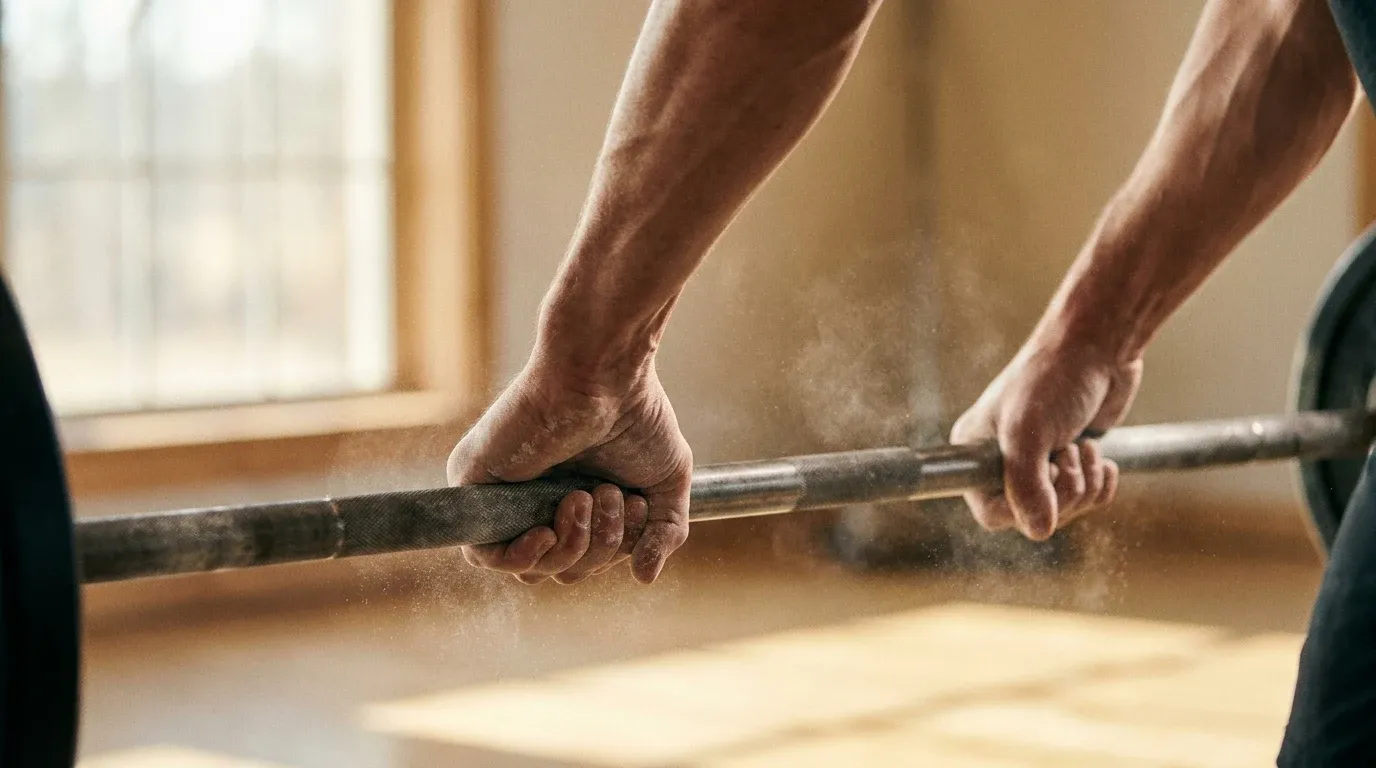
Most gym-goers track their bench press, their body weight, maybe their VO2 max if they're serious. Almost none of them track grip strength. That's a significant oversight, because the research connecting hand grip to long-term health outcomes is more compelling than almost any other single fitness marker you can measure without a lab coat.
This isn't about hand exercisers and stress balls. It's about what your ability to hold a heavy load says about your cardiovascular system, your brain, and how long you're likely to live.
What the Research Actually Shows
The evidence base here is unusually strong. A landmark study published in The Lancet tracked nearly 140,000 adults across 17 countries and found that every 5 kg decrease in grip strength was associated with a 17% higher risk of cardiovascular death and a 7% higher risk of heart attack. Crucially, this held up after controlling for physical activity level, BMI, and other confounding factors.
It doesn't stop at the heart. Longitudinal data from the UK Biobank, which has followed hundreds of thousands of participants over years, consistently shows that lower grip strength at baseline predicts faster cognitive decline and greater risk of dementia. One analysis found that individuals in the lowest grip strength quartile had significantly higher rates of cognitive impairment a decade later, independent of education level or existing health conditions.
All-cause mortality follows the same pattern. Studies in older adult populations show that grip strength is one of the strongest physical predictors of death from any cause, outperforming measures like walking speed, balance, and self-reported activity in some analyses. This has led researchers to describe it as a kind of "biomarker of aging," a window into systemic physiological function that you can assess in under a minute.
The connection to cognitive health is worth pausing on. If you're already paying attention to research on deep sleep waves and their role in guarding against Alzheimer's, grip strength sits in that same category of underappreciated, non-pharmaceutical levers for long-term brain protection.
The Decline Starts Earlier Than You Expect
Here's where the timeline becomes uncomfortable. Grip strength doesn't just fade in old age. In untrained individuals, it starts declining at roughly 1 to 3% per year beginning around age 30. By the time most people notice any functional weakness, they've already lost a meaningful portion of their peak capacity.
Peak grip strength typically occurs somewhere between 25 and 35, depending on sex and training history. After that, without deliberate intervention, it's a slow but consistent downward slope. By age 65, average grip strength in sedentary adults has often dropped 30 to 40% from peak values.
The reason early intervention matters is compounding. A 1 to 3% annual loss sounds small, but it accumulates over decades. Starting targeted grip work at 35 rather than 55 gives you twenty years of maintained or improved capacity instead of twenty years of silent decline. And unlike some fitness qualities, grip strength responds well to training at any age, including in adults over 70.
Why Your Current Program Probably Isn't Enough
If you deadlift, row, and do pull-ups, you're building some grip strength incidentally. Pulling movements generally do more for your hands than pushing movements, which is one reason they deserve more space in your training. But "incidental" is the operative word.
Standard barbells have a 28 to 32mm diameter. Your hands adapt to that diameter. Gyms keep bars knurled so the bar doesn't slip. Chalk and straps exist precisely to bypass grip as a limiting factor. When you use them habitually, you're deliberately removing grip from the training equation.
That's sometimes the right call when you're trying to overload the posterior chain. But if grip is never the limiting factor, it never gets a specific adaptation stimulus. And for most people running a standard push-pull-legs split, it isn't the limiting factor in a single exercise they do.
Addressing your push-to-pull ratio is a good starting point. If you want to understand where grip fits into a broader pulling program, pull movements are often the most neglected element in standard gym programs, and fixing that ratio creates conditions where grip naturally gets more work.
The Training Methods That Actually Build It
The most effective approaches to deliberate grip development fall into a few clear categories.
- Thick bar and fat grip training. Using a 50 to 60mm diameter bar forces your hand to work significantly harder to maintain the same load. Fat Gripz attachments let you convert standard equipment. Research on thick bar training consistently shows greater forearm and grip activation compared to standard implements at equivalent loads.
- Farmer's carries. Loading a heavy implement in each hand and walking with it is one of the most functional and demanding grip exercises available. It trains crush grip, wrist stability, and forearm endurance simultaneously. A practical starting point is 50% of your bodyweight per hand for 20 to 30 meters per set.
- Dead hangs. Hanging from a pull-up bar with straight arms trains grip endurance and decompresses the spine as a side benefit. Even 30-second sets add up quickly. The shoulder and grip benefits of a simple 30-second hang are more significant than most people expect from something this low-tech.
- Plate pinches. Pinching two weight plates together between your thumb and fingers trains the pinch grip, which standard bar work largely ignores. Start with two 10 lb plates pinched smooth-side out for 20 to 30 second holds.
- Towel pull-ups and rope climbing. Wrapping a towel over a pull-up bar forces the hand into a position that's far more demanding than a standard grip. Even a single set to failure creates a significant adaptation stimulus.
Adding two or three of these methods to your existing training two to three times per week is enough to drive meaningful improvement. You don't need a separate grip day. Five to ten minutes at the end of a pulling session, or as a standalone finisher, is enough volume for most intermediate lifters.
The 60-Second Test You've Probably Never Taken
A hand-held dynamometer is the tool researchers use in virtually every grip strength study. It's a small device you squeeze maximally for a few seconds, and it gives you a force reading in kilograms or pounds. The test takes under 60 seconds. It doesn't require a clinic.
Basic dynamometers are available for under $40. Clinical-grade models used in research settings run $200 to $400, but consumer versions provide reliable enough readings to track trends over time. You squeeze three times with each hand, alternating, and take the average.
The normative values that matter: for adult men, a reading below roughly 26 kg (57 lbs) in the dominant hand is generally considered low and associated with elevated health risk in the research literature. For adult women, the threshold is around 16 kg (35 lbs). These cutoffs vary slightly by age group and study, but they give you a working benchmark.
If you're working with a trainer and this test hasn't come up, it's worth raising. A good coach uses assessments that go beyond aesthetics and one-rep maxes. The kinds of questions worth asking when evaluating any coaching relationship are covered in detail in what to ask during a personal training consultation. Any trainer worth their rate should be tracking functional health markers, not just performance metrics.
Grip Strength in a Broader Health Context
Grip strength doesn't exist in isolation. It correlates with overall muscle mass, neuromuscular function, and the kind of systemic physiological reserve that protects against disease and aging. High grip strength in middle age is often a proxy for having maintained physical capacity across the board.
That said, it's trainable on its own terms. You don't have to rebuild your entire program to address it. If you're going through a training reset or rebuilding consistency after a gap, integrating grip work from the start is far easier than retrofitting it later. A structured approach to rebuilding your training routine is a natural opportunity to add it in deliberately.
The other angle worth mentioning is recovery and systemic health support. Connective tissue in the hands and forearms responds to training stress more slowly than muscle. Adequate magnesium intake supports neuromuscular function, and if you're not recovering well between sessions, the tendons and ligaments of the forearm are often the first things that complain. Chronic stress compounds this further, which is why looking at stress management strategies that actually work matters if your forearm recovery feels sluggish despite reasonable training loads.
Start Measuring Before You Start Optimizing
The simplest thing you can do today is get a baseline reading. Buy a dynamometer, test both hands three times each, and write down the numbers. Do it again in three months after adding targeted grip work. The trend matters more than a single snapshot.
Grip strength is one of the few health markers that gives you direct, immediate, actionable feedback. Unlike cholesterol panels or imaging, you can track it weekly, adjust your training based on what you see, and watch it improve in real time. For something so tightly linked to cardiovascular health, cognitive function, and longevity, that's a remarkably accessible feedback loop.
Most gym programs ignore it entirely. That's not a reason you have to.