
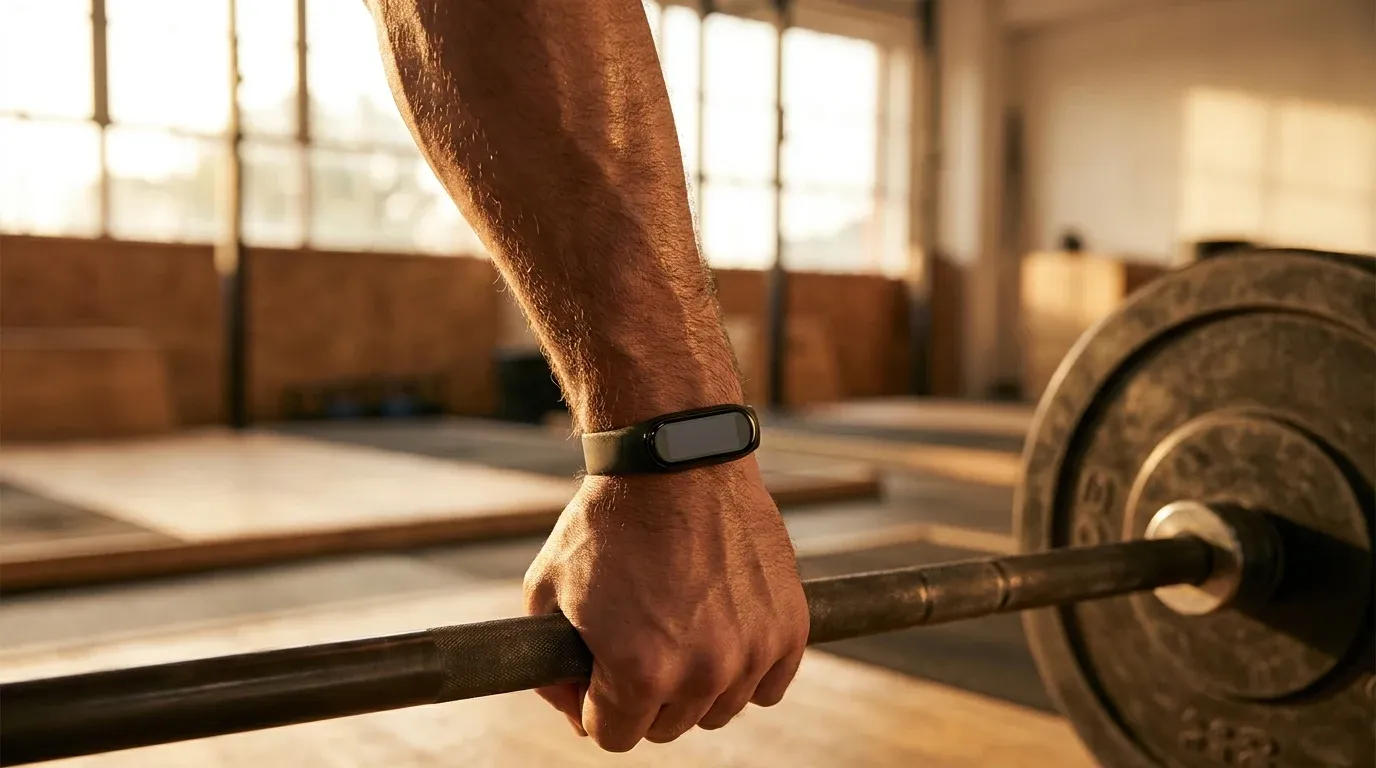
Wearable technology has topped the American College of Sports Medicine's annual global fitness trends survey for the third consecutive year in 2026. That's not a small footnote. It means more people than ever are strapping a device to their wrist before they train. And yet, walk into any gym and you'll see the same pattern: someone squats, someone deadlifts, and someone glances at their watch to check their step count.
That's the gap. Most gym-goers are using less than 20% of what their wearable can actually do for strength training. The hardware is capable. The data is there. The problem is that nobody taught you how to read it for lifting.
This guide fixes that.
Why Wearables Were Built for More Than Steps
Modern fitness trackers from brands like Garmin, WHOOP, Apple, and Polar collect a continuous stream of physiological data. Heart rate variability, resting heart rate, sleep stages, respiratory rate, skin temperature, and blood oxygen all feed into algorithms designed to tell you something meaningful about your body's current state.
The issue is that most people only look at the surface metrics. Steps. Calories. Active minutes. These numbers feel rewarding, but they tell you almost nothing about whether you're ready to push hard in the gym today, or whether you need to pull back before you dig yourself into a recovery hole.
Strength training demands a different lens. You're not just asking "did I move enough?" You're asking "can my central nervous system handle a heavy load today?" and "is my body primed to adapt to the stress I'm about to impose?" Your wearable can answer both questions. You just need to know where to look.
HRV: The Most Useful Number You're Probably Ignoring
Heart rate variability is the variation in time between consecutive heartbeats. A higher HRV generally indicates a well-recovered autonomic nervous system. A lower HRV suggests accumulated fatigue, stress, illness, or poor sleep. It's one of the most sensitive early-warning signals your body produces.
For strength athletes, HRV is particularly valuable because heavy compound lifting is deeply taxing on the central nervous system. Two lifters can have identical muscle soreness and still be in completely different recovery states. HRV often catches what soreness doesn't.
Here's how to use it practically:
- Track your baseline first. Don't act on a single HRV number. Wear your device consistently for two to three weeks to establish your personal normal range. Population averages are mostly irrelevant. Your trend is what matters.
- Green means go, but go smart. When your HRV is elevated relative to your baseline, that's a signal your system is primed. Schedule your heaviest sessions, your max-effort work, or your new personal record attempts on these days.
- Low HRV is data, not failure. When your HRV dips significantly below baseline, don't force the planned heavy squat session. Shift to lighter technical work, accessory lifts, or a focused mobility session that maintains training quality without adding systemic stress.
- Watch weekly trends, not daily spikes. A single low-HRV morning isn't a crisis. A consistent downward trend over seven to ten days is a red flag that your training load, sleep, or life stress is outpacing your recovery.
The connection between nervous system stress and physical performance is well-documented. Chronic stress directly affects muscle tension and recovery capacity, which means your HRV isn't just tracking your workouts. It's tracking everything.
Sleep Scores: The Overlooked Training Variable
Your wearable's sleep tracking is more than a curiosity. Sleep is when muscle protein synthesis peaks, when growth hormone pulses, and when the nervous system consolidates the motor patterns you drilled in the gym. If you're skipping this data, you're ignoring roughly a third of your training stimulus.
Most devices now break sleep into stages: light, deep, and REM. For strength development, deep sleep is the priority. It's during slow-wave sleep that the majority of physical repair happens. If your device consistently shows low deep sleep percentages, your gains are likely being limited by something that has nothing to do with your programming.
Practical applications for lifters:
- Use sleep score as a session modifier. A sleep score below 70 (on platforms like Garmin or WHOOP) is a reasonable threshold to reduce training intensity by 15 to 20%. You can still train. Just don't test your one-rep max on four hours of fragmented sleep.
- Look for patterns, not exceptions. One bad night happens. Three consecutive nights of poor sleep means your recovery infrastructure is failing, and no training program will compensate for that.
- Align your heaviest training days with your best sleep nights. This sounds obvious, but most people schedule heavy days on a fixed calendar. If you have schedule flexibility, let your sleep data guide the placement of your hardest sessions within a training week.
Heart Rate Zones and Strength Training: What Actually Applies
Zone training is commonly associated with cardio. But heart rate data during strength sessions carries useful information if you know how to interpret it.
During compound lifts like squats and deadlifts, it's normal for heart rate to spike into Zone 4 or even Zone 5. That's not the problem. The problem is when your heart rate stays elevated between sets and doesn't drop back toward your resting baseline within the rest period. Poor inter-set recovery indicates either insufficient rest time, excessive training volume, or a cardiovascular system that's not keeping pace with the demands you're placing on it.
Use heart rate between sets as a readiness cue. If you're programmed for 3-minute rest periods and your heart rate is still sitting 40 beats above resting at the 2-minute mark, that's a signal to extend the rest. Rushing sets when your heart rate hasn't recovered increases the risk of technical breakdown and reduces the quality of the stimulus.
This kind of data-informed approach to rest periods has overlap with high-intensity work. Research on sprint-based training shows that short, intense cardiovascular efforts can produce meaningful adaptations with low time investment. Brief, maximal sprint intervals produce cardiovascular adaptations that longer steady-state sessions can't replicate, partly because the intensity zones are so different. Your wearable can help you manage that distinction intentionally.
Building a Practical Framework for Smarter Lifting
Here's a simple three-step system you can apply starting this week, regardless of which device you're using.
Step 1: Morning check-in (2 minutes). Before you plan your training day, check three numbers: HRV relative to your baseline, sleep score or hours of deep sleep, and resting heart rate. If two or more of those metrics are below your personal normal, downgrade the session intensity. If all three are solid, you're cleared for your hardest planned work.
Step 2: In-session tracking with purpose. During your workout, use heart rate data not as entertainment but as a pacing tool. Monitor inter-set recovery. If you're doing technically demanding work like heavy squats, reviewing evidence-based squat cues alongside your movement data creates a feedback loop that accelerates skill development alongside raw strength.
Step 3: Weekly review (10 minutes, Sunday or Monday). Pull your weekly HRV trend, total sleep data, and training load if your device calculates it. Ask one question: is my recovery keeping pace with my training demand? If the answer is consistently no, the fix is rarely to train less. It's usually to sleep more, manage stress better, or assess whether your nutrition supports the volume you're running.
The Limits of What Your Wearable Can Tell You
It's worth being honest about what wearables can't do. They measure proxies. HRV isn't a direct measure of nervous system fatigue. Sleep scores are algorithm-generated estimates, not polysomnography. Calorie burn estimates during resistance training can be significantly inaccurate.
These limitations don't make the data useless. They mean you should treat it as one input among several, not as the definitive verdict on your training day. How you feel, how the bar moves, your session performance over time. those signals matter too.
There's also a growing category of AI-powered coaching tools that use wearable data to generate programming recommendations. These tools are improving quickly. The question of whether AI-driven coaching can replicate the judgment of an experienced human coach is worth examining before you hand your programming decisions entirely to an algorithm.
Make the Data Work for You
You're already wearing the device. You're already collecting the data. The only thing left is to actually use it.
HRV tells you when to push and when to protect. Sleep scores tell you whether your body is building anything from the work you're doing. Heart rate zones during lifting tell you whether your rest periods and pacing are serving your goals. Together, these three data streams give you a physiological picture that a generic program simply can't account for.
The lifters who get consistently stronger over years aren't just the ones who work the hardest. They're the ones who know when to work hard and when to back off. Your wearable, used properly, is one of the clearest windows into that distinction you'll find.