
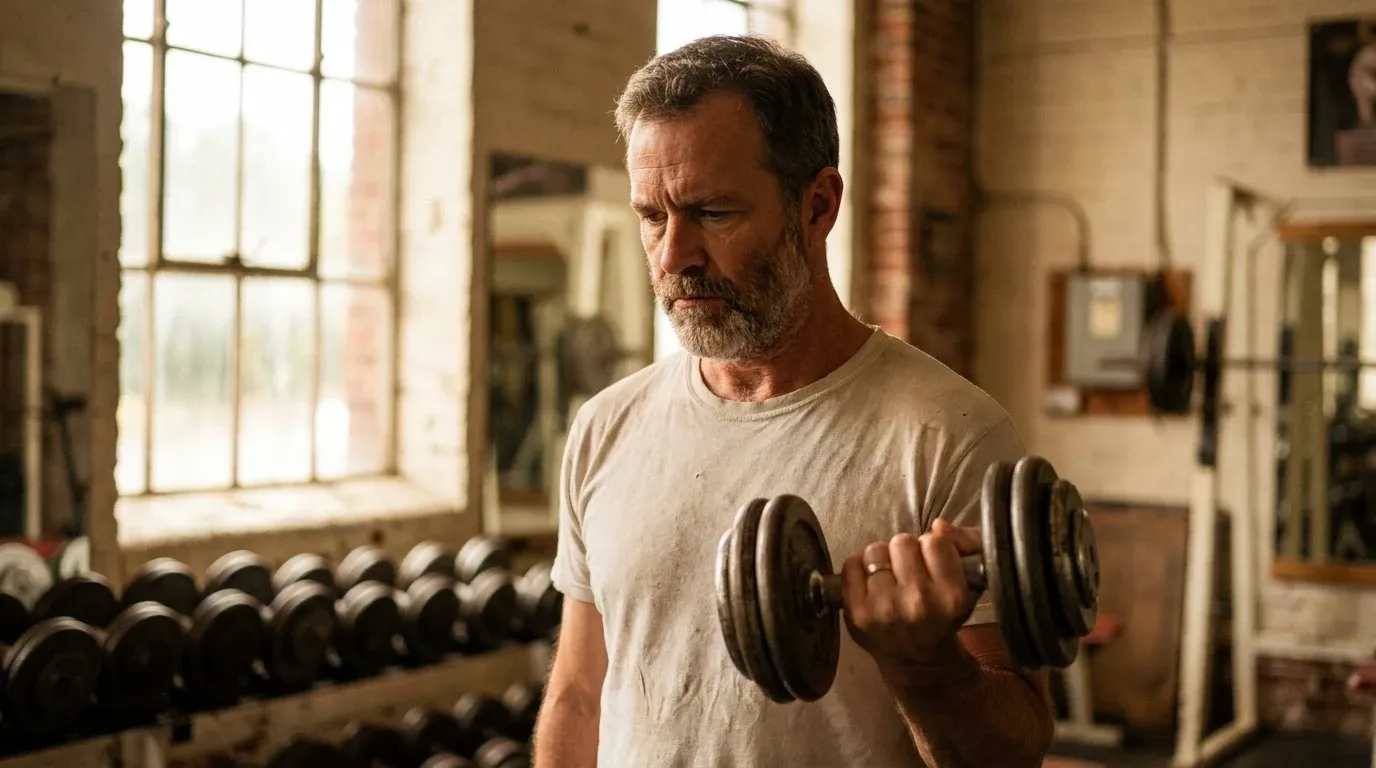
Most people pick up a barbell to build muscle, lose fat, or get stronger. Those are good reasons. But a growing body of research suggests that resistance training does something far more interesting than reshape your body. It reshapes your brain. And a new study published in GeroScience has put a number on exactly how much.
One year of resistance training made participants' brains appear between 1.4 and 2.3 years younger on neuroimaging measures. That's not a metaphor. Researchers used established brain-age estimation models to compare structural MRI scans before and after the intervention, and the results were consistent: lifting slows the biological aging of the brain in ways that are measurable, significant, and distinct from other forms of exercise.
What the GeroScience Study Actually Found
The study enrolled older adults and had them follow a structured resistance training protocol over 12 months. At the end of the intervention, brain scans showed reduced brain age compared to what would be predicted for their chronological age. The effect ranged from 1.4 to 2.3 years of apparent brain age reversal, depending on the neuroimaging marker used.
Brain age is calculated by feeding structural MRI data into machine learning models trained on thousands of scans. These models learn what a "typical" 60-year-old brain looks like versus a 65-year-old brain, then estimate where your brain falls on that spectrum. When participants who lifted for a year scored younger than expected, that gap reflects real, structural changes, not just a better mood or sharper focus in the short term.
The findings add to a picture that's been building for years: the brain doesn't just benefit from being attached to a body that exercises. It responds specifically to the type of exercise you're doing.
Why Resistance Training, Not Just Any Exercise
Here's where it gets interesting. The cognitive benefits of aerobic exercise, particularly running and cycling, are well-documented. Cardio increases cerebral blood flow, promotes the release of brain-derived neurotrophic factor (BDNF), and has long been associated with lower dementia risk. But the GeroScience study's findings point to mechanisms that appear to be specific to resistance training, not simply exercise in general.
Resistance training drives a distinct hormonal and inflammatory response. It increases insulin-like growth factor 1 (IGF-1), which crosses the blood-brain barrier and supports neuronal maintenance. It reduces systemic inflammation markers that are closely tied to accelerated brain aging. And it appears to preserve white matter integrity, the connective tissue of the brain that degrades with age and underpins processing speed and cognitive flexibility.
Aerobic exercise and resistance training are not interchangeable when it comes to brain health. They work through overlapping but different pathways. That's a clinically relevant distinction, especially as you get older and your training time becomes more deliberate.
It's also worth noting that resistance training's cardiovascular benefits have their own evidence base. Isometric Training 2x a Week Drops Blood Pressure Fast is one example of how strength-focused work can compete directly with cardio on markers traditionally considered its domain. The brain data is another layer on top of that.
A New Argument for Longevity That Has Nothing to Do With Looks
The longevity conversation in fitness has shifted significantly over the past decade. It used to be almost entirely about lifespan: how do you add years to your life? The newer, more useful question is about healthspan: how do you stay functional, sharp, and independent throughout those years?
Cognitive decline is one of the most feared aspects of aging, and for good reason. Dementia affects roughly 55 million people worldwide, with numbers projected to nearly triple by 2050. Even subclinical cognitive decline, the gradual slowing that doesn't meet a clinical threshold but still affects your life, has a significant impact on quality of life, independence, and mental health.
The idea that lifting weights for a year can make your brain measurably younger reframes resistance training as a cognitive intervention, not just a physical one. You're not just preserving muscle mass or protecting your joints. You're investing in the organ that determines whether you remain yourself as you age.
This also connects to the growing evidence around mood and mental health. Weightlifting Cuts Depression in Women, Study Finds is part of the same broader picture: resistance training has effects on the brain that extend well beyond what happens in the gym.
What This Means for How You Train
The study used structured resistance training protocols, meaning consistent, progressive sessions with real load. This wasn't chair yoga or light stretching. Participants lifted weights with sufficient intensity to drive physiological adaptation. If you want the cognitive benefits, you need to actually challenge the muscle.
The good news is that you don't need to train like an athlete to see results. Most studies in this space use two to three sessions per week, with compound movements, moderate to heavy loads, and progressive overload built in over time. That's a manageable commitment for most people.
For coaches working with older clients, this research shifts the conversation. The case for resistance training used to rest heavily on sarcopenia prevention, fall reduction, and metabolic health. Those are still valid. But adding brain age to that list changes the weight of the argument considerably. One Session a Week: What Coaches Should Tell Aging Clients covers the minimum effective dose for this population in more depth.
If you're building or adjusting your training plan, it's also worth thinking about how resistance work fits alongside other modalities. How to Structure Your Autumn Training Plan offers a practical framework for balancing strength, cardio, and recovery as the seasons change.
The Recovery Side of the Equation
Brain adaptation doesn't happen during the workout. It happens during recovery. Sleep, in particular, is where a significant portion of neurological repair and consolidation takes place. The glymphatic system, which clears metabolic waste from the brain, operates primarily during deep sleep. If you're training hard but sleeping poorly, you're leaving cognitive gains on the table.
The relationship between sleep and brain health is increasingly well-supported. Research has linked better sleep architecture, particularly more REM sleep, to dramatically lower rates of age-related neurological disease. More REM Sleep Is Linked to 83 Fewer Diseases puts that data into context. If you're serious about brain longevity, your recovery deserves as much attention as your programming.
Stress management matters here too. Chronic psychological stress accelerates biological aging, including in the brain. Building a training routine that includes structured recovery, not just rest days, is part of the picture. The evidence on what actually moves the needle on recovery is worth revisiting if you haven't done so recently.
The Bigger Picture on Brain Longevity
Resistance training is not the only lever you can pull for cognitive longevity. Nutrition, sleep, social connection, cognitive engagement, and stress management all contribute. But the GeroScience findings matter because they're specific and quantified. You can measure brain age. You can change it. And one year of lifting is apparently enough to make a meaningful difference.
That's a remarkable result when you consider what most people associate with a year of weightlifting. Better physique, stronger lifts, improved metabolic markers. All of those are true. But a measurably younger brain is a different kind of return on investment. It's the kind that compounds over decades and affects everything, not just how you look or perform, but how clearly you think, how well you remember, and how fully you remain yourself.
The barbell has always been an underrated health tool. This study makes the case that it might be one of the most powerful anti-aging interventions available, and one that doesn't require a prescription or cost more than a gym membership.