
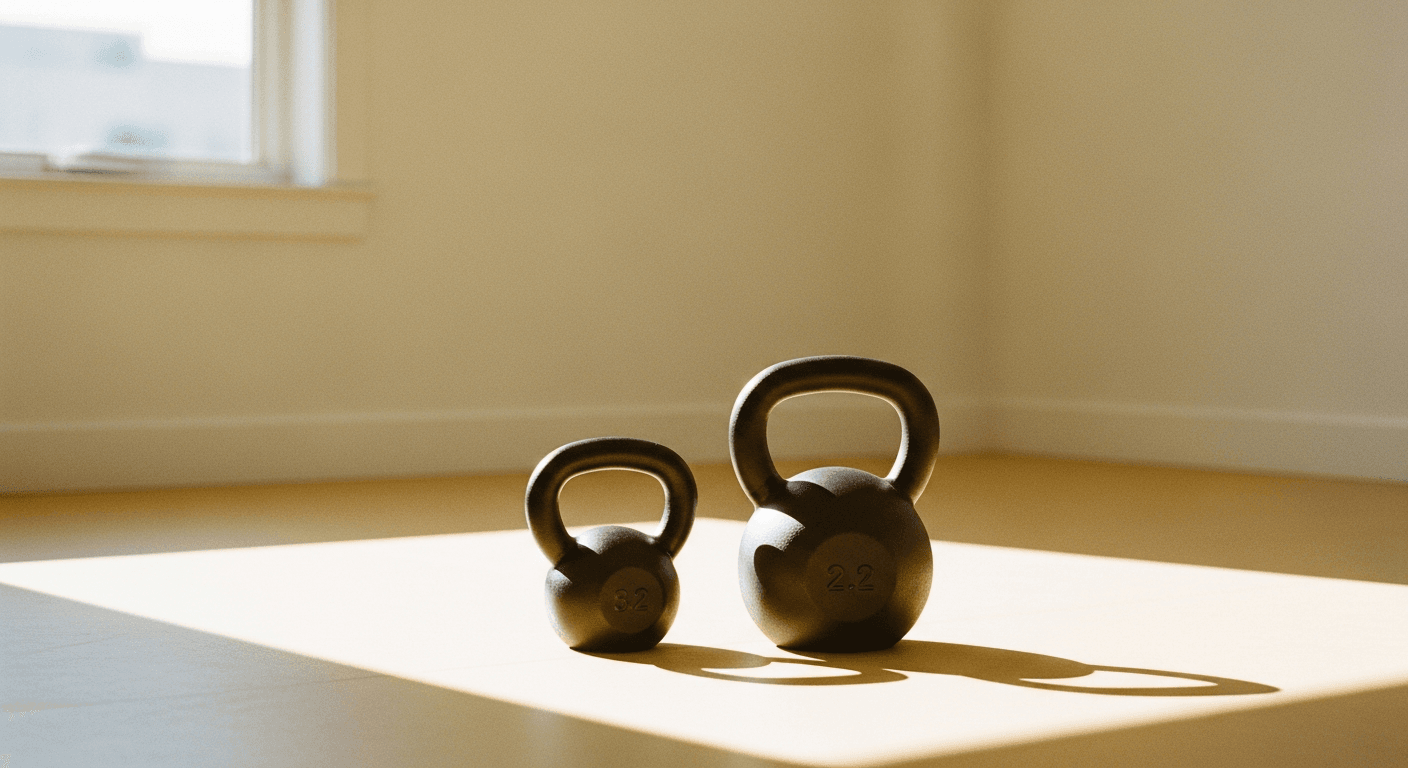
Light or Heavy Weights: What the Research Actually Shows
If you've ever stared at the weight rack wondering whether to go heavier or knock out more reps with something lighter, you're not alone. It's one of the most debated questions in strength training, and a study published in the Journal of Applied Physiology just gave us a cleaner answer than most people expected.
Researchers tracked trained lifters across multiple weeks, comparing low-load protocols (around 30-50% of 1RM) taken close to muscular failure, against high-load protocols (70-85% of 1RM). On the question of muscle hypertrophy, the two groups ended up in virtually the same place. Similar volume gains, similar cross-sectional growth. The weights were different. The outcome wasn't.
Where the groups diverged was strength. Heavier loads produced greater maximal strength gains. That makes sense: your nervous system adapts to the specific demands you place on it. Train with heavy loads, and you get better at moving heavy loads.
The Real Variable: Relative Effort
Here's the key insight from this research. The number on the dumbbell isn't the primary driver of muscle growth. What matters is how hard you're actually working relative to your maximum effort. Are you pushing close to failure? Are you recruiting enough muscle fibers to create a growth stimulus?
A set performed at 40% of 1RM taken to complete exhaustion recruits a similar number of muscle fibers as a set at 80% of 1RM done with equal relative effort. That's the mechanism. That's why both approaches land in a similar place for hypertrophy.
This has real practical value. If you train at home with lighter dumbbells, or you're in a caloric deficit and your performance has dropped, you don't have to panic about losing muscle. As long as you're pushing hard enough in each set, you can hold onto your gains.
What This Means for Your Training
This doesn't mean heavy weights are useless. If strength is your primary goal, heavier loads are still non-negotiable. Training specificity is real: you get good at what you practice. But if hypertrophy is your main driver, you have more flexibility than most training culture suggests.
You can rotate between heavy phases and higher-volume, moderate-load phases without sacrificing muscle growth. That kind of variation may actually help you avoid plateaus and reduce the cumulative joint stress that comes from always training at your maximum loads.
Researchers at McMaster University have previously shown that even two to three sessions per week with sufficient effort is enough to maintain and build muscle mass, regardless of the specific loads used.
How to Apply This Right Now
You don't need to overhaul your whole program. Here's a practical way to use this research.
For compound movements like squats, deadlifts, and bench press, heavier loads still have a functional advantage. For isolation work like curls, lateral raises, and cable flyes, moderate loads with higher rep ranges and strong effort work extremely well. In both cases, track your proximity to failure: aim to finish each set within one or two reps of not being able to continue.
Your muscles don't read the label on the plate. They respond to the effort you impose. The weight you choose is just the tool. How hard you push is the actual training stimulus.