
The gym industry has long sold the idea that serious fitness requires serious facilities. Rows of machines, cable stacks, a full rack of dumbbells. But research published by the American College of Sports Medicine confirms what many athletes already suspected: home-based training produces results equivalent to gym-based training when programming and effort are matched.
Key Takeaways
- A functional home gym can start from around $300 of investment
- Adjustable dumbbells replace up to 15 pairs of fixed dumbbells
- An adjustable bench + adjustable dumbbells cover over 80% of gym exercises
That changes the math on what you actually need. You're not building a commercial gym in your spare bedroom. You're assembling a focused toolkit that covers the fundamentals without wasting money on equipment that collects dust.
Start With the Principles, Not the Products
Before spending a dollar, understand what effective training actually requires. Your body needs progressive overload, movement variety across major patterns, and enough recovery stimulus to drive adaptation. That's it. The equipment you buy should serve those three demands. Nothing else earns space in your home.
The major movement patterns are straightforward: push, pull, hinge, squat, carry, and core. A well-designed home setup lets you train all six with a handful of tools. You don't need a machine for every muscle group.
The Non-Negotiable Tier
These are the items that do the most work per square foot. If your budget is tight, start here and stop here until you've outgrown them.
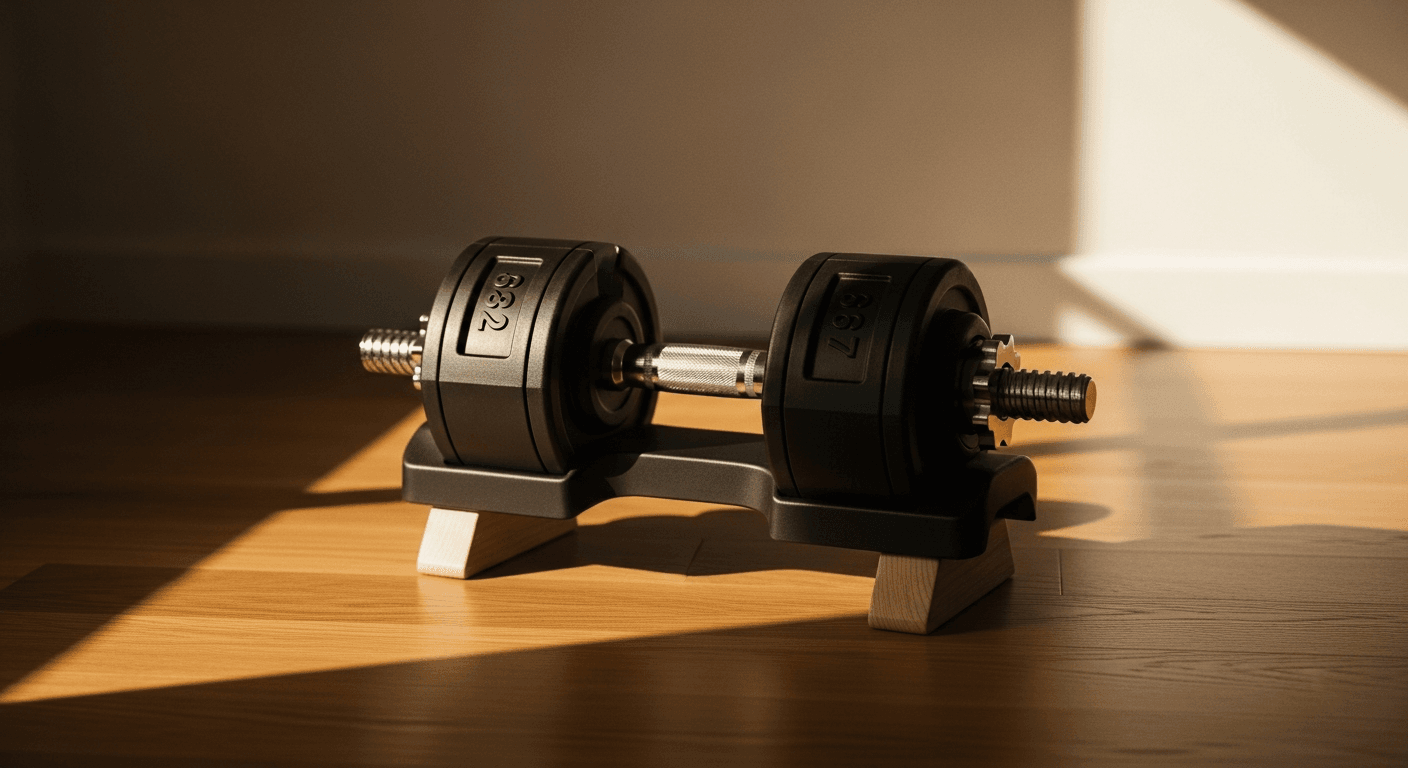
- Adjustable dumbbells (5–50 lbs or equivalent in kg): A single pair of adjustable dumbbells replaces an entire dumbbell rack. They cover everything from shoulder mobility work to heavy Romanian deadlifts. Brands like Bowflex and Powerblock have proven durability records, though budget alternatives have improved significantly. This is your highest-priority purchase.
- Pull-up bar: Vertical pulling is the hardest movement pattern to train without equipment. A doorframe pull-up bar solves it for under $30. It handles pull-ups, chin-ups, hanging core work, and with a set of rings or straps attached, inverted rows. Don't underestimate it.
- Resistance bands (loop and tube styles): Bands aren't a substitute for weights. They're a complement. They add accommodating resistance, support mobility and activation work, and allow exercises that dumbbells can't replicate. A set covering light to heavy resistance runs $20–$50 and lasts for years.
- Exercise mat: Floor work, stretching, and core training require a surface that isn't your hardwood floor. A 6mm to 10mm mat handles it. This isn't glamorous, but skipping it means you'll skip the floor work.
The High-Value Second Tier
Once the basics are in place, a few additions dramatically expand what you can train and how heavy you can go. These aren't luxuries. They're investments that extend the lifespan of your home setup by years.
- Kettlebell (one or two): A single kettlebell between 16–24 kg for most adults unlocks swings, Turkish get-ups, goblet squats, and single-arm pressing variations. The swing alone is one of the most effective posterior chain exercises available. Two kettlebells of different weights gives you even more range. Buy quality here. Cheap kettlebells with rough handles cause calluses and grip fatigue that interrupt training.
- Adjustable bench: A flat bench is useful. An adjustable bench is far more useful. Incline pressing, step-ups, Bulgarian split squats, and seated rows all become accessible. Look for a bench rated to at least 600 lbs with minimal wobble at full incline. This is one area where spending more upfront pays off in safety and durability.
- Gymnastic rings: Rings are underrated by most home gym owners. They turn bodyweight training into a serious strength stimulus. Ring push-ups, ring rows, and ring dips all create high levels of muscle activation due to instability demands. A study in the Journal of Human Kinetics found that unstable surface training significantly increases muscle activation in pressing movements. At $30–$50 for a quality set, the return on investment is hard to match.
What You Don't Need
Home gym marketing pushes a lot of products that sound useful but don't earn their cost or footprint. Here's what you can skip without compromising your results.
A treadmill. Unless running indoors is a specific requirement due to climate or safety, a treadmill is expensive, large, and mechanical failures are common. You're better served by outdoor running or a jump rope for conditioning work. A quality jump rope costs under $20 and burns comparable calories per minute to moderate-intensity treadmill running, according to data from the Compendium of Physical Activities.
Leg press or hack squat machines. These feel productive but they're expensive, space-intensive, and replicate what a loaded split squat or goblet squat already does. With dumbbells and a bench, your leg training options are extensive.
Ab rollers and novelty core tools. Planks, hanging knee raises, and dead bugs require no equipment and deliver excellent core stimulus. The ab roller isn't bad. It's just unnecessary when your pull-up bar and mat already cover the category.
How to Organize Your Space
A functional home gym doesn't require a dedicated room. Six to eight square feet of clear floor space handles most workouts. Store adjustable dumbbells on a small rack or shelf. Mount rings from a ceiling beam or power rack if you add one later. Keep your mat rolled near the pull-up bar.
The real enemy of home training isn't lack of equipment. It's friction. The longer it takes to set up, the less likely you are to train. Keep everything visible and accessible. A home gym you can be ready in 90 seconds beats a commercial gym that requires a 20-minute commute.
Budget Breakdown
You can build the non-negotiable tier for $150–$250 depending on the adjustable dumbbell system you choose. Adding the second tier brings the total to $400–$700. That's a fraction of a year's gym membership in most urban markets, and it's a one-time cost.
Prioritize adjustable dumbbells and the pull-up bar first. Add the bench next. Everything else follows as budget allows. You'll be training effectively long before the setup is complete.
The Real Advantage
ACSM research is clear that home training works. But the deeper advantage isn't equivalence to the gym. It's consistency. You're more likely to train when the barrier is walking to another room than driving across town. Equipment availability isn't an excuse. Weather isn't an excuse. A crowded squat rack isn't an excuse.
The minimum setup described here covers every major movement pattern, supports progressive overload across beginner to intermediate levels, and fits in a small apartment. That's not a compromise. That's a strategy.
Related articles
- Minimum Effective Dose: How Little Can You Train and Still See Results?
- Strength Training: The Minimum Effective Dose for Real Progress
- Casein Before Bed: Does It Actually Help With Muscle Growth?