
Most people assume that building or maintaining muscle requires multiple gym trips per week, a structured split routine, and a serious time commitment. That assumption is keeping a lot of older adults on the sidelines. New research suggests it doesn't have to be that way.
A growing body of evidence now confirms that even a single weekly resistance training session can meaningfully slow sarcopenia, the age-related loss of muscle mass and strength that affects roughly 10 to 16 percent of adults over 60 globally. For sedentary individuals and older beginners especially, one session per week isn't just better than nothing. It's enough to produce real, measurable results.
What the Research Actually Shows
Several recent studies have examined what researchers call the "minimum effective dose" of resistance training. The findings are consistent: frequency matters far less than most fitness professionals have assumed, particularly for people who are new to strength work or returning after a long break.
In trials involving adults over 60, participants who trained once per week for 8 to 12 weeks showed significant improvements in muscle strength, functional performance, and markers of physical independence, including chair stand tests and walking speed. The gains weren't as large as those seen in groups training two or three times per week, but they were clinically meaningful. In practical terms, meaningful means staying independent, staying mobile, and reducing fall risk.
The underlying mechanism comes down to the novice effect. When your muscles haven't been challenged regularly, even a modest stimulus triggers adaptation. One session per week is sufficient to expose aging muscle fibers to the mechanical stress they need to resist atrophy and promote protein synthesis.
It's also worth noting that sarcopenia doesn't just affect strength. Muscle loss is linked to metabolic decline, increased cardiovascular risk, and reduced cognitive function. Resistance training addresses all of these pathways, which means the benefits of even a single weekly session extend well beyond what you can see in the mirror.
What One Session Should Look Like
The research isn't prescribing an easy workout. Quality still matters. A single session per week needs to be purposeful, progressive, and target the major muscle groups. Think legs, hips, back, chest, shoulders, and arms. You're not going to get the same return from a casual 20-minute walk around the block.
The good news is that the exercise modality is flexible. Studies have shown meaningful results across a range of training tools and formats:
- Bodyweight movements: Squats, lunges, push-ups, step-ups, and glute bridges are highly effective and require no equipment. These are especially accessible for older adults training at home.
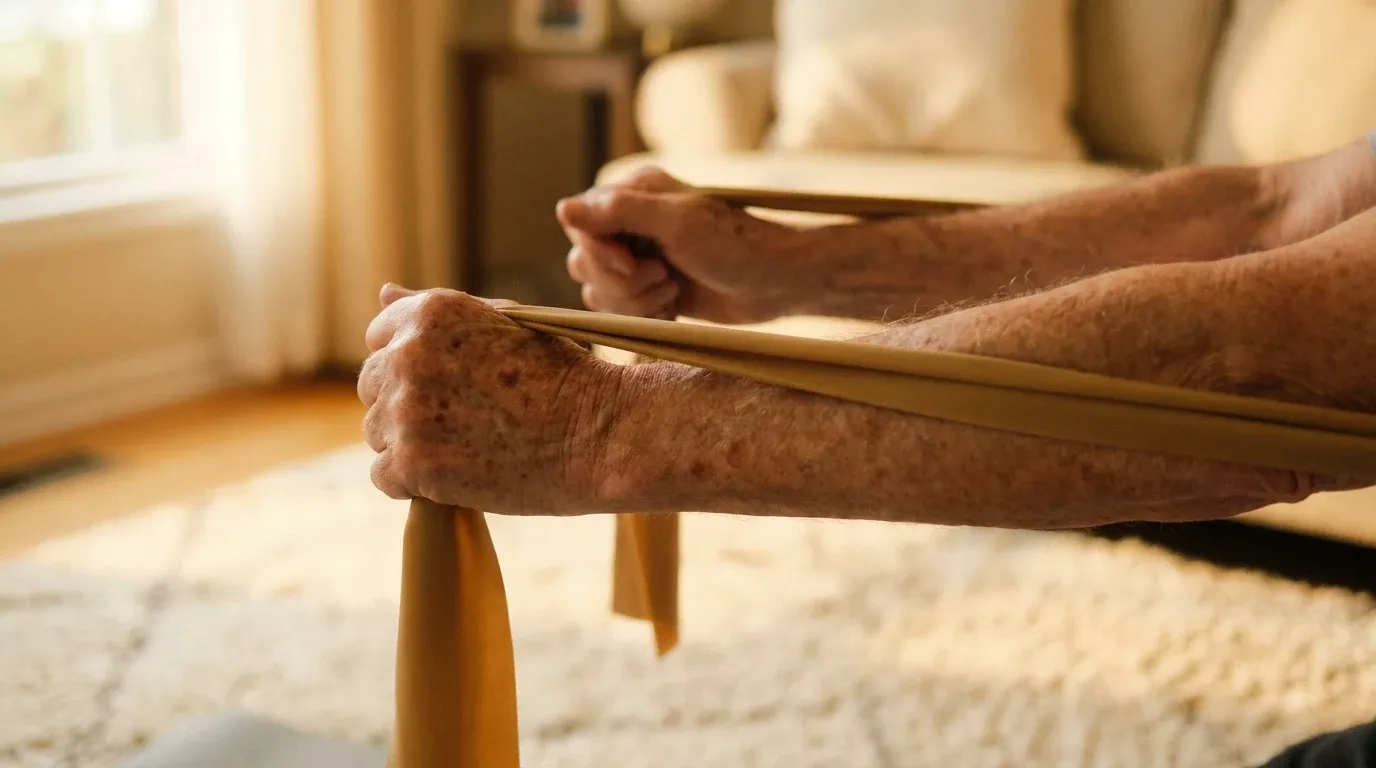
- Resistance bands: Bands allow for controlled loading with joint-friendly resistance curves. They're portable, affordable, and well-supported by clinical research in aging populations.
- Free weights and machines: Dumbbells, barbells, and cable machines offer the most precise progressive overload. If you have gym access, these remain excellent options.
- Functional compound movements: Exercises that mimic everyday tasks, like sit-to-stand patterns or carrying loads, tend to produce better real-world outcomes for older adults than isolated single-joint moves.
A practical once-weekly session might include four to six compound exercises, two to three sets each, at a load that feels challenging by the last few reps. The whole thing can be completed in 45 to 60 minutes. That's a manageable investment for most people.
Progressive overload still applies, even at once a week. You should aim to gradually increase the resistance, reps, or difficulty over time. Staying at the same weight indefinitely won't continue to produce results.
Why This Finding Matters for Coaches and Trainers
For fitness professionals, this research does something important. It gives you a defensible, evidence-based starting point for clients who are overwhelmed by what they think training has to look like.
A 65-year-old who hasn't exercised in years isn't going to respond well to a five-day-per-week training prescription. It feels impossible before they even try. One session per week, framed clearly and backed by science, is a genuinely achievable commitment. And achievable commitments get kept.
The coaching opportunity here isn't just about the workout itself. It's about shifting the narrative. Many older adults have internalized the belief that they've "missed their window" for strength training, or that their age makes meaningful improvement unlikely. The data contradicts that directly. For a deeper look at how to frame this conversation with aging clients, One Session a Week: What Coaches Should Tell Aging Clients offers a practical coaching framework built around this exact evidence.
There's also a broader wellness picture to consider. Clients who feel overwhelmed by exercise demands often struggle across multiple health behaviors simultaneously. When you lower the barrier in one area, compliance tends to improve elsewhere too. Sleep improves. Stress tolerance tends to go up. The minimum effective dose isn't a consolation prize. It's a strategic entry point.
If you're working with clients who are resistant to any kind of structured training, it's also worth exploring complementary practices that can layer in without adding major time demands. Research on isometric training, for instance, shows that two sessions of isometric work per week can produce meaningful reductions in blood pressure, making it a natural pairing with a once-weekly strength session for clients managing cardiovascular risk alongside muscle loss.
Lowering the Barrier Without Lowering the Standard
There's an important distinction between making fitness more accessible and making it less rigorous. One session per week is a starting point, not a ceiling. The goal for most clients should be to build gradually toward two or three sessions per week as their capacity and confidence grow. The research simply confirms that waiting until you can commit to that full volume isn't necessary. You can start now with less, and the results will still be real.
This is especially relevant for older adults who face practical constraints. Mobility limitations, chronic pain, caregiver responsibilities, and fixed incomes all create genuine friction. A session at home with a set of resistance bands that costs under $30 is a completely valid training environment. Access to a $100-per-month gym is not a prerequisite for fighting sarcopenia.
The research also reinforces why the mental and emotional dimensions of training matter so much. Weightlifting has been shown to significantly reduce depression symptoms in women, a finding that's particularly relevant when you consider how isolation and low motivation often compound physical decline in older adults. Strength training isn't just a physical intervention.
Building a Complete Picture of Healthy Aging
Resistance training is one piece of a larger puzzle. Sleep quality, nutrition, stress management, and recovery all interact with the muscle-preserving benefits of exercise. Adults who are sleep-deprived or chronically stressed will see reduced adaptation from their training, regardless of how often they train.
If you're helping clients build sustainable healthy aging habits, it's worth thinking about how all these elements fit together. Structuring a seasonal training plan is one way to give clients a concrete roadmap that accounts for changing energy levels, schedules, and goals across different times of year, rather than prescribing a static routine that doesn't flex with real life.
Nutrition also plays a critical supporting role. Adequate protein intake is essential for muscle protein synthesis, and the benefits of resistance training are significantly blunted without it. Older adults tend to under-consume protein relative to their needs, which makes dietary guidance a natural part of any sarcopenia-focused coaching plan.
Recovery, too, is underestimated. When training frequency is low, the quality of recovery between sessions becomes even more important. Poor sleep, chronic inflammation, and inadequate rest all compromise the adaptations you're working to build.
The Takeaway
One strength session per week is enough to produce meaningful protection against age-related muscle loss. That's not a compromise. That's the science. For older adults who've been putting off strength training because the commitment felt too large, this finding removes one of the most common barriers standing between them and better health.
For coaches, it's a powerful tool. When a client says they don't have time, you now have a credible, research-backed answer. One hour. Once a week. That's the starting line, and it's closer than most people think.