
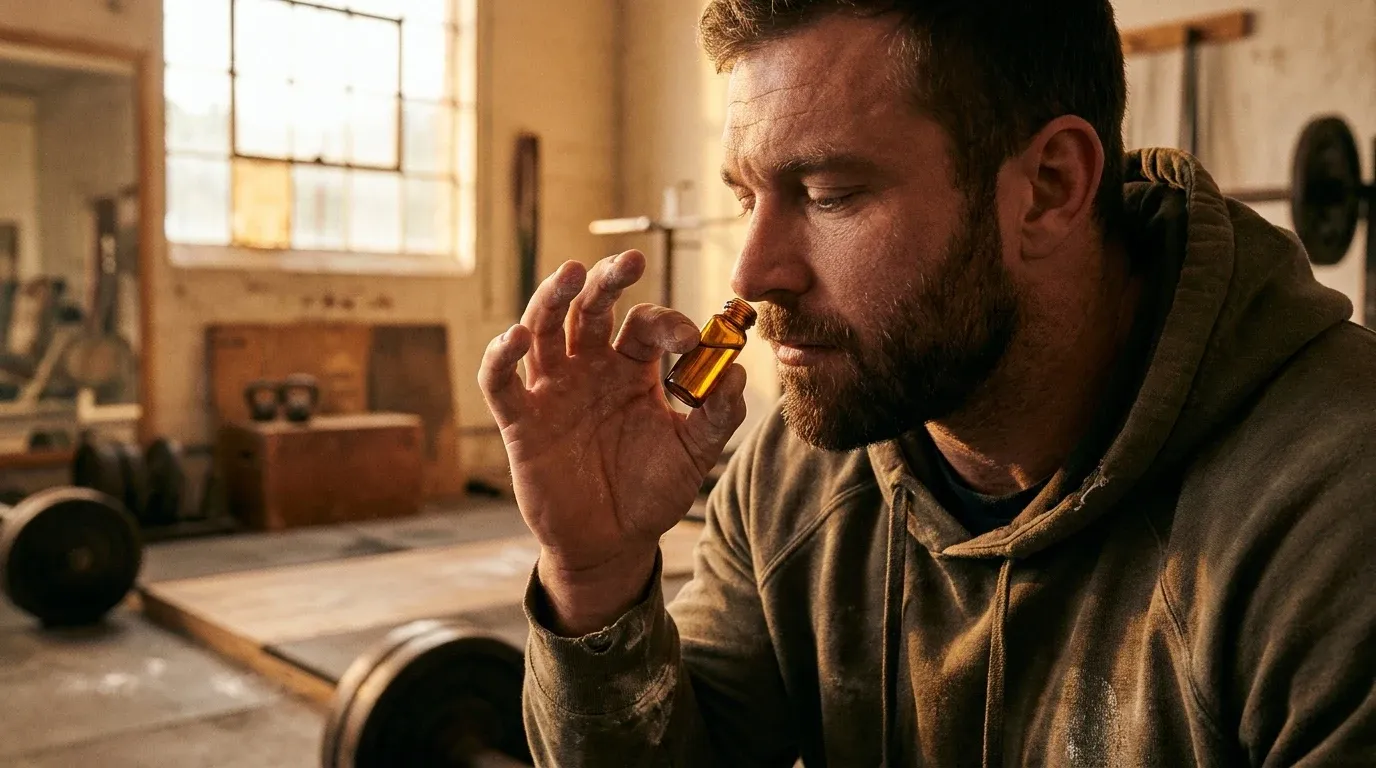
Most lifters walk into the gym, throw on a playlist, and hope the session clicks. Some days it does. Most days it's a grind. But what if the difference between a mediocre workout and a personal best had less to do with sleep or nutrition, and more to do with what your senses experienced in the fifteen minutes before your first set?
That's the premise behind sensory priming. And the science behind it is more concrete than you'd expect.
What the Chocolate Smell Study Actually Shows
Researchers studying the effects of olfactory cues on physical performance found that exposing participants to a chocolate aroma before and during exercise influenced their perception of effort. Subjects completed more repetitions before reaching failure and reported lower ratings of perceived exertion compared to a control group. The smell didn't change their muscles. It changed their brain's interpretation of the work being done.
The mechanism is rooted in reward circuitry. Certain sensory inputs, particularly pleasant or familiar scents, activate dopaminergic pathways that soften the brain's threat response to physical discomfort. When your nervous system perceives a situation as rewarding rather than purely threatening, it's more willing to sustain output before hitting the brakes.
This is significant because failure in a set is rarely true muscular failure. It's almost always neural. Your brain pulls the plug before your fibers are fully exhausted. Anything that shifts that threshold, even slightly, translates to more training volume and, over time, more adaptation.
Scent as a Pre-Workout Tool
Chocolate aroma is the headline, but the broader principle applies to any scent that your brain associates with reward, focus, or energy. Peppermint is the most studied alternative. Multiple trials have shown that inhaling peppermint essential oil before exercise improves grip strength, running performance, and ventilatory efficiency. The effect is modest but consistent.
How you apply this practically matters. Dabbing a few drops of peppermint oil on your wrist or under your nose during your warm-up is enough to trigger the effect. You're not trying to flood your olfactory system. You're giving your brain a signal that something good is about to happen.
Some lifters have also reported that simply associating a specific scent with training, used repeatedly over weeks, can create a conditioned response. The smell itself becomes a trigger that nudges the nervous system toward a ready state. That's basic Pavlovian conditioning applied to performance, and it's completely free.
Music: The BPM Threshold That Actually Matters
Music is the most widely used pre-workout sensory tool, but most people use it passively. They stream whatever's popular, let it shuffle, and treat it as background noise. That's leaving performance on the table.
Research is consistent on one number: 120 BPM. Tracks with a tempo at or above 120 beats per minute are associated with measurable increases in power output during resistance training, along with reductions in perceived exertion. The effect is strongest during compound lifts and high-intensity intervals, where psychological arousal has the most mechanical impact.
The reason is partly psychophysiological synchrony. Your body has a natural tendency to align its movement rhythms to external auditory cues, a phenomenon called entrainment. When your music tempo is pushing upward, your motor system follows. You move faster, with more force, without consciously deciding to.
Beyond tempo, the emotional valence of a track matters too. Songs you genuinely enjoy produce larger dopamine responses than technically similar music you're neutral toward. So don't build your gym playlist around what's supposed to be a pre-workout anthem. Build it around what actually gives you a visceral lift.
Practically, this means curating a dedicated lifting playlist of fifteen to twenty tracks, all above 120 BPM, that you genuinely respond to. Start it three to five minutes before your first working set. By the time you load the bar, your arousal state will already be elevated.
Visual Priming: Why What You Watch Before Lifting Matters
This is the most underused tool in the sensory priming toolkit. Before a session, most people scroll through social media, often consuming passive or negative content that does nothing for their performance state. Switching that habit is one of the highest-leverage changes you can make.
Studies using neuroimaging have shown that watching sport-specific or motivational video before physical performance activates regions associated with motor planning, action observation, and anticipatory arousal. In one line of research, subjects who watched video of skilled athletes performing the movement they were about to attempt showed improved early-set technique and higher initial output compared to those who watched neutral content.
This works through mirror neuron activation and motor simulation. When you watch someone squat, your brain is partly rehearsing the squat. The neural pathways responsible for that movement fire in preparation. When you actually step under the bar, you're not starting from zero. You've already run a mental preview.
For practical application, keep a short video library of two to three clips on your phone. They don't have to be elaborate. A twenty-second clip of a clean, heavy pull or an explosive set of squats from an athlete you respect is enough. Watch it immediately before your first working set, not an hour earlier. Timing matters here.
If you're working on a specific movement pattern, matching the video to that pattern amplifies the benefit. Struggling with glute activation and hip mechanics? Watching someone execute a perfect hip hinge before your session primes exactly the motor sequences you need.
The Compounding Effect of Combining Cues
Each sensory cue on its own produces a modest, real effect. But there's evidence that combining two or more cues doesn't just add their effects. It multiplies them. This is because the brain's readiness state is built from multiple parallel inputs simultaneously. When scent, sound, and vision all signal the same message, that signal becomes significantly harder to ignore.
Think of it as a pre-session protocol rather than a single trick. Here's what a combined sensory priming routine looks like in practice:
- 10 minutes out: Start your curated playlist at or above 120 BPM while traveling to or changing at the gym.
- 5 minutes out: Apply a performance-associated scent, peppermint oil on the wrist or in a small inhaler, during your movement prep.
- 90 seconds before your first working set: Watch one short clip of sport-specific or motivational video. No scrolling. Just the clip.
That three-step sequence takes almost no additional time and costs nothing. But it systematically raises your psychological readiness before you've touched a weight.
It's also worth noting what this approach is not. It's not a replacement for good programming, adequate rest between sets, sleep quality, or basic nutrition. Those are the foundation. Sensory priming works because it gives your brain the optimal conditions to express whatever physical capacity you've already built.
Why This Matters More Than Another Pre-Workout
The pre-workout supplement market is enormous, and stimulant-heavy products dominate it. Caffeine, beta-alanine, and high-dose niacin are the staples, and they do work, within limits. But they also come with tolerance curves, dependency risks, and a ceiling effect. You can't keep escalating stimulant load indefinitely.
Sensory priming has no tolerance curve. You can use the same peppermint inhaler, the same playlist curation strategy, and the same pre-session video ritual for years without the effect diminishing. If anything, the conditioned association strengthens over time as your brain reinforces the link between those cues and high-output performance.
For lifters who do use supplements like creatine, sensory priming stacks cleanly with them. If you're already familiar with the cognitive and physical performance research on creatine, you'll recognize that it operates on substrate availability, not psychological arousal. These are separate systems. You can optimize both independently.
And for those who prefer a fully supplement-free approach, sensory priming offers a legitimate, evidence-backed path to raising training quality without a single pill or scoop. That's not a minor point. Managing your psychological state before demanding physical work is one of the highest-leverage interventions available, and most athletes never deliberately engage with it.
Building Your Sensory Priming Stack
Here's a summary of the toolkit and how to build yours:
- Scent: Peppermint essential oil is the most evidence-backed option. Chocolate-associated or personally rewarding scents also work via the reward pathway. Apply during warm-up, not during the set.
- Music: Build a dedicated playlist above 120 BPM using tracks you genuinely respond to emotionally. Start it before you arrive at the station, not after. Keep it consistent so the conditioned response builds.
- Visual cue: Keep two to three short performance clips ready. Watch one immediately before your first heavy set. Match the movement to what you're training that day when possible.
- Timing: Layer the cues in the final ten minutes before your first working set. The closer to performance, the stronger the priming effect.
Your gym performance is partly physical and largely mental. You've probably spent years optimizing the physical side. The sensory environment you create around your sessions is a legitimate variable, and it's been sitting unused the whole time.
Start with one cue. Add a second after two weeks. By the time you're running all three, you'll notice the difference before you've even chalked your hands.