
Most lifters hit September with a vague sense of whether training is going well. They feel stronger, or they don't. They've been consistent, or they haven't. But feeling and knowing are different things, and Q4 is too valuable a training window to enter on instinct alone.
A simple battery of bodyweight benchmarks takes less than 20 minutes, costs nothing, and gives you a clearer picture of your actual fitness than three months of subjective gut checks. Here's how to run one, what the numbers mean, and how to use the results to structure your fall program.
Why Bodyweight Benchmarks Still Matter for Lifters
There's a tendency among gym-goers to dismiss bodyweight testing as too basic. If you're squatting 300 pounds, why does a push-up test tell you anything useful? The answer is that loaded strength and bodyweight capacity measure related but distinct qualities. One reflects what your nervous system and muscles can produce under external load. The other reflects how well you move and express force relative to your own body mass.
Gaps between the two are informative. A lifter who back squats heavy but struggles with single-leg squat variations has identified something worth addressing. A lifter who benches well but fades after 15 push-ups has a muscular endurance gap that can limit performance, and potentially health, more than they realize.
That last point isn't just gym logic. Research published in JAMA Network Open found that firefighters who could complete 40 or more push-ups in a single set had a significantly lower risk of cardiovascular events over a 10-year follow-up compared to those who could manage fewer than 10. The test wasn't a cardiac stress test or a VO2 max assessment. It was 40 push-ups on the floor. That kind of data makes a strong case for treating basic bodyweight benchmarks seriously, regardless of how much you lift.
The Push-Up Test: Upper Body and Cardiovascular Baseline
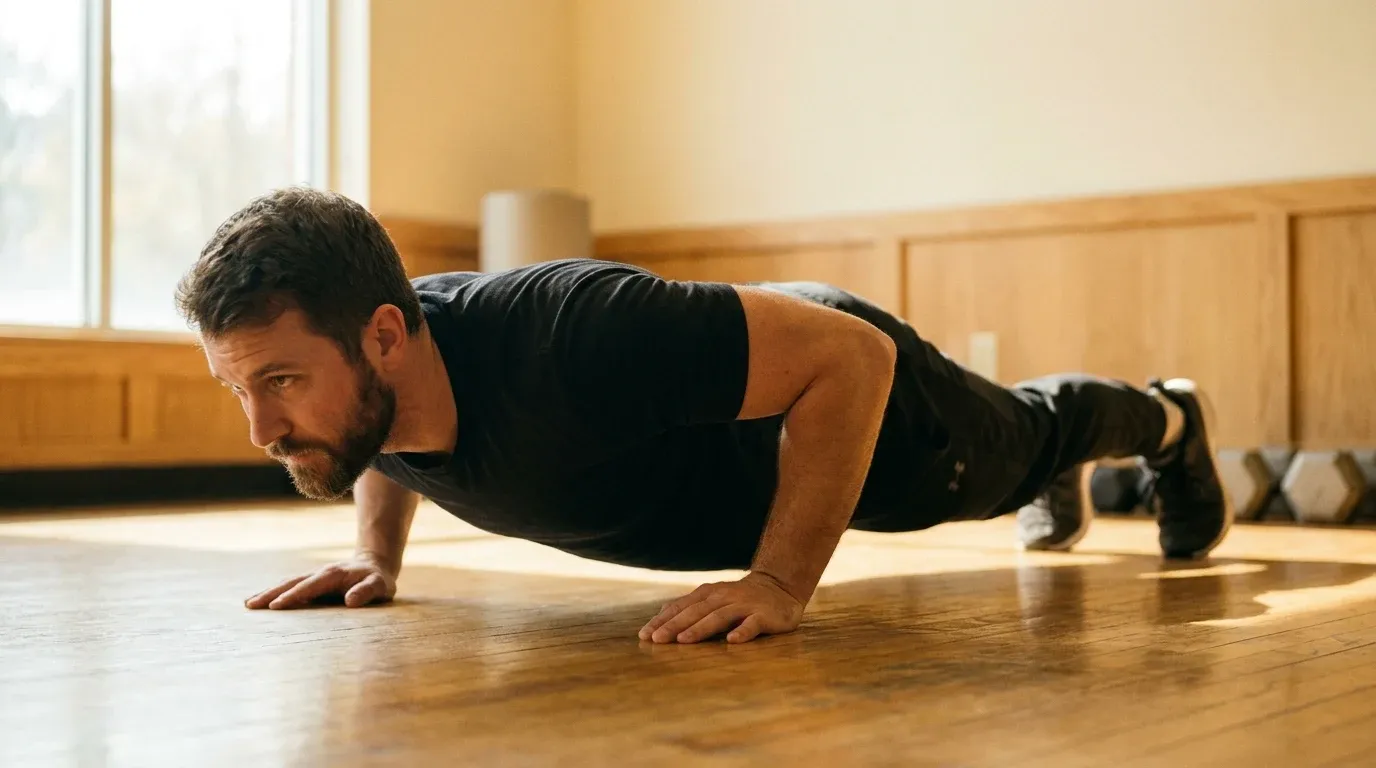
The push-up test is the single most efficient benchmark you can run. No equipment, no warm-up beyond a few shoulder rolls, no need for a spotter. Set a timer, get into a full plank position with hands just outside shoulder width, and do as many clean reps as possible without stopping. Full chest to floor, full lockout at the top, no sagging hips.
General benchmarks by age group (men):
- 20s: Below 25 is below average. 25 to 39 is average. 40 or more is strong.
- 30s: Below 20 is below average. 20 to 34 is average. 35 or more is strong.
- 40s: Below 15 is below average. 15 to 24 is average. 25 or more is strong.
General benchmarks by age group (women):
- 20s: Below 15 is below average. 15 to 29 is average. 30 or more is strong.
- 30s: Below 12 is below average. 12 to 24 is average. 25 or more is strong.
- 40s: Below 10 is below average. 10 to 19 is average. 20 or more is strong.
If you're landing in below-average territory, that's data, not a verdict. It tells you that horizontal pushing endurance and scapular stability deserve a dedicated place in your Q4 programming. If you're already in the strong range, you're maintaining, not building, in that category for now.
The Squat Test: Lower Body Depth and Control
The squat benchmark isn't about load. It's about the quality of your movement pattern at bodyweight, which sets the ceiling for how well you'll tolerate load as training intensity builds through October and November.
For the test: stand with feet shoulder-width apart, toes turned out slightly, arms crossed or extended forward for balance. Squat as deep as you can with control, heels staying flat on the floor, knees tracking over toes, chest staying relatively upright. Hold the bottom position for two seconds, then stand.
What you're assessing:
- Depth: Can you hit parallel or below with heels flat? If not, you have ankle mobility or hip flexor restrictions worth addressing before adding load.
- Knee tracking: Do your knees cave inward at the bottom? That's a glute medius and hip abductor issue, common and correctable.
- Torso angle: Excessive forward lean under bodyweight suggests limited thoracic mobility or quad dominance relative to your posterior chain.
For a capacity element, count how many controlled bodyweight squats you can perform in 60 seconds with genuine depth. Fewer than 20 for most adults under 50 suggests conditioning work is needed. Above 35 with clean form indicates solid lower body endurance as a foundation.
The Hinge Test: Posterior Chain Readiness
The hinge pattern, the movement behind deadlifts, Romanian deadlifts, and kettlebell swings, is where many lifters have the largest hidden deficit. You can squat adequately and push well but still have a posterior chain that's lagging, which shows up as lower back fatigue during compound lifts, limited pulling power, and a higher injury risk heading into heavier Q4 training blocks.
Test it with a single-leg Romanian deadlift to touch. Stand on one leg, hinge forward keeping the back flat, and reach your opposite hand toward the floor. A reasonable benchmark is touching within six inches of the floor without losing spinal neutrality, rounding the back, or losing balance in under three attempts. Most people are surprised how this exposes asymmetries between left and right sides that bilateral deadlifts completely mask.
If you're falling forward, losing your back position early, or finding a significant difference between sides, that's your Q4 priority signal. The hinge pattern should be trained as a skill before it's trained for load.
Adding a Recovery Layer to Your Snapshot
Benchmarks measure output. Recovery capacity determines how quickly you can repeat that output across a training week. If your push-up and squat numbers are solid but you're consistently sore for four or five days after moderate sessions, or your sleep quality is poor, or you're training hard without seeing progress, recovery is the variable that needs attention.
Practical recovery tools have legitimate evidence behind them. Tart cherry juice has real research support as a recovery aid, including reductions in delayed onset muscle soreness and markers of inflammation following intense training. It's not a replacement for sleep and nutrition, but it's one of the few supplemental tools that earns its place in a well-structured program.
Similarly, if you use pre-workout nutrition to support your benchmark testing or your regular training sessions, the quality of those compounds matters. Understanding what's actually in your pre-workout, versus what's just marketing language, saves money and sets realistic expectations for what supplementation can and can't do for performance.
Using Your Results to Build a Q4 Program
Once you have scores across all three benchmarks, the programming logic is straightforward: train your deficits harder, maintain your strengths with lower volume, and don't try to bring everything up simultaneously.
If your push-up capacity is below average but your squat and hinge benchmarks are solid, your Q4 template might look like this:
- Two dedicated upper body sessions per week with push-up volume built in across sets
- One lower body strength session maintaining squat and hinge quality without adding significant volume
- One full-body session to integrate patterns under load
If your hinge is the weak link, the reverse applies. More posterior chain work, more single-leg and unilateral hinge variations, and a temporary reduction in heavy squat volume to give the body bandwidth to adapt.
The key principle is specificity. General fitness programs treat everyone identically. Your benchmark data lets you treat yourself like an individual with specific gaps, which is what actually produces progress.
If you're unsure how to translate your results into a coherent training structure, working with a qualified coach for even a short block can accelerate the process considerably. A good coach does more than write sets and reps. They read how you're responding week to week and adjust before plateaus or injuries develop. If you're considering that route, it's worth understanding what a professional coaching relationship actually looks like in practice before committing. Knowing the green flags and red flags when hiring a trainer protects your investment and your progress.
The Honest Bottom Line
September benchmarks aren't about scoring perfectly. They're about replacing vague impressions with actual information. If you hit all three tests and land in strong ranges across the board, you know Q4 can be focused on progressive overload and performance. If you find weak links, you've done something most lifters never do: identified exactly where your training needs to go next.
Twenty minutes of honest self-assessment is worth more than three months of training based on a feeling. Run the tests. Look at the numbers. Let the data drive the plan.