
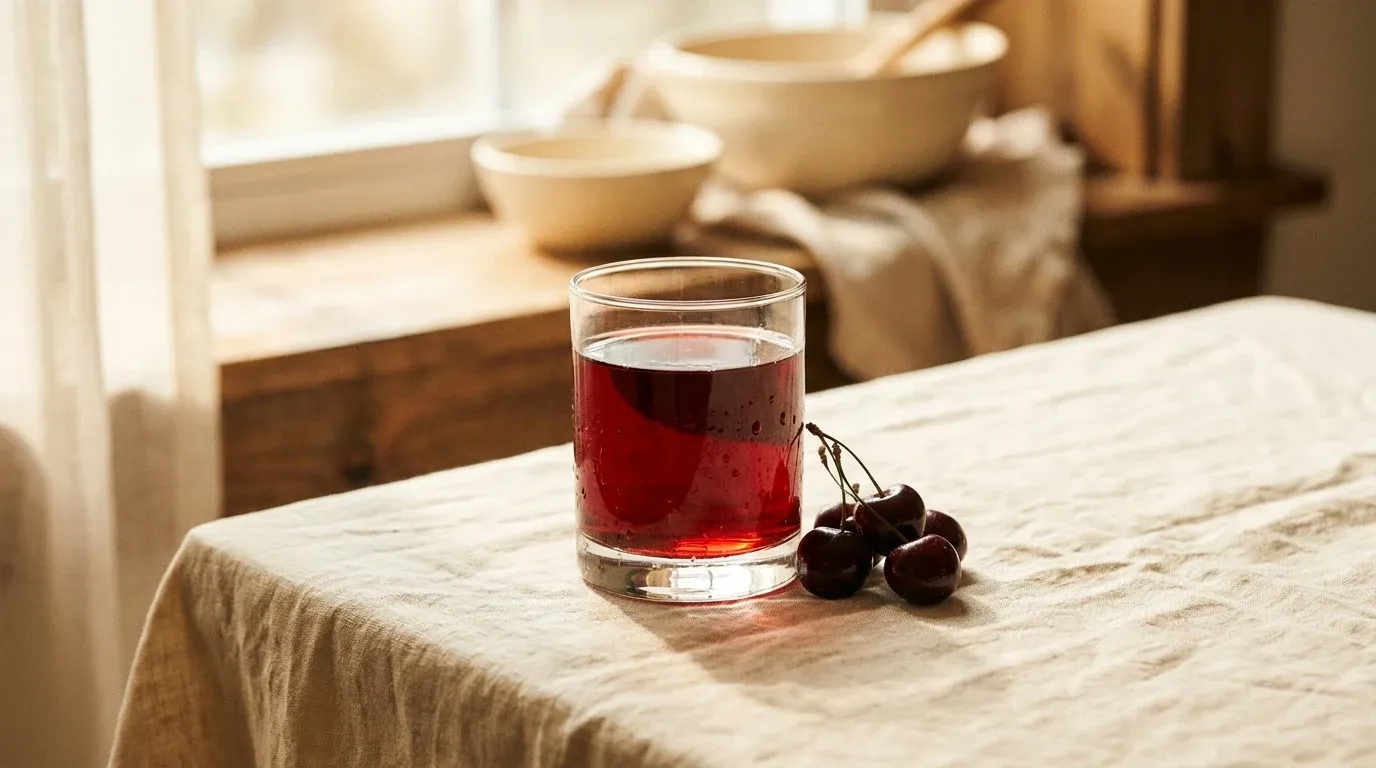
The recovery supplement market is built on promising more than it delivers. Compression sleeves, BCAAs, cryotherapy chambers, peptide blends. Most of them struggle to outperform a decent night's sleep once researchers put them through rigorous trials. Tart cherry juice is a genuine exception to that pattern, and the evidence behind it is specific enough to be useful.
This isn't a "promising preliminary findings" situation. It's a body of research that has held up across multiple independent labs, in different athlete populations, using different training protocols. That consistency matters more than any single study ever could.
What Makes Tart Cherry Juice Different
The active compounds responsible for tart cherry's effects are anthocyanins. These are the pigments that give Montmorency cherries their deep red color, and they do something pharmacologically interesting: they inhibit the same inflammatory pathways targeted by NSAIDs like ibuprofen.
Specifically, anthocyanins suppress COX-1 and COX-2 enzyme activity. That's the same mechanism ibuprofen uses to reduce inflammation and pain. The practical difference is that regular ibuprofen use carries a well-documented risk of gastrointestinal damage, including gastric ulceration with prolonged use. Tart cherry doesn't carry that burden. You're getting a meaningful anti-inflammatory effect without the tradeoffs that make frequent NSAID use a concern for high-volume athletes.
The research shows reductions in creatine kinase and C-reactive protein, both standard markers of muscle damage and systemic inflammation, in subjects who consumed tart cherry concentrate around periods of intense training. These aren't trivial numbers. Some trials have recorded soreness reductions of 20 to 30 percent compared to placebo groups doing identical workouts.
The Protocol That Matches the Evidence
Here's where a lot of people go wrong: they buy a bottle, drink some after a hard session, and wonder why they don't notice much. Timing and dose matter significantly with tart cherry, and the research is clear on both.
The evidence-backed protocol looks like this:
- Dose: 250 to 350ml of tart cherry concentrate twice daily. Not diluted juice. Concentrate. The polyphenol content in standard juice is too low to replicate what the trials actually used.
- Timing: Start two days before a hard training block or competition. Continue through the event and for three to four days after.
- Frequency: Twice daily, morning and evening, keeps blood levels of anthocyanins more stable across the day.
The front-loading period is critical. Anthocyanins need time to build up in tissue and begin modulating inflammatory response. Starting the morning of a hard session gives you almost nothing. Starting 48 hours out gives your body a working buffer.
Concentrate is the key purchasing decision here. Quality products typically run $25 to $40 for a bottle that covers a five to seven day protocol. That's a reasonable cost compared to most supplements with far weaker evidence behind them.
What the Research Actually Shows
Multiple randomized controlled trials have looked at tart cherry in distance runners, strength athletes, and team sport players. The findings cluster consistently around three outcomes: reduced muscle soreness in the 24 to 72-hour window post-exercise, lower inflammatory biomarkers in blood samples, and faster recovery of muscle function.
That last point is worth emphasizing. Reduced soreness is subjective and relatively easy to produce with placebo effects. Faster recovery of strength and power output is measurable and objective. Trials using isokinetic dynamometry, which directly measures force production, have shown meaningful differences in recovery trajectories between tart cherry and placebo groups.
One of the more compelling angles in this research is sleep quality. Tart cherries are a natural source of melatonin and tryptophan. Several studies have recorded improvements in sleep duration and efficiency in subjects using the supplement during recovery periods. Given how central sleep is to physical recovery, this secondary effect adds practical value beyond the direct anti-inflammatory mechanism. If you're already thinking carefully about sleep quality as part of your recovery stack, it's worth reading about how treating insomnia connects to broader daytime function outcomes.
How It Compares to Other Popular Recovery Tools
The recovery supplement landscape tends to operate on hype cycles. Something gets popular, a wave of low-quality studies follows, and the nuanced picture gets buried. It's worth being direct about what the evidence actually shows for the tools that get compared to tart cherry most often.
BCAAs. A September 2026 investigation by National Geographic reviewed the controlled trial literature on BCAAs and found no meaningful advantage over placebo in well-controlled settings. The protein synthesis argument depends heavily on total daily protein intake already being insufficient, which isn't the situation for most people following a structured training program.
Electrical muscle stimulation devices for recovery show a similar pattern: popular, marketed aggressively, and largely indistinguishable from sham treatments when blinding is done properly. The same National Geographic investigation flagged EMS recovery devices alongside BCAAs as products that consistently fail to outperform placebo under rigorous conditions.
This is worth knowing because it reflects a broader pattern. As the gap between ingredient testing and real-world supplement results shows, a compound performing well in isolation doesn't guarantee the finished product delivers the same effect. Tart cherry concentrate side-steps much of this problem because the active compounds are well-characterized and the whole-food matrix that delivers them is relatively stable.
Cold Water Immersion: The Comparison That Matters Most
Cold water immersion deserves separate treatment because it's genuinely effective at reducing soreness, which makes it seem like a direct alternative to tart cherry. But the two tools have different effects on adaptation, and that distinction is significant for anyone training with muscle-building goals.
The concern with cold water immersion is specific: when used immediately after resistance training sessions, it appears to blunt the signaling pathways involved in muscle protein synthesis. The inflammatory response that CWI suppresses is the same one that drives hypertrophic adaptation. Suppress it consistently and you may recover faster in the short term while making slower structural gains over months.
Tart cherry doesn't appear to interfere with this process. The anti-inflammatory effect is meaningful but not so aggressive that it shuts down the anabolic signaling your muscles need to grow. That makes it compatible with strength and hypertrophy goals in a way that regular post-lifting ice baths may not be. If you want to think through the cold plunge question more carefully, the evidence on cold plunge after training as either a recovery tool or a gains killer lays out the current research in useful detail.
This doesn't mean CWI has no place. For endurance athletes, for recovery between competition days, or for periods when soreness management is more important than hypertrophy, it's a legitimate tool. The point is that tart cherry doesn't force the same tradeoff.
How to Fit This Into a Broader Recovery Strategy
Tart cherry works best as one component of a recovery approach that also prioritizes sleep, adequate protein, training load management, and movement quality. It's not a replacement for any of those. It's an addition with a specific and relatively narrow function: reducing the inflammatory load after hard training.
Athletes who tend to benefit most are those doing high-volume blocks, back-to-back competition days, or transitioning into a significantly harder phase of training. It's also worth considering when you know you're going into a period where soreness will affect your ability to train consistently, since showing up to sessions with manageable legs matters more than any single workout optimization.
If you're working with a coach to structure training phases, complementary disciplines like those explored in why serious lifters are adding Pilates in 2026 can reduce the total inflammatory burden on the body by improving movement quality and reducing compensatory patterns, which lowers injury risk without any supplementation at all.
What to Buy and What to Avoid
Look for 100 percent Montmorency tart cherry concentrate with no added sugars. The label should list tart cherry as the only ingredient. Avoid products that blend sweet cherry with tart cherry, which dilutes the anthocyanin content significantly.
Capsule versions exist and some trials have used them successfully, but the liquid concentrate has the most consistent research behind it. If you're traveling or prefer capsules for convenience, look for products standardized to a specific anthocyanin content per serving rather than just listing cherry powder.
Store the concentrate refrigerated after opening. Anthocyanins degrade with heat and light exposure, so glass bottles stored properly outperform plastic kept at room temperature over time.
Tart cherry juice won't transform your recovery overnight. But it's one of the few supplements where the underlying science, the trial results, and the practical protocol all point in the same direction. For a category where that alignment is genuinely rare, that's worth taking seriously.