
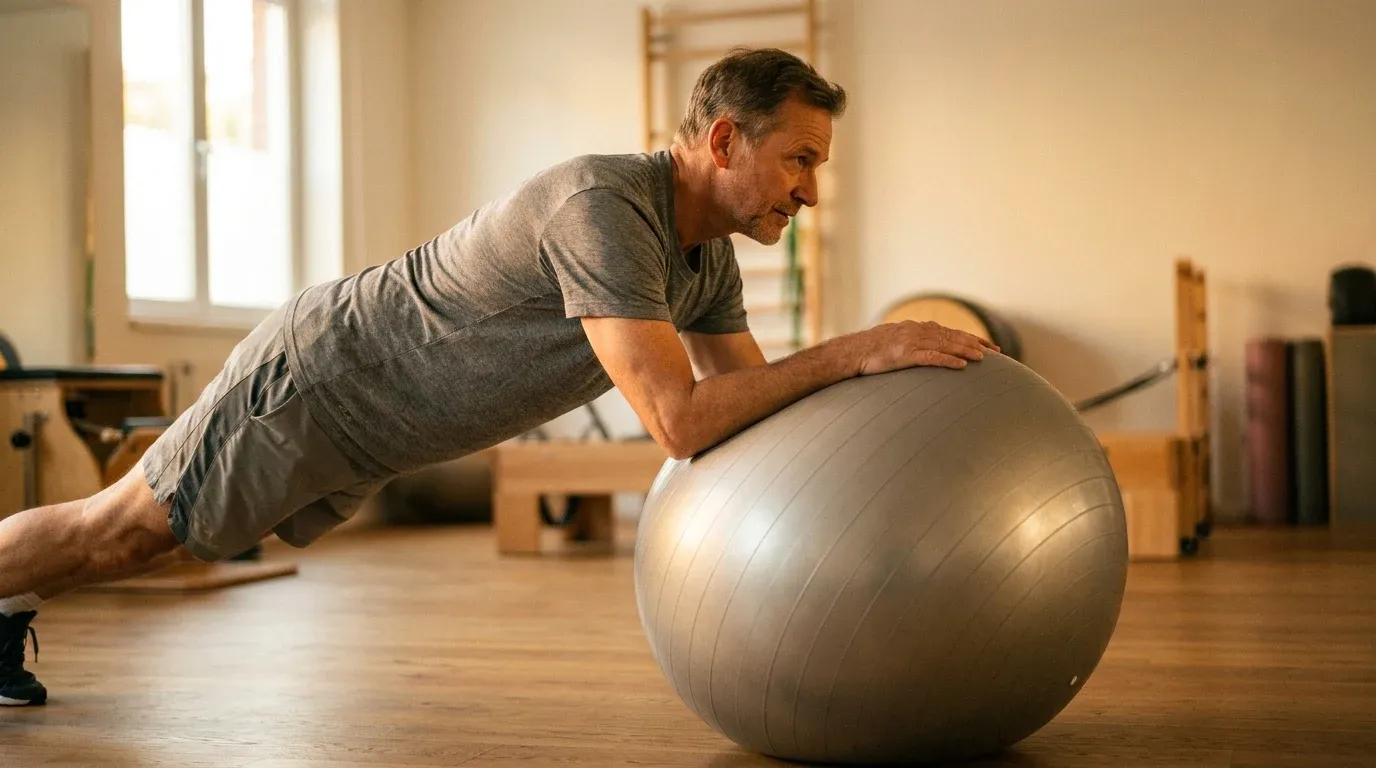
If you're over 50 and still grinding out sets of floor crunches, you're not just wasting time. You're training the wrong muscles entirely. The surface-level abs that crunches target look good in theory, but they do almost nothing to protect your spine, improve your balance, or fight the kind of muscle loss that quietly accelerates after your fifth decade.
There's a better tool sitting in the corner of most gyms, often ignored by anyone who isn't a physical therapist: the stability ball. Used correctly, it forces your deep core to engage in ways a mat or a bench never will. And for men over 50, that distinction matters more than most people realize.
Why Deep Core Training Changes After 50
Your core isn't just your abs. It's a system of muscles that includes the transverse abdominis, the multifidus along your spine, the diaphragm, and the pelvic floor. These muscles work together to stabilize your spine under load, absorb impact, and transfer force between your upper and lower body.
The problem is that aging quietly erodes all of it. Sarcopenia, the gradual loss of muscle mass that begins around age 35 and accelerates after 50, hits stabilizing muscles just as hard as the bigger prime movers. Research published in sports medicine literature consistently shows that men over 50 lose between 1 and 2 percent of muscle mass per year without intervention. The deep core, because it's rarely trained directly, tends to deteriorate faster than most people notice.
Surface crunches train the rectus abdominis, the "six-pack" muscle. That's a flexion movement. But everyday life and athletic performance demand anti-rotation, anti-extension, and lateral stability. Those are the patterns your deep core is built for, and those are the patterns a stability ball trains exceptionally well.
If you're looking to combine this kind of targeted core work with a broader strength-building strategy, the principles behind Progressive Overload: The One Principle That Drives Gains apply directly to stability training, even when the weights are light or absent.
What the Research Says About Reversing Frailty
Frailty isn't just about being weak. Clinically, it's defined by a cluster of markers: reduced grip strength, slower walking speed, unintentional weight loss, low physical activity, and exhaustion. Once frailty sets in, the risk of falls, hospitalizations, and loss of independence rises sharply.
The good news is that it's reversible. A growing body of research confirms that the most effective approach for older adults combines three elements: aerobic exercise, resistance training, and balance work. Not one or two. All three. Studies tracking adults over 60 show that programs integrating balance-focused resistance training reduce fall risk by up to 34 percent compared to resistance training alone.
That's exactly where stability ball training earns its place. It's resistance work that inherently demands balance. Every rep recruits the stabilizers that keep you upright on uneven ground, catch you when you slip, and absorb the shock of an awkward step. You're not just building strength. You're building the neuromuscular coordination that keeps you functional.
Pairing this kind of training with proper nutrition compounds the results significantly. The research on lifting and eating strategically after 50 shows that protein timing and adequate caloric intake are essential for making any resistance program actually stick.
4 Stability Ball Exercises Your Deep Core Actually Needs
These four movements were selected based on recommendations from elite-level strength coaches who specialize in training men over 50. They range from foundational to moderately challenging, and each one targets a different deep core demand. Start with two sets of each and build from there.
1. Stability Ball Dead Bug
This is the foundational movement. Lie on your back, press a stability ball between your hands and knees with your hips and knees bent at 90 degrees. Brace your core hard, then slowly lower one heel toward the floor while simultaneously pressing your hands into the ball and resisting any rotation or arch in your lower back.
The ball forces your arms and legs to work against each other, creating intense co-contraction through the transverse abdominis and multifidus. This is anti-extension training in its most controlled form. Aim for 8 to 10 reps per side, moving slowly and breathing throughout. If your lower back lifts off the floor, you've gone too far.
2. Ball Rollout
Kneel on a mat with the stability ball in front of you. Place your forearms on the ball and, keeping your body in a rigid plank position, slowly roll the ball forward by extending your arms. Roll as far as you can without losing the neutral spine position, then pull back in using your core, not momentum.
This is one of the most demanding anti-extension exercises available, and the ball's unstable surface amplifies the demand on every stabilizing muscle from your lats to your hip flexors. Research has shown this movement produces significantly higher activation in the rectus abdominis and obliques than a standard crunch, while also recruiting the deep stabilizers that crunches miss entirely. Start with a short range of motion and extend it only as your control improves.
3. Stability Ball Stir the Pot
Set up in the same starting position as the rollout: forearms on the ball, body in a plank. Instead of rolling forward, make small, controlled circles with your forearms, as if stirring a pot. Go slowly in one direction for 6 to 8 circles, then reverse.
The circular motion creates rotational and lateral instability that your core has to constantly resist. This is where the deep rotators and lateral stabilizers get directly challenged. It looks deceptively easy. Within a few circles, you'll know otherwise. Keep your hips level, your glutes engaged, and your breathing steady.
4. Ball Wall Squat With Isometric Hold
Place the stability ball between your lower back and a wall. Walk your feet forward about 18 inches, then squat down until your thighs are parallel to the floor. Hold the bottom position for 3 to 5 seconds before pressing back up.
This movement addresses something the other three don't: the connection between core stability and lower-body strength under load. The ball creates constant feedback, rolling slightly when your posture shifts, which forces your deep core and spinal erectors to maintain alignment throughout the movement. The isometric hold at the bottom raises the muscular demand significantly without adding any weight. For men over 50 with knee or hip concerns, this is often more accessible than a free-standing squat while still delivering a real training stimulus.
Building a Routine That Sticks
These four exercises work best when you treat them as a dedicated core block two to three times per week, rather than an afterthought at the end of a session. Ten to fifteen minutes done consistently will outperform a 45-minute core workout done sporadically.
Progression matters here. Once the dead bug and rollout feel controlled, increase the range of motion. On the stir the pot, increase circle size before adding reps. On the wall squat, increase the hold duration or reduce the ball size slightly to raise the balance demand. If you want a broader framework for how to apply progressive overload across your entire training approach, 5 Ways to Actually Build Muscle at Home covers several accessible methods that pair well with stability work.
It's also worth noting that core stability doesn't exist in isolation. Sleep quality, stress management, and recovery all affect how well your neuromuscular system responds to training. Men over 50 often underestimate how much stress and poor sleep undermine their progress. The sleep and stress strategies that support metabolic health are as relevant to your training results as the exercises themselves.
The Bigger Picture on Core Strength After 50
Here's what's at stake. Muscle mass naturally declines as you age. That's not a failure. It's biology. But the rate and consequences of that decline are largely within your control. A strong, functional deep core keeps you lifting, moving, and doing the things you care about for years longer than neglecting it will.
The stability ball isn't a gimmick. In the right hands, with the right programming, it's a direct line to the muscles that protect your spine, stabilize your pelvis, and coordinate your entire body. For men over 50, that's not a nice bonus. That's the whole point.
If you want to expand this approach beyond core-specific work, the emerging hybrid training models covered in Pilates Meets Lifting: the Hybrid Format Taking Over Gyms blend stability, mobility, and resistance in ways that align well with exactly what this demographic needs.
Start with two sessions this week. Pick two of the four movements and do them well. Add the others when you're ready. Consistency at a moderate level will always beat intensity you can't sustain.