

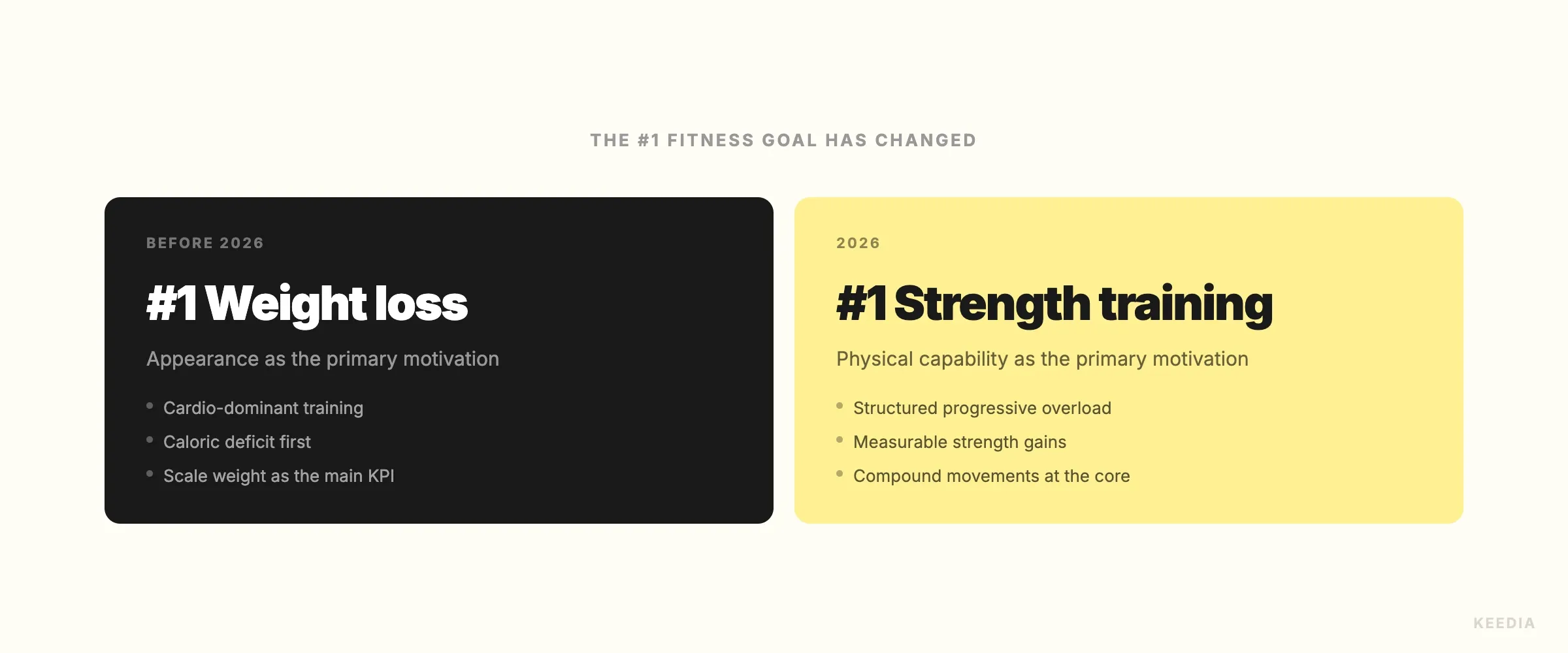
For decades, the most common reason Americans walked into a gym was to lose weight. That's no longer true. For the first time, strength training has overtaken weight loss as the number one fitness priority among US consumers heading into 2026. It's a small statistical shift on paper. It's a significant cultural one in practice.
Key Takeaways
- Strength training has passed weight loss as the #1 fitness goal in America
- Google searches for 'strength training' have doubled in 5 years
- The global fitness market exceeds $96 billion in 2026
The data comes from consumer surveys tracking fitness intentions for 2026, and it's been reinforced by industry research from the American College of Sports Medicine, which ranks strength training and functional movement among the top fitness trends of the year. This isn't a niche movement. It's a mainstream behavioral shift, and it's already changing how gyms are programmed, what equipment sells, and what coaches are being hired to do.
From Looking Thin to Being Capable
The framing matters here. People aren't just choosing a different type of workout. They're choosing a different definition of success. Where "getting fit" once meant shrinking. it now increasingly means getting stronger, moving better, and maintaining physical capability over time.
This reframing shows up clearly on social media, where the cultural ideal has shifted from thinness toward visible strength. Fitness content built around compound lifts, progressive overload, and functional movement has dominated engagement across platforms. The aspiration is no longer the smallest version of yourself. It's a capable, durable one.
The Washington Post and NPR both covered this trend in March 2026, which signals something important: this conversation has moved well beyond fitness media. When mainstream outlets report on a shift in how Americans train, it's because the change is broad enough to reach people who don't already identify as gym-goers.
Three Forces Accelerating the Shift
Several converging trends explain why strength training is rising now, and why the shift feels durable rather than cyclical.
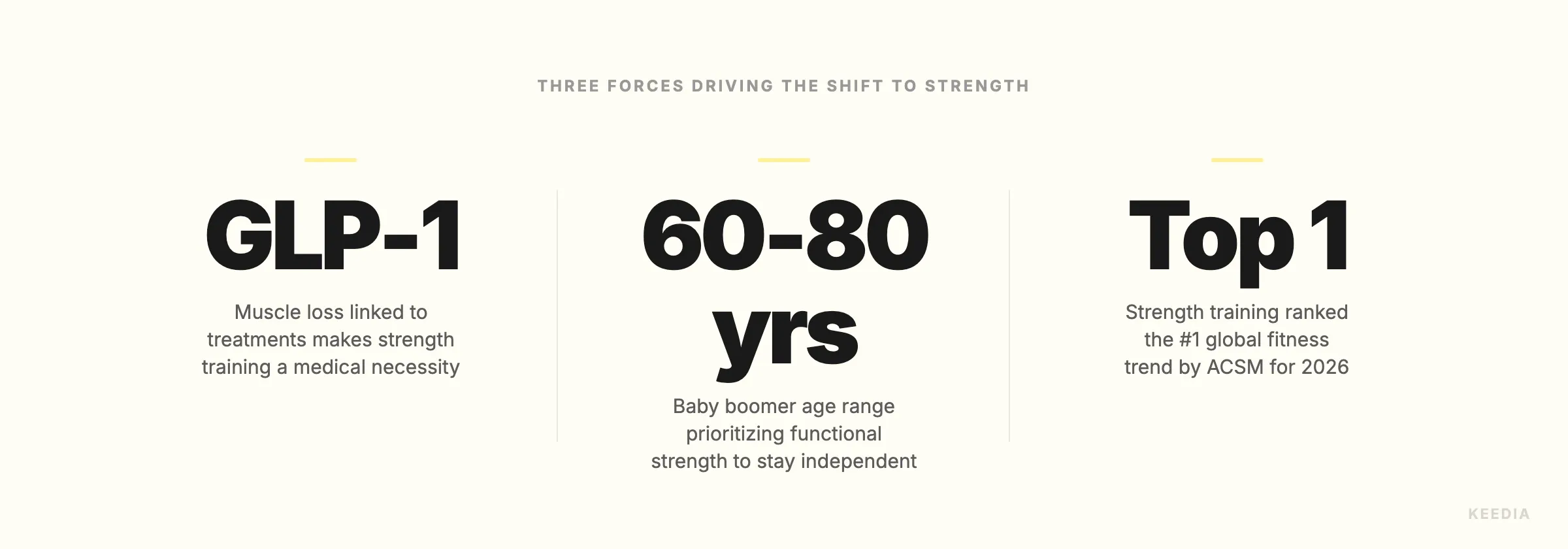
GLP-1 drugs and muscle preservation. The rapid adoption of GLP-1 medications for weight loss has created an unintended side effect: heightened awareness of muscle loss. Users and clinicians alike have flagged that aggressive caloric restriction without resistance training leads to significant lean mass loss. Research on GLP-1 drugs and muscle loss in 2026 confirms that resistance training is increasingly recommended as a non-negotiable complement to these medications. That clinical conversation has filtered into consumer behavior. People on GLP-1s are asking their coaches and trainers about strength work specifically because they've been told their muscle mass is at risk.
Aging demographics. Baby boomers are now in their 60s and 70s, and the fitness priorities of this cohort are fundamentally different from those of younger generations. Functional strength, fall prevention, bone density, and maintaining independence are the goals. These are not aesthetic concerns. They are health and quality-of-life concerns. As this demographic becomes a larger share of the active fitness market, the aggregate data on "top fitness goals" moves with them.
Shifting social norms. Younger generations, particularly women, have embraced strength training at rates that would have seemed unlikely a decade ago. The cultural permission to train heavy, build visible muscle, and prioritize performance over appearance has expanded significantly. This isn't just anecdotal. It shows up in equipment sales, gym membership patterns, and the growth of strength-focused programming across commercial gym chains.
What the Industry Data Confirms
The ACSM's annual fitness trends report is one of the most closely watched indicators in the industry, drawing on surveys of thousands of fitness professionals globally. For 2026, strength training and functional movement consistently appear near the top of the rankings. This matters because the ACSM data reflects what trainers, gym owners, and program designers are actually seeing in demand, not just what consumers say in a survey.
The industry infrastructure is responding. Equipment manufacturers have reported strong growth in free weight and functional training categories. Commercial gyms are expanding their strength training floor space. Programming that once centered on group cardio is being redesigned around barbell and resistance work.
If you want a broader view of how the fitness industry is orienting around this shift, the HFA Show 2026 in San Diego offered a clear read on where 10,000 fitness professionals see the market heading.
What This Means If You're Coaching or Running a Gym
The practical implications for coaches and gym owners are direct. Clients are arriving with more specific expectations than they had five years ago. They're not just asking to "get in shape." They're asking for structured progressive overload, measurable strength benchmarks, and guidance on compound movements like squats, deadlifts, and pressing patterns.
That's a different client to serve. It requires coaches who can assess movement quality, program intelligently across training blocks, and track performance metrics that go beyond the scale. Measuring client progress beyond weight and performance numbers has become a more relevant skill set as clients increasingly define success in terms of what they can do, not what they weigh.
For trainers building their practice around strength, understanding the minimum effective dose for real strength progress is essential. Not every client has time for five days a week in the gym. Knowing how to structure meaningful strength development within realistic training frequencies is a competitive differentiator right now.
Gym pricing and program structures are also shifting. Strength-focused coaching, whether in-person or hybrid, typically commands higher rates than general conditioning or cardio-based classes. Specialty strength programs at established gyms in major US markets are running anywhere from $150 to $350 per month depending on format and coaching access. Personal training packages built around progressive strength programming are pricing at a premium over general fitness packages in most markets.
The Bigger Picture
Strength training's rise isn't happening in isolation. It's connected to a broader shift in how people think about health, aging, and physical capability. Training for longevity, training to preserve muscle mass, training to stay functional into older age. these are the motivations showing up more and more in intake forms, consults, and gym membership surveys.
It's also worth noting that strength training doesn't operate independently of recovery, sleep, or nutrition. Recovery strategies become more important, not less, as training intensity increases. Coaches who address strength work as part of a complete system, including how clients sleep, eat, and manage fatigue, are better positioned to deliver results that last.
The shift from weight loss to strength as America's top fitness goal isn't just a data point. It reflects a change in what people believe fitness is actually for. That's the kind of shift that doesn't reverse quickly. And for the coaches, gyms, and brands paying attention, it's already defining what the next chapter of the fitness industry looks like.
Related articles
- Strength Training Overtakes Weight Loss as America's Top Fitness Goal
- Strength Training Overtakes Weight Loss as America's Top Fitness Goal
- Strength Training Is America's #1 Fitness Goal for 2026. Coaches Who Get This Are Winning