
For years, Whoop has owned a very specific corner of the fitness wearable market: the athlete who doesn't need a screen, just wants clean recovery data, and is willing to pay a monthly fee to get it. That model has worked. Whoop reportedly crossed 1 million active subscribers, generating reliable recurring revenue while keeping hardware costs low. But a leaked Suunto device suggests that formula may be about to face its most direct challenge yet.
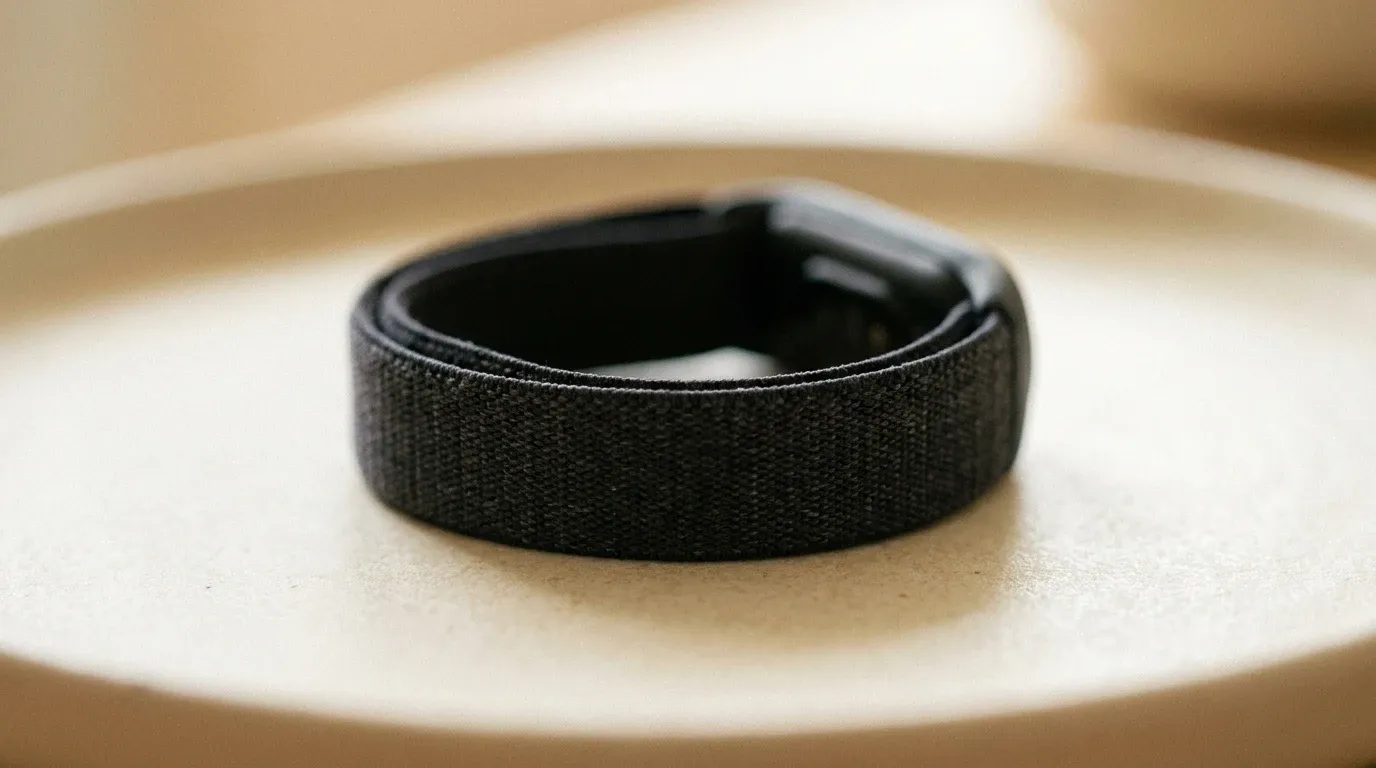
Leaked images and early spec sheets circulating across fitness forums point to a screenless fitness tracker from Suunto. The device appears stripped of a display entirely, prioritizing sensor quality and battery life over the kind of smartwatch features that have cluttered the wearable category for the past decade. If the specs hold up, this could be the most credible competitor Whoop has faced since launching its subscription model.
What the Leak Actually Shows
The leaked images suggest a slim, band-style device with no touchscreen or display of any kind. Instead, data would be routed entirely through a companion app, similar to how Whoop operates. Early spec rumors point to continuous heart rate monitoring, heart rate variability tracking, skin temperature sensing, blood oxygen saturation, and sleep stage analysis.
That's essentially Whoop's core feature set. The sensors themselves aren't the story. What's generating attention is the pricing model attached to the device. Based on leaked product listings and retailer placeholder pages spotted in Europe and Asia, the device appears to be positioned as a one-time purchase with no required subscription tier.
That's a significant departure from the subscription-first market that Whoop built. Whoop's standard membership runs $30 per month, or roughly $239 per year if you commit annually. Over two years, you're looking at close to $480 just for access to the platform. A one-time hardware purchase changes that math entirely.
Why the No-Subscription Model Matters More Than You Think
Subscription fatigue is real. Consumers across every category are pushing back against recurring charges that add up quietly in the background. Fitness is no exception. A 2023 consumer survey found that subscription-based fitness services saw significantly higher cancellation rates than comparable one-time-purchase alternatives, even when the subscription delivered more value on paper.
Whoop's model has always required a certain level of buy-in. You're not just buying a device. You're committing to a platform. For dedicated athletes who use every feature, that trade-off makes sense. But for the broader population of gym-goers who primarily want HRV trends and a sleep score, paying $30 a month feels like a lot for data you could theoretically get from a cheaper device.
This is where Suunto's reported positioning could hit hard. Suunto already has credibility in endurance sports. Its GPS watches are respected by trail runners and triathletes. A screenless recovery tracker carrying the Suunto name, sold as a hardware product with no ongoing fees, would appeal to exactly the cost-conscious, performance-oriented consumer that Whoop targets.
It's worth reading "Stress-Tracking Apps: Where the Science Still Falls Short" before you assume any tracker, subscription-based or not, will give you a complete picture of your stress and recovery. The sensor data is useful. But the interpretation layer still has real limitations that no pricing model fixes.
Recovery Metrics Without a Screen: Does It Actually Work?
The screenless design isn't a gimmick. It's a deliberate product philosophy that Whoop proved has a market. When you remove the screen, you remove the temptation to check the time, respond to notifications, or treat the device like a smartwatch. The wearable becomes a passive sensor. You wear it, sleep in it, and check the data when you want to, on your phone.
For recovery tracking specifically, this approach has real advantages. You're not distracted by the device. Battery life improves significantly without a display drawing power. And the form factor becomes smaller and more comfortable for overnight wear, which matters enormously for sleep tracking accuracy.
The core metrics expected from the Suunto device, HRV, sleep quality scoring, and daily recovery readiness, are well-validated in sports science research. HRV in particular has decades of evidence supporting its value as a proxy for autonomic nervous system status and readiness to train. A lower HRV after a hard week isn't just a number. It's a signal that your body needs time before loading up again.
Of course, the tracker can only tell you so much. If you're ignoring the basics, the data won't save you. "Sometimes the Best Recovery Is Doing Nothing at All" covers why passive recovery strategies, sleep, nutrition, and genuine rest, still outperform any gadget-optimized approach when you're genuinely depleted.
Who This Device Is Actually For
Whoop built its audience around a specific user: the driven athlete who wants to quantify everything and is comfortable paying for premium software features like strain coaching, cycle tracking, and behavioral insights. That's a real audience. But it's not the only audience for this type of device.
There's a much larger group of gym-goers and recreational athletes who want recovery data without committing to a subscription platform. They train four or five days a week, they care about sleep quality, and they'd find HRV trends useful. But they don't need advanced coaching features, and they don't want another monthly charge on their credit card statement.
A one-time-purchase screenless tracker built by a credible hardware brand addresses that group directly. It doesn't try to replace Whoop for the power user. It goes after everyone Whoop's subscription model has been quietly turning away.
If you're already working with a coach or using an AI-based training tool, layering in recovery data from a wearable can sharpen how you adjust training loads week to week. "Coaching App vs. Human Coach: Which One Do You Need?" breaks down where automated tools and human judgment each have the edge, which is relevant if you're building a tracking stack around a new device.
The Competitive Pressure on Whoop and the Subscription Model
Whoop isn't the only target here. Ouraring, while ring-based rather than band-based, also moved to a subscription model in 2023 and faced immediate backlash. The wearable category has been drifting toward recurring revenue because it's good for business. It smooths out cash flow, reduces dependence on hardware upgrade cycles, and creates lock-in. But it also creates an opening for any hardware competitor willing to go the other direction.
Garmin, Polar, and now potentially Suunto represent a different school of thought: sell good hardware, charge for it once, and let the data be yours without conditions. That philosophy is increasingly attractive in a market where consumers are actively auditing their subscriptions.
Suunto's alleged move into screenless recovery tracking would be the most direct challenge yet to Whoop's positioning, because it targets the same user type with the same use case and removes the one friction point that keeps some athletes away: the monthly fee.
It also raises broader questions about where wearable coaching is heading. "The Personal Trainer of 2026 Is Not Just Counting Reps" looks at how recovery data, behavioral insight, and technology are converging to reshape what personalized fitness guidance actually looks like. A screenless tracker feeding into that ecosystem could be a surprisingly powerful tool.
What to Watch Before You Buy
Leaked specs are not a product announcement. Suunto has not officially confirmed any screenless device, and the details circulating now should be treated as preliminary. Hardware often changes significantly between the leak stage and actual launch.
That said, the direction makes strategic sense. Suunto has the sensor engineering background. It has brand credibility in endurance sports. And it operates in a market where the subscription backlash is loud enough that going subscription-free would itself be a marketing story.
Here's what's worth watching as more information surfaces:
- Sensor accuracy: Whoop's HRV and sleep data have been validated in multiple independent studies. Any competitor needs to match that standard, not just claim it.
- App quality: Without a screen, the app is everything. If the companion software is clunky or the data visualization is poor, the device loses its appeal regardless of price.
- Battery life: Screenless designs should offer significantly longer battery life than display-based trackers. Anything under five days would be a red flag for a device in this category.
- Data ownership: One-time purchase doesn't automatically mean your data is fully portable or privately held. Reading the privacy policy matters as much as reading the spec sheet.
- Price point: If the device lands above $200, the savings over a two-year Whoop membership shrink quickly. The sweet spot is likely $150 or under to make the value case obvious.
The wearable market has been ready for this kind of disruption for a while. If Suunto's screenless tracker delivers on what the leaks suggest, it won't just compete with Whoop. It could force the entire subscription-based wearable category to rethink its pricing assumptions and remind the industry that sometimes the smartest product is also the simplest one.