
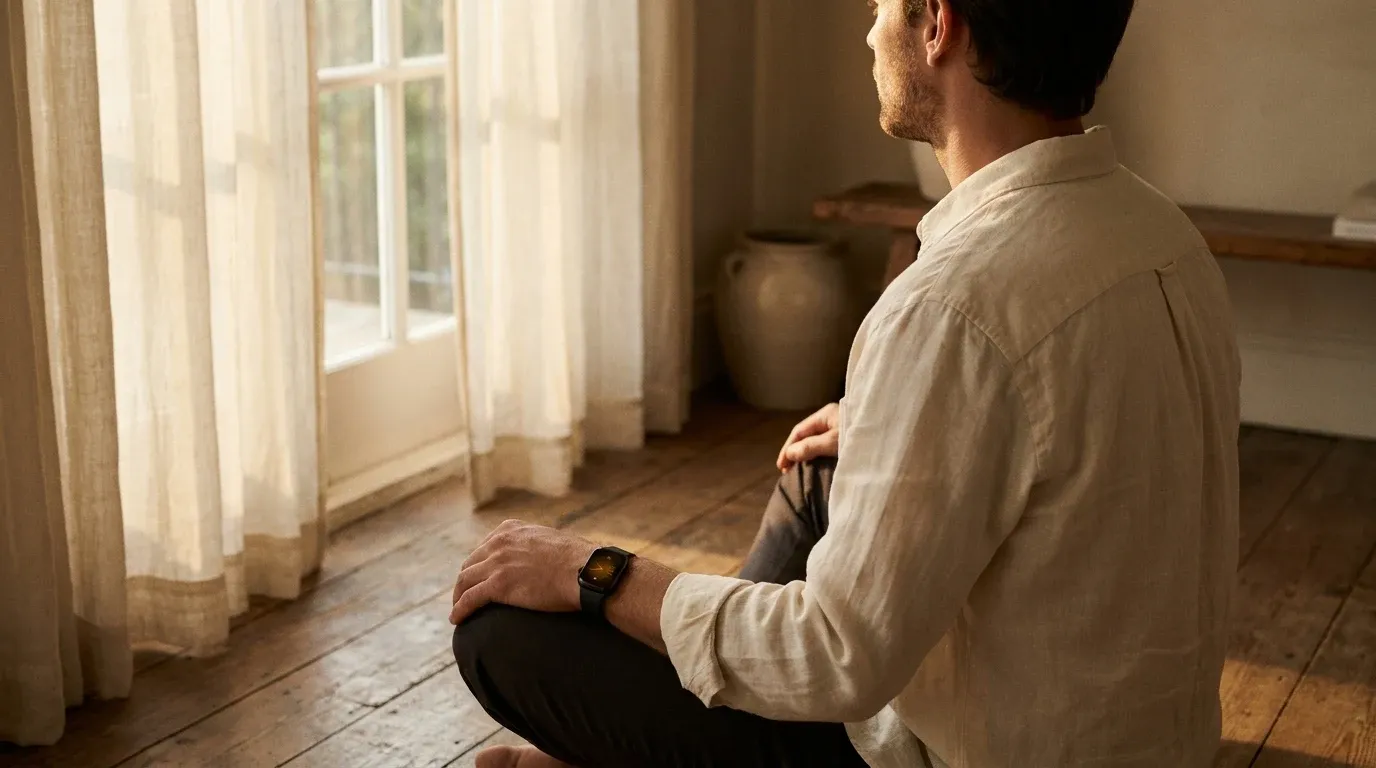
Your wearable buzzes. Your stress score is elevated. A little icon tells you to breathe. You ignore it and keep scrolling. Sound familiar? That tiny moment captures everything that's wrong with how we think about stress-tracking technology right now.
The devices have gotten remarkably good at detecting physiological stress. The science of actually doing something about it, automatically and in real time, is a different story entirely.
What a 2026 Systematic Review Actually Found
A July 2026 systematic review examining machine learning applications in stress management drew a clear distinction that most wearable marketing glosses over: detecting stress and controlling stress are two fundamentally different problems.
The review found that machine learning is now widely used in stress detection, pulling signals from heart rate variability, skin conductance, cortisol proxies, and behavioral patterns to flag when someone is under physiological load. Algorithms trained on these inputs have become genuinely impressive. Classification accuracy in controlled settings regularly exceeds 85 to 90 percent across multiple studies.
But the application of those same tools to stress intervention, actually reducing the stress once it's detected, remains underdeveloped. The number of studies using automated feedback control systems to manage stress in real time is small. The evidence that these systems work outside of lab conditions is smaller still.
That gap matters more than most people realize.
Why Closing the Loop Is So Hard
In engineering, a feedback control system detects a deviation from a target, calculates a corrective response, and applies it automatically. Your home thermostat does this. A cruise control system does this. The idea of applying the same logic to human stress is appealing on paper.
In practice, it runs into a series of biological and behavioral walls.
First, stress isn't a single signal. It's a constellation of interacting physiological, cognitive, and emotional states that vary significantly between individuals and even within the same individual across days and contexts. A heart rate spike during an argument looks identical to a heart rate spike during a hard interval run. An algorithm has to know the difference to respond appropriately, and most don't have reliable access to that context.
Second, effective stress reduction requires an active behavioral response from the human. Breathing exercises work. Progressive muscle relaxation works. Cold exposure, movement, and quality sleep all shift your autonomic nervous system in measurable ways. But no device can perform those actions for you. It can only suggest them, and suggestion compliance is notoriously inconsistent.
Third, there's the question of what "control" even means over time. Short-term stress reduction and long-term resilience building are not the same target. A system optimized to lower your immediate stress response might, if poorly designed, actually undermine the adaptation process that makes you more stress-resilient in the long run. Exercise stress is one obvious example. How you train in your 30s to protect strength after 40 depends partly on tolerating and recovering from productive physical stress, not eliminating it.
Detection Is Real. Intervention Is Still on You.
None of this means your wearable is useless. It means you need to understand what it's actually good at.
Stress detection through wearables has real value as an awareness tool. Most people underestimate their chronic stress load and overestimate how well they're recovering. Seeing an elevated heart rate variability trend over two weeks, or noticing that your stress score spikes every Sunday evening, gives you actionable data about patterns you might not have noticed consciously.
That awareness is the first step in any behavior change. It's just not the last step. And that's where the technology, as it currently stands, hands the baton back to you.
The systematic review makes this explicit: the human side of recovery still matters more than the device. Automated systems can prompt, track, and report. They cannot replace the cognitive and behavioral work of actually managing stress at its source.
Research on cortisol reduction consistently points to interventions that require your active participation. Spending time outdoors is one of the most evidence-backed. Twenty minutes outside measurably lowers your cortisol, and no app can replicate that effect by detecting that you need it and delivering it for you. You still have to go outside.
The Limits of the "Score" Mentality
Part of what makes wearable stress data misleading is the reduction of a complex biological state to a single number. A stress score of 72 or a recovery readiness of 61 percent carries an implied precision that the underlying science doesn't always support.
These numbers are derived from proxy measurements, primarily heart rate variability and resting heart rate, filtered through proprietary algorithms that vary between manufacturers and are rarely validated against clinical gold standards in real-world populations. They're informative directionally. They're not diagnostic.
The risk is that users start optimizing for the score rather than for actual recovery. You start wearing a device to bed and feeling anxious when your sleep score is low, which itself elevates stress. You interpret a normal physiological stress response to a challenging workout as a warning sign and pull back from training that was actually beneficial.
Sleep quality is a good example of this tension. The NIH's 2026 sleep conference highlighted how deeply sleep affects stress regulation and metabolic health. What the NIH's 2026 sleep conference changes for you includes a sharper understanding of why tracking sleep data is useful but obsessing over it can backfire. The score is a signal, not a verdict.
What the Evidence Actually Supports
If the technology can't yet close the loop for you, what does the research say you should actually be doing when you're stressed?
The evidence-backed toolkit is neither new nor complicated. What's changed is that we now have better mechanistic understanding of why these interventions work, and in some cases, wearable data can tell you whether they're working for you specifically.
- Controlled breathing. Slow, extended exhalation activates the parasympathetic nervous system and reduces heart rate within minutes. Box breathing, 4-7-8 breathing, and resonance frequency breathing at around 6 breaths per minute all have solid trial data behind them. Your wearable can confirm the HRV shift after the fact.
- Movement. Even low-intensity movement reduces cortisol and increases BDNF. This doesn't require a structured workout. A 15-minute walk achieves measurable autonomic effects. If you're building a longer-term foundation, how you structure resistance training matters for stress resilience too, not just fitness.
- Sleep prioritization. The relationship between stress and sleep is bidirectional. Chronic stress degrades sleep quality; poor sleep amplifies stress reactivity the following day. Tracking your sleep trends is useful. Protecting your sleep window is essential.
- Morning habits and nutrition timing. Emerging research suggests that your early-morning behavioral choices shape how well your nervous system handles stress throughout the day. Your morning habits shape how well you handle stress, and some of that influence operates through cortisol awakening response patterns that are measurable but not yet automatable.
- Passive recovery. Doing less is sometimes the intervention. Overscheduled recovery protocols can become their own stressor. Passive recovery outperforms most expensive recovery tools in the peer-reviewed literature, which is a useful reminder when you're tempted to add another biohack to your stack.
How to Use Your Device Smarter
The practical reframe here isn't to throw out your wearable. It's to stop expecting it to manage your stress and start using it to inform your decisions.
Think of your device the way you'd think of a blood pressure cuff. A blood pressure cuff gives you data. It tells you something is elevated. It doesn't lower your blood pressure by measuring it. The intervention, whether that's medication, dietary changes, or stress management, happens separately, and it requires your engagement.
A few principles that align with where the science actually is:
- Use trends, not daily scores. A single day's stress reading is noisy. A two-week trend in HRV or resting heart rate is more informative and less anxiety-inducing.
- Set a specific response protocol. When your device flags elevated stress, have a pre-decided response ready. Three minutes of slow breathing. A ten-minute walk. Not scrolling social media. The device is the prompt. The protocol is yours.
- Cross-reference with subjective experience. If your device says you're recovered but you feel terrible, trust your body. If your device says you're stressed but you feel fine and the context explains it (an intense workout, a big meeting), don't pathologize a normal response.
- Audit your tracking behavior. If checking your stress scores is itself a source of anxiety, that's a signal worth taking seriously. The tool is supposed to reduce your cognitive load, not add to it.
The Technology Will Keep Improving. Human Biology Won't Wait.
Machine learning applications in health are moving fast. The 2026 systematic review doesn't suggest that closed-loop stress management will never be possible. It suggests it isn't ready now, and that users who rely on it as if it were ready are likely to be disappointed.
The gap between detection and intervention is likely to narrow over the next decade as algorithms improve, sensor accuracy increases, and personalized intervention models get more training data. There's real promise in the research direction.
But in 2026, the honest position is that your wearable is a sophisticated awareness tool. It can tell you when to pay attention. It cannot do the recovery work for you. That part, the breathing, the sleep, the movement, the deliberate rest, still depends entirely on you acting on what you see.
The devices are getting smarter. Use them to make yourself smarter about how you respond. That's still the job.