
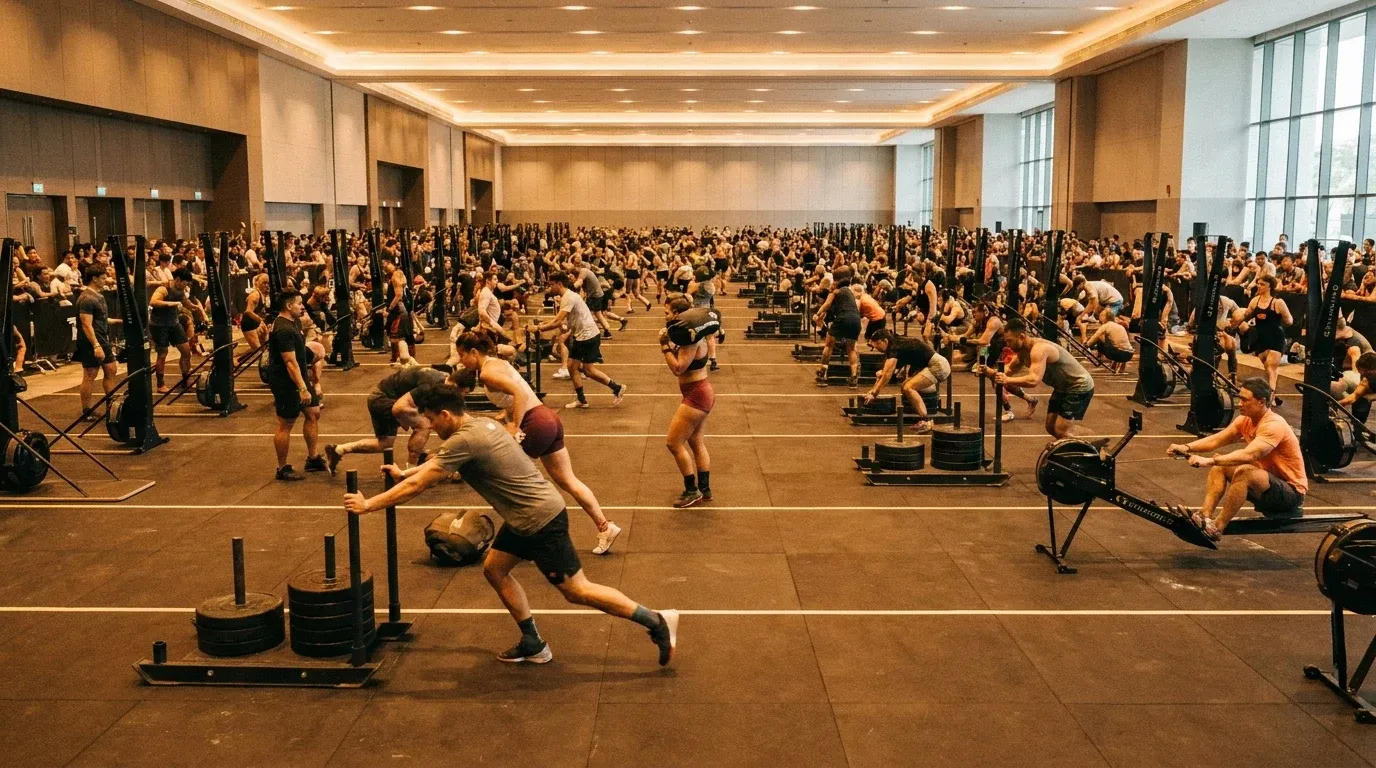
Something shifted in global fitness this August. When over 22,000 participants converged on the Queen Sirikit National Convention Center in Bangkok for BYD HYROX Bangkok, it wasn't just another international stop on the HYROX calendar. It was a statement about where functional fitness racing is heading, and who's driving it there.
That number alone deserves a pause. Twenty-two thousand participants. At a single event. In a city that, five years ago, wasn't even on the competitive fitness circuit's radar. For context, most major European HYROX events draw between 8,000 and 12,000 athletes. Bangkok just doubled the ceiling.
What Happened in Bangkok
BYD HYROX Bangkok ran from August 13 to 16, 2026, across four full days of racing at the Queen Sirikit National Convention Center. The venue, one of Southeast Asia's largest convention facilities, was transformed into a multi-track competition arena capable of running parallel heats across divisions including Open, Pro, Doubles, and Relay.
The sheer logistics of managing 22,000 athletes through a standardized format. eight functional workout stations separated by one-kilometer runs. required operational precision on a scale HYROX hasn't had to execute outside of its flagship Hamburg events. By all accounts, it delivered.
Athletes competed across more than a dozen nationalities, with strong contingents from Thailand, Japan, South Korea, Australia, Singapore, and the United States. The international mix reflected something the sport's organizers have been building toward: HYROX as a genuinely borderless competition format, not a European export product that travels occasionally.
Why Bangkok, Why Now
The Asia Pacific fitness market has grown at a compound annual rate that outpaces every other major global region for the past three years. Middle-class expansion, rising urban gym culture, and social media penetration across markets like Thailand, Vietnam, Indonesia, and the Philippines have created an audience hungry for structured, goal-driven fitness that also offers community and spectacle.
HYROX fits that demand almost perfectly. The format is repeatable, measurable, and photogenic. You don't need to be an elite athlete to enter, but the competitive framework means there's always something to train toward. That combination has proven irresistible to the same demographic driving gym membership growth across Southeast Asia's major cities.
Bangkok itself was a deliberate choice. It's Southeast Asia's most connected hub, with flight access from Tokyo, Seoul, Sydney, Singapore, and Dubai in under eight hours. For a sport trying to attract a truly regional field, that geography matters as much as the venue.
The event also benefited from strong title sponsorship from BYD, the Chinese electric vehicle manufacturer making aggressive plays across Asian markets. That partnership signals something important: major regional brands now see HYROX as a credible platform for reaching an affluent, health-conscious consumer. That's a different kind of commercial validation than the sport has historically received.
The Physical Demands of Racing in the Heat
Bangkok in August isn't a forgiving environment. Average temperatures sit around 32 to 34 degrees Celsius, with humidity regularly above 80 percent. Even inside a climate-controlled venue, the physical toll of completing eight workout stations at competition intensity in tropical conditions is real.
Athletes who'd trained in cooler climates faced a meaningful adaptation challenge. The physiological cost of heat stress during sustained functional effort is well-documented: core temperature rises faster, sweat rates increase, and electrolyte losses compound fatigue in ways that pure cardiovascular fitness can't compensate for. If you're planning a major HYROX event in a hot climate, understanding heat and hydration strategies for endurance athletes isn't optional preparation. It's race strategy.
Organizing teams implemented expanded hydration stations and cooling zones between workout stations, reflecting lessons learned from earlier HYROX events in warm-weather locations. Multiple athlete reports from Bangkok cited the sled pulls as the section where heat fatigue hit hardest, which tracks with the sustained isometric demand of that movement. If you want to refine your approach to that specific station, the technical breakdown in HYROX sled push and pull technique covers exactly where efficiency losses occur under fatigue.
HYROX Youngstars: Building the Next Generation
The most strategically significant announcement out of Bangkok wasn't the attendance figure. It was the formal launch of HYROX Youngstars, a structured youth program targeting children aged 8 to 15.
The initiative is designed to introduce younger participants to the HYROX format through age-appropriate workout stations, modified distances, and scaled loads. It's explicitly tied to the Asia expansion strategy, targeting markets where youth sport participation is already high but Western-style functional fitness racing has minimal presence.
The thinking behind this is sound. Sports that build participation at youth level retain athletes into adulthood at dramatically higher rates than those that recruit primarily from an adult pool. By establishing HYROX as a family sport rather than a pure adult competition, the organization is seeding a participant pipeline that could sustain regional growth for a decade or more.
HYROX Youngstars events are expected to roll out across Asia Pacific markets throughout the 2026/27 season, with school partnership programs under discussion in Thailand, Japan, and Australia. If those partnerships materialize, you're looking at HYROX entering physical education infrastructure in a way no functional fitness format has managed before.
What This Means for the 2026/27 Season
Bangkok wasn't a one-off. It's the anchor event of a broader Asia Pacific calendar that now includes stops in Tokyo, Singapore, and Sydney as confirmed major events for the season. The weight given to each of these events in terms of prize pools, qualification pathways, and broadcast coverage has increased meaningfully compared to the 2024/25 season.
HYROX has historically treated its European calendar, anchored by Hamburg, Cologne, and London, as the sport's competitive spine. Those events still matter. But the organizational and commercial attention now flowing toward Asia suggests that the center of gravity is shifting. Asia isn't being serviced as a secondary market. It's being built as a co-primary one.
For athletes in the US, UK, Canada, and Australia, this has a practical implication. If you're targeting HYROX qualification in the 2026/27 cycle, Asian major events now carry the same qualification weight as equivalent European stops. That expands your options if you're planning your racing season around work schedules, travel budgets, or training peaks. The guide to building your fall 2026 race season covers how to structure a multi-event calendar across different competitive formats, which is increasingly relevant as HYROX's global footprint expands.
Training Implications for HYROX Athletes Everywhere
Bangkok puts a spotlight on something any serious HYROX competitor already knows: the sport punishes physical weaknesses that general fitness training tends to ignore. The combination of repeated running with station-based functional work targets grip, posterior chain endurance, and aerobic capacity simultaneously. You can't paper over gaps the way you might in a pure running or pure lifting context.
Grip strength, in particular, is the limiting factor at the sled pull, wall balls, and farmer's carry stations for a significant proportion of competitors. Research consistently shows that grip capacity is one of the most transferable physical qualities for functional performance, and it tends to be undertrained relative to its importance. Grip strength's role as a health predictor extends well beyond HYROX performance, but the sport happens to be excellent training stimulus for building it.
The other frequently overlooked element is structural balance. HYROX athletes who have invested in posterior chain work, particularly the kind of systematic back training that addresses push-to-pull ratios, tend to hold their form and power output better through the final stations when fatigue is highest. If your training skews heavily toward pushing movements, the evidence on back training mistakes most lifters make is directly applicable to your HYROX prep.
The Bigger Picture
HYROX launched in Hamburg in 2017 with around 600 participants at its first event. Nine years later, a single event in Bangkok is drawing 22,000. That trajectory isn't luck or marketing. It's a product that solves a real problem for a specific audience: people who want competition, community, and measurable progress in one experience.
The Asia expansion, anchored by Bangkok's record numbers, suggests the sport has found a second wave of that same audience. The cultural ingredients are there. Urban fitness culture is accelerating across Southeast Asia and East Asia at a pace that mirrors what happened in the US and UK between 2012 and 2018. HYROX is entering those markets earlier in their growth cycle than it entered most Western ones.
Whether you're an athlete tracking the competitive circuit, a coach building a HYROX-focused training business, or someone just deciding whether to sign up for your first event, Bangkok tells you something useful. This sport isn't plateauing. It's scaling into new territory, and Asia is where the next chapter of that story is being written.
If you're targeting a 2026/27 HYROX entry and haven't looked at the Asian calendar yet, now's the time to look.