
Dylan Scott and Alyssa McElheny Are the 2026 HYROX World Champions
Stockholm delivered. On a June weekend that drew the best HYROX athletes on the planet, Dylan Scott and Alyssa McElheny claimed the top spots at the 2026 HYROX World Championships and redefined what it means to compete at the sport's highest level. These weren't just wins. They were statements.
Both performances cut through a stacked field and left the HYROX community recalibrating its expectations for what elite looks like heading into the 2026-2027 season. If you've been following the sport, you already sensed something was building. Stockholm confirmed it.
What Went Down in Stockholm
The 2026 HYROX World Championships served as the final, defining event of the 2025-2026 competitive season. Held at the Avicii Arena in Stockholm, the event brought together qualifiers from across the US, UK, Europe, Canada, Australia, and beyond. Thousands of athletes competed across individual and doubles categories, but it was the elite heats that commanded the sport's full attention.
Dylan Scott, competing in the men's individual Pro division, put together a race that combined disciplined pacing with exceptional strength output across the eight workout stations. Alyssa McElheny, in the women's Pro division, delivered a performance that was equally controlled and equally devastating for anyone trying to keep pace with her.
The format, as always, demands a complete athlete. Eight one-kilometer running legs alternating with eight functional fitness stations. Ski erg, sled push, sled pull, burpee broad jumps, rowing, farmers carry, sandbag lunges, wall balls. Every weakness gets exposed. Neither Scott nor McElheny gave the field a single opening.
Breaking Down Dylan Scott's Winning Performance
Scott's edge came from his ability to maintain running velocity late in the race. By the time most elite athletes are managing fatigue through the sixth and seventh running legs, Scott appeared to be running within himself. His station transitions were sharp, and his wall ball splits stood out as a particular strength in post-race analysis.
What separates the top HYROX finishers from the field isn't raw power on a single station. It's the cumulative cost of effort. The athletes who win are the ones who've trained to sustain output when the body is screaming to back off. Scott clearly built his preparation around that specific demand.
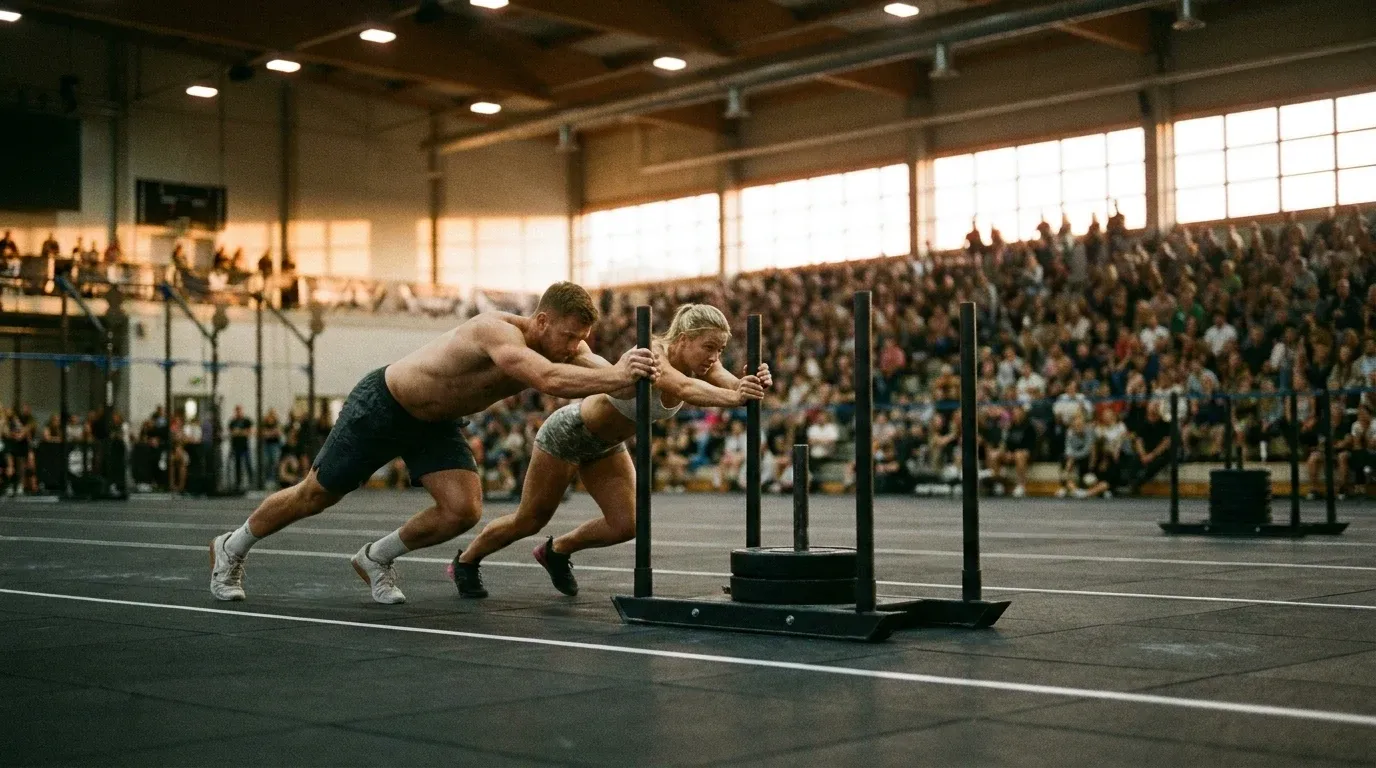
His sled push, one of the stations that tends to produce the largest time differentials at the pro level, was executed with consistent drive and minimal hesitation at the turnaround points. These are the marginal details that add up to podium finishes at a World Championship.
What Set Alyssa McElheny Apart
McElheny's win told a slightly different story but with the same underlying message. Her running economy through the mid-race segments was the standout feature. While other competitors in the women's Pro field showed visible strain between stations four and six, McElheny's form held. She wasn't just surviving the running legs. She was using them to rebuild.
This connects to something broader about the physiology of hybrid endurance events. The athletes who dominate HYROX at the highest level tend to carry an aerobic base that lets them recover faster between maximal efforts. Research into hybrid athlete profiles consistently points to aerobic capacity as the platform everything else sits on. McElheny's performance in Stockholm illustrated that principle in real time.
Her sandbag lunge section was particularly composed. It's a station where technique breaks down fast when you're already carrying accumulated fatigue. McElheny's posture and cadence stayed intact, which is a product of deliberate training under accumulated load, not just raw strength.
Stockholm as a Turning Point for the Sport
The 2026 World Championships didn't just crown two individual champions. They marked a shift in the competitive baseline for HYROX as a global sport. Entry into the Pro division has become structurally harder, and the depth of the field in Stockholm reflected that. Athletes who would have been genuine podium threats in previous seasons were finishing outside the top ten.
HYROX has grown at a pace that few functional fitness formats have matched. Since its founding in 2017, the series has expanded to hundreds of events annually across dozens of countries, with participant numbers growing year over year. The professionalization of the athlete pool has followed that growth trajectory. Stockholm 2026 was the clearest evidence yet of where the competitive ceiling has moved.
For athletes who are building toward the 2026-2027 season, the benchmark just shifted. Scott and McElheny's times and station splits will become reference points that coaches and serious competitors work backward from when structuring their programs. If you're not already thinking about your hybrid training model, the time to start is now. Understanding how HYROX training makes you a stronger marathoner is a useful place to anchor your approach, since the running demand in these races is genuinely unforgiving at the elite level.
What Aspiring HYROX Athletes Should Take Away
You don't need to be chasing a World Championship podium for Scott and McElheny's performances to mean something to your training. The principles that produced those wins scale down the competitive ladder. Here's what you can pull directly from their approach:
- Aerobic base before everything else. Both champions demonstrated running economies that most functional athletes underinvest in. Your capacity to recover between stations is built over months of consistent aerobic work, not in the final weeks before a race.
- Train transitions, not just stations. The time you lose moving from a running leg into a station is real time. The athletes who win practice the first ten seconds of each station as a deliberate skill.
- Late-race strength is a training variable. If you're only doing your strength work fresh, you're training a version of the sport that doesn't exist on race day. Build sessions around accumulated fatigue intentionally.
- Nutrition and fueling are part of the performance. A race lasting anywhere from 60 minutes to over two hours requires a fuel strategy. simple diet changes that actually move the needle on endurance performance are well within reach for most athletes and don't require an overhaul of how you eat every day.
- Recovery is a competitive variable. The depth of field in Stockholm meant that athletes who arrived undertrained or under-recovered paid for it quickly. Sleep, load management, and micronutrient support are no longer optional at the top end of the sport.
The Season Ahead: What to Expect in 2026-2027
With Stockholm in the books, attention turns to what the 2026-2027 HYROX season looks like. The series has consistently added new host cities, refined its qualifying structure, and increased prize pools at the Pro level. Both Scott and McElheny now carry world champion status into the new season, which brings its own competitive pressure. In any sport, defending is harder than winning for the first time.
The broader field will spend the off-season analyzing the Stockholm splits and adjusting. Expect training methodologies to evolve further toward the hybrid model, with more emphasis on running quality alongside functional strength. Coaches working with serious HYROX athletes will likely push harder on aerobic development, knowing that's where the winning margins are being built.
Fueling strategy will also get more attention at the elite level. As race durations extend and the field becomes more competitive, the athletes who have dialed in their hydration and electrolyte management will have an edge. Understanding what you actually need from electrolytes during high-output events isn't just a warm-weather consideration. It's a year-round performance variable for athletes competing at this intensity.
One area that will continue to draw scrutiny is supplementation. As prize pools grow and the stakes rise, athletes and coaches are paying closer attention to product quality and label accuracy. It's a legitimate concern in any high-performance context, and knowing whether you can actually trust what's on your supplement label matters more when your race-day preparation depends on it.
A New Standard Has Been Set
Dylan Scott and Alyssa McElheny didn't just win races in Stockholm. They showed a sport still defining itself what its ceiling actually looks like right now. The times will be beaten eventually. The standards will keep rising. That's what happens when a sport grows this fast and attracts this level of talent.
But for this moment, they're the best in the world. And for everyone else working toward their own version of the HYROX podium, that's the number on the wall.