
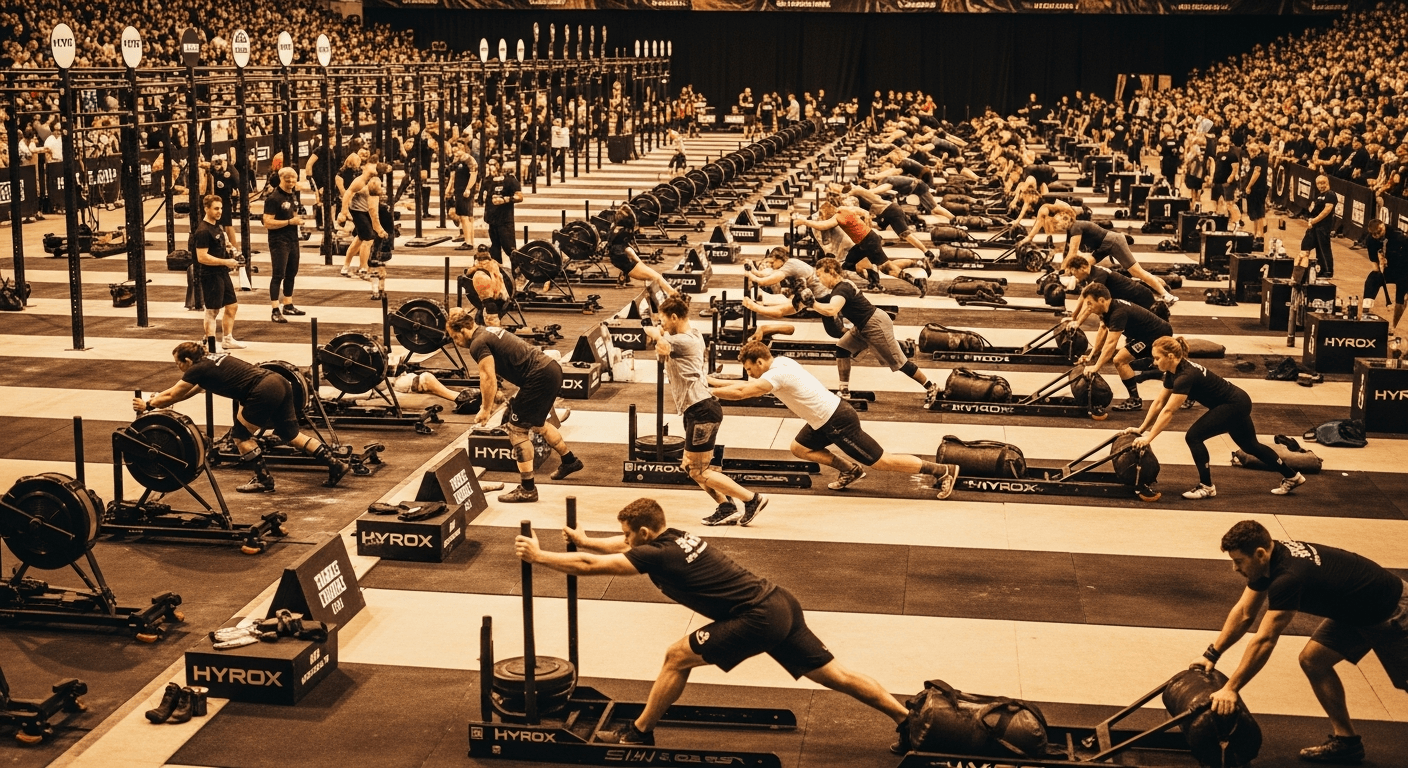
Numbers don't lie, and the numbers around HYROX right now are hard to ignore. The format recorded between 1.3 and 1.5 million participants globally in its 2025-2026 season alone. To put that in perspective, the New York City Marathon, one of the most iconic endurance events on the planet, draws around 50,000 finishers per edition. HYROX isn't just growing. It's scaling at a pace that established endurance sports spent decades trying to reach.
If you've been watching the functional fitness space, you already know something is happening here. If you haven't, here's what you need to understand about why HYROX is pulling athletes away from traditional racing calendars and what that shift actually means for anyone deciding where to compete.
What HYROX Actually Is (and Why It Sticks)
HYROX was founded in Germany in 2017 and built around a deceptively simple structure: eight kilometers of running, broken into eight intervals, each followed by one functional workout station. The stations are always the same. SkiErg, sled push, sled pull, burpee broad jumps, rowing, farmer's carry, sandbag lunges, and wall balls. In that order, every time, at every event worldwide.
That consistency is the product. You're not adapting to a new course or guessing what movements will show up. You show up knowing exactly what's coming, which means your training is directly transferable, your benchmarks are globally comparable, and your improvement is measurable in a way that most fitness pursuits never allow.
This is fundamentally different from a trail race where elevation and terrain vary dramatically, or a functional fitness competition where the programming changes each year. HYROX gives you a single, repeatable test. Athletes respond to that.
The Standardization Advantage No One Talks About Enough
Standardization doesn't sound exciting. But it's the structural backbone behind HYROX's growth, and it solves a problem that has frustrated competitive athletes for years.
When you finish a half marathon in Austin and your friend finishes one in Edinburgh, your times aren't directly comparable. Courses differ. Weather differs. Elevation differs. You both ran 13.1 miles, but the contexts are completely different. HYROX eliminates that gap. A 1:05 finish in Chicago carries the same weight as a 1:05 in Sydney or Singapore because the course, the equipment, and the workload are identical.
For athletes who care about progression, this is significant. You can track your performance across years and cities without an asterisk. You can enter a race in a new country and immediately understand where you stand against the local field. That kind of global comparability is something running races and CrossFit-style competitions have never cleanly delivered.
You can see this playing out in real time. Check recent results from HYROX Hangzhou and Sydney 2026 and you'll notice athletes benchmarking their splits across both events as if they were the same track. Because effectively, they are.
Institutional Money Is Now Paying Attention
L Catterton, the private equity firm backed by LVMH, has been reported as having interest in HYROX. L Catterton doesn't chase trends. Its portfolio includes Peloton, Equinox, and a range of premium consumer brands. When a firm with that track record circles a fitness property, it signals that the growth metrics have moved beyond enthusiast territory into something investable at scale.
What institutional capital typically brings to a sport isn't just money. It's infrastructure. Venue expansion accelerates. Prize pools grow. Media rights deals get structured. Athlete pathways get formalized. The sport starts to look less like an emerging concept and more like an established property with long-term staying power.
For athletes, this matters in a practical way. A HYROX Pro division finish in 2026 carries more career relevance than the same finish did in 2020, and that gap will likely widen as the organization professionalizes further. Getting in now, building your ranking, and establishing yourself in the competitive ecosystem is a different proposition than joining after the prize money and media attention have already peaked.
The Competitive Ladder Is Actually Structured
One of the most underappreciated aspects of HYROX is how it handles athlete progression. The format runs Open, Pro, and doubles divisions with clear performance thresholds separating them. You don't self-select into the Pro division based on ego. You qualify based on time standards. That structure creates a competitive ladder that running races and most functional fitness competitions don't replicate cleanly.
In a typical road race, everyone from a 3:30 marathoner to a 5:00 marathoner toes the same starting line with a wave assignment. There's no formal progression, no division standard you're working toward, no moment where the field officially recognizes you've moved up a tier. HYROX builds that in by design.
For athletes who've plateaued in traditional endurance sports or who've found CrossFit-style competition too unpredictable, this structure is genuinely appealing. You have a defined target. You train toward it. You either hit the standard or you don't. That clarity drives sustained engagement in a way that open-entry events often can't sustain over multiple years.
What It Takes to Compete: The Training Demands
HYROX rewards a specific hybrid athlete profile. You need enough cardiovascular capacity to sustain eight kilometers of running at a competitive pace. You also need functional strength to hit the workload stations without your splits falling apart in the back half. Neither quality alone is enough. Both need to be trained in combination, which is part of what makes the format demanding and part of what makes improvement feel tangible.
The nutrition side of HYROX training deserves more attention than it usually gets. Hybrid athletes are burning through a significant volume of both aerobic and anaerobic work across a training week. Protein intake in particular needs to reflect that demand. If you're training seriously for HYROX, you probably need more protein than standard guidelines suggest, and how you distribute that intake across the day matters for recovery and adaptation.
Timing also plays a role. The research on protein timing and muscle synthesis for active adults is relevant here, particularly for athletes juggling two training sessions or combining strength blocks with long running intervals in a single day. Getting the post-workout window right can accelerate the recovery timeline meaningfully.
The supplement landscape is another area where HYROX athletes need to think clearly. The market is saturated, and not everything on the shelf delivers what the label claims. Knowing how to read a supplement label without getting misled is a practical skill for anyone investing serious time and money into their HYROX training.
How HYROX Compares to Traditional Competitive Options
If you're an athlete evaluating where to direct your competitive energy, the comparison points matter. Here's how HYROX lines up against the most common alternatives:
- Road running: Lower barrier to entry, but limited structured progression and no functional strength component. Times are course-dependent, which limits global benchmarking.
- Triathlon: High equipment cost (a competitive triathlon setup can run $3,000 to $10,000 or more), complex logistics, and a steeper learning curve for the swim leg. HYROX requires minimal specialized equipment.
- CrossFit competition: Programming variability means your training doesn't always map directly to what you'll face on competition day. The open format is accessible, but the elite level is highly specialized and difficult to break into as an adult athlete.
- HYROX: Fixed format, global comparability, structured divisions, growing prize pool, and a training profile that rewards sustained athletic development rather than sport-specific skill.
None of these are wrong choices. But HYROX solves specific problems that the others don't, and that's why athletes with backgrounds in running, weightlifting, rowing, and functional fitness are all finding a home in the same competitive space.
Where the Growth Goes From Here
HYROX currently runs events across North America, Europe, Asia-Pacific, and the Middle East. The 2025-2026 season's participant numbers suggest demand is outpacing venue availability in several markets. With institutional investment on the horizon, venue expansion in underserved US markets, additional Asian cities, and secondary European markets is a logical next step.
Prize pool growth is also a reasonable expectation. The Pro divisions currently offer competitive but modest payouts relative to what the participant base would suggest the market can support. As media rights and sponsorship deals mature, that will likely change.
The comparison to other fast-growing endurance properties is useful context. Events like Western States have built decades of credibility through consistent execution and a clear athlete culture. Western States 2026 drew the kind of attention that only comes after years of trust-building. HYROX is compressing that timeline significantly, which carries both opportunity and risk. The core format needs to stay consistent as the organization scales. Standardization is the product. If that slips, so does the value proposition.
For now, the trajectory is clear. HYROX has crossed the threshold from emerging format to established competitive property. If you're trying to decide whether it belongs in your 2026 calendar, the honest answer is that the window to establish yourself in an early-growth competitive ecosystem is already narrowing. The 1.5 million participants figure doesn't make HYROX less appealing. It confirms that the athletes who saw it early were right.