
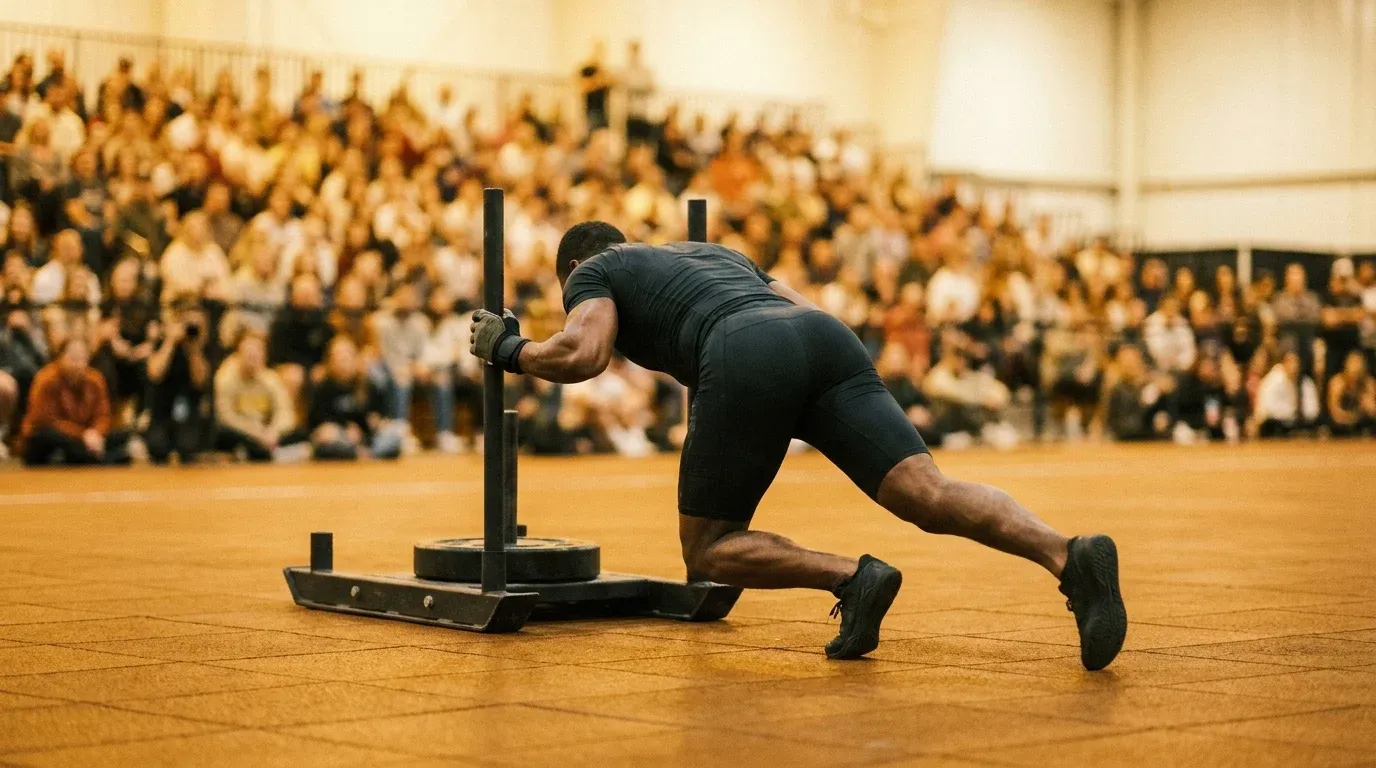
HYROX launched in Hamburg in 2017 with a simple but ambitious premise: combine running with functional fitness stations into a single, standardized race format that anyone could enter and everyone could measure themselves against. Eight years later, that premise has turned into one of the fastest-growing competitive fitness formats on the planet. And the 2026 calendar makes it clear this is no longer a European story.
A Calendar That Tells Its Own Story
The 2026 HYROX global race schedule reads like a deliberate strategic document. Events are no longer clustered around Western Europe or the handful of US cities that adopted the format early. The calendar now stretches across continents, with dates confirmed in Asia-Pacific, the Middle East, North America, and beyond. For competitive athletes, that shift means more than just travel options. It means the competitive ecosystem is fundamentally changing.
Back-to-back events in Hangzhou and Sydney in early July 2026 represent one of the clearest signals yet of where HYROX is heading. China has historically been a difficult market for Western fitness formats to crack. Hangzhou's inclusion on the calendar isn't just a symbolic gesture. It reflects real infrastructure investment and a growing local athlete base willing to compete in a structured, time-based format with clear performance benchmarks.
Sydney, meanwhile, completes a one-two punch that puts two major Asia-Pacific cities on the radar within the same week. Australia's fitness culture has long been race-hungry, from triathlon to obstacle course racing, and HYROX fits neatly into that competitive appetite. Pairing Hangzhou and Sydney in early July 2026 suggests HYROX is treating the region as a single growth corridor rather than isolated market experiments.
What Global Expansion Actually Means for Athletes
If you're a competitive HYROX athlete, the expansion of the calendar isn't just good news for the sport in the abstract. It directly affects your qualifying strategy. HYROX's World Championship model relies on athletes earning qualifying times or slots at sanctioned events throughout the season. More sanctioned events globally means more pathways into that championship field.
That's a meaningful change. In the early years of HYROX, the qualifying funnel was relatively narrow. Athletes in North America or Australia often faced long travel commitments just to access enough competitive events to lock in a qualifying time. A denser global calendar removes that friction. It also raises the overall quality of the qualifying field, because more athletes competing in more locations means the benchmark times get sharper and the competition at Worlds gets harder.
For athletes who are serious about performance, this is the moment to treat HYROX preparation with the same rigor you'd apply to any other endurance or strength sport. The crossover between HYROX and running-specific fitness is well documented. How HYROX Training Makes You a Stronger Marathoner breaks down why the hybrid demands of the format build a fitness base that transfers directly to endurance performance across disciplines.
The Format That Makes Global Expansion Work
One reason HYROX has been able to scale internationally in a way that other fitness race formats have struggled to do is the standardization of the format itself. Every HYROX event, whether it's held in Hamburg, Chicago, Dubai, or Hangzhou, follows the same structure: eight one-kilometer runs, each followed by one of eight functional fitness stations. The stations, the distances, the weights, and the scoring are identical across every event on the calendar.
That standardization solves a fundamental problem for global expansion. Athletes know exactly what they're training for regardless of where they sign up. Coaches can build programs around a consistent set of demands. And results from a race in Sydney are directly comparable to results from a race in London or Dallas. That portability of performance data is rare in fitness competition and it's a significant competitive advantage for HYROX as it enters new markets.
It also makes the sport easier to cover, follow, and understand for a new audience. When a new athlete in Hangzhou watches race footage from a previous European event, they're seeing the exact experience they'll have on race day. There's no translation required.
The Asia-Pacific Opportunity Is Real
The decision to invest in Asia-Pacific isn't arbitrary. The region has seen significant growth in functional fitness participation over the past five years, driven partly by CrossFit's early penetration into markets like Australia, Hong Kong, Singapore, and increasingly mainland China. HYROX offers a different entry point. It's more accessible to athletes without a dedicated CrossFit background, the time-based format is intuitive for runners and general fitness participants, and the event experience is more spectator-friendly than most gym-based competitions.
China specifically represents a market with enormous untapped potential. The country has invested heavily in sports infrastructure and has a growing middle class with disposable income directed toward health and performance. Entry fees for HYROX events typically range from $100 to $175 USD depending on the category and location, which positions the sport as a premium but accessible experience in markets where fitness spending is on the rise.
Australia is a more mature market for endurance sport, but HYROX fills a specific gap. The format bridges the running community and the strength training community in a way that few other competitive events do. If you've ever felt that your marathon training left your upper body and functional strength underdeveloped, or that your gym work never translated to real-world endurance, HYROX was essentially designed for that frustration.
Nutrition and Recovery Demands Scale With Competition
As the competitive field deepens globally, the margin between qualifying and not qualifying gets thinner. That means the details matter more. Athletes who are serious about HYROX performance can't treat nutrition as an afterthought. The race itself runs anywhere from 60 minutes for elite athletes to over 90 minutes for competitive age-group competitors, which puts it squarely in the territory where fueling and hydration strategy directly affect output.
Managing electrolyte balance during training blocks and on race day is one of the more overlooked variables in HYROX prep. Electrolytes in the Heat: What You Actually Need This Summer covers the science of sodium, sweat rates, and what actually works beyond the marketing claims on most sports drink labels.
The supplement side of athletic preparation is also worth scrutinizing carefully. As HYROX expands into new markets, athletes will encounter a wider range of products marketed specifically at hybrid athletes. The quality control on those products varies significantly. Can You Actually Trust What's on Your Supplement Label? is a useful starting point for understanding what scrutiny to apply before adding anything to your protocol.
Beyond supplementation, foundational dietary quality remains the biggest lever most athletes haven't fully pulled. Simple Diet Changes That Actually Move the Needle offers practical adjustments that don't require overhauling your entire eating pattern but do produce measurable improvements in training output and recovery.
What Competitive Athletes Should Do Right Now
If you're already in the HYROX competitive ecosystem, the expanding 2026 calendar is an opportunity to think strategically about your qualifying path. Here's what that looks like in practice:
- Audit your current event access. With more events on the global calendar, there may be a race closer to you than last season. Check the updated schedule before assuming you need to travel internationally to secure a qualifying slot.
- Set a target time, not just a target event. Qualifying for Worlds isn't just about showing up. The field is getting faster as participation grows globally. Know the current qualifying standards for your category and build your training cycle backward from those numbers.
- Build your running base deliberately. The eight one-kilometer runs in a HYROX event are not a formality. Athletes who underestimate the cumulative running volume in the format consistently leave time on the course. Structured running training is non-negotiable at the competitive level.
- Track your station-specific weaknesses. The sled push, the ski erg, and the wall balls each have different energy demands and recovery profiles. Identify the two or three stations where you lose the most time relative to your overall pace and prioritize those in training.
- Think about recovery load, not just training load. More events on the calendar creates the temptation to race more frequently. But HYROX puts significant stress on the posterior chain and the respiratory system. Spacing events appropriately and building structured recovery blocks is how you improve across a season rather than burning out mid-calendar.
The Bigger Picture for Fitness Racing
HYROX's global push in 2026 is happening against a backdrop of broader growth in structured fitness competition. The appetite for events that combine measurable performance with community and spectacle is growing across age groups and fitness levels. What HYROX has done effectively is create a format that works at every level of that spectrum, from first-timers completing the course in two hours to elite athletes pushing toward sub-60 minutes.
The Hangzhou and Sydney events in July 2026 aren't the endpoint of that expansion. They're a signal of direction. If the format continues to grow at its current rate, the question for competitive athletes isn't whether HYROX will be a legitimate global sport. It already is. The question is whether your preparation is keeping pace with a field that's getting faster, deeper, and more international every season.
That's the pressure and the opportunity that global expansion creates. The calendar is bigger. The field is stronger. The time to take your HYROX preparation seriously is now.