
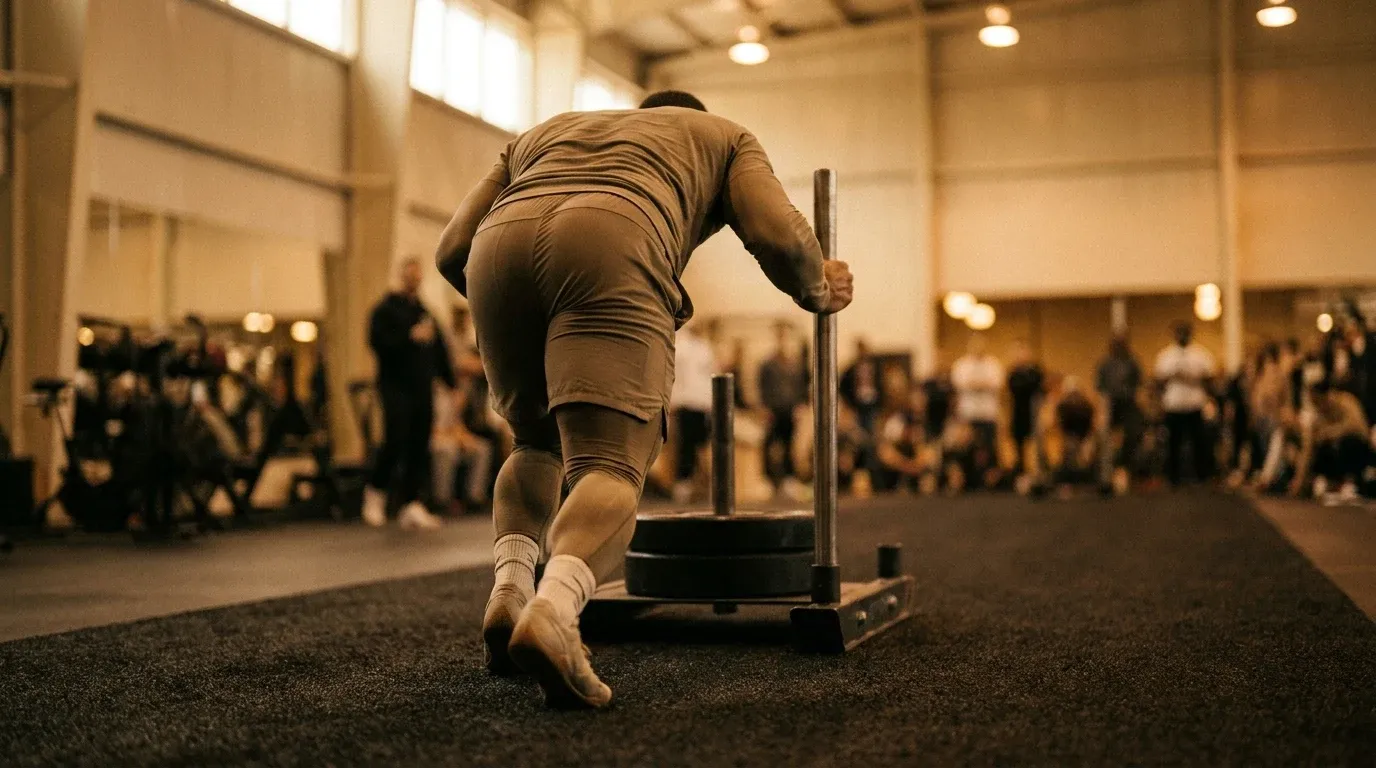
HYROX Toronto 2026 ran from October 1 to 4 at the Enercare Centre, drawing one of the largest fields of any Canadian stop in the sport's history. Across four days of racing, thousands of athletes competed across Pro, Open, Doubles, and Relay divisions. The numbers told a clear story: North American competitive depth is no longer a talking point. It's a measurable reality.
Toronto has become one of the marquee stops of Season 9, and this year's edition raised the bar again. Canadian athletes didn't just participate. They challenged international fields in ways that would have been unusual two or three seasons ago.
Top Finishers by Division
In the Men's Pro division, the podium was tight at the front. The winner crossed in 57:14, with second and third place separated by under 90 seconds. Canadian athletes placed inside the top eight across both the men's and women's Pro fields, a significant step up from their Season 8 performances at the same venue.
Women's Pro saw the race won in 1:03:41. The top three were separated by just over two minutes, reflecting how compressed the women's elite field has become globally. Station pacing, not raw running speed, determined the final order.
In the Open divisions, overall completion rates were strong, with average men's finish times clustering around 1:18 to 1:24 and women's Open averages landing between 1:28 and 1:36. These ranges are consistent with what was recorded in Washington D.C. earlier in the season, suggesting a stabilizing competitive baseline across North American stops.
The Doubles and Relay categories again drew the biggest crowds as spectator events. Mixed Doubles saw strong turnout, and several teams posted splits competitive with Open solo times, highlighting how strategic station handoffs can compress overall race time significantly.
Split Data: Where Toronto Athletes Won and Lost Time
Split data from Toronto revealed some of the clearest patterns of Season 9 so far. Athletes familiar with the format know that what HYROX actually does to your fitness is unique among hybrid events. The physiological demand shifts with every station, and Toronto's results made that visible in the numbers.
Here's where athletes gained and lost the most time across the eight functional stations:
- SkiErg (Station 1): Pro men averaged 3:28, with top finishers coming in under 3:10. Open men averaged 4:15. Athletes who went out too hard here paid for it at the Burpee Broad Jump and Rowing stations later.
- Sled Push (Station 2): One of the biggest differentiators in Toronto. The floor conditions at Enercare created more resistance than athletes reported at D.C., leading to higher-than-expected times across all divisions. Pro women averaged 4:52 on the push, roughly 12 seconds slower than the Season 9 benchmark.
- Sled Pull (Station 3): Closely correlated with the push. Athletes who paced the push conservatively recovered better here. Pro men's top times averaged 3:44.
- Burpee Broad Jump (Station 4): The great equalizer. In the Open field, time gaps between athletes at this station were smaller than at any other. Pro men averaged 5:21, pro women 6:09.
- Rowing (Station 5): A station where Canadian athletes showed measurable improvement over previous seasons. Multiple Canadian Open men came in under 3:50, which tracks with a broader trend of rowing efficiency gains across the North American field.
- Farmers Carry (Station 6): Fast station for most athletes. Elites moved through in under 1:30. Open averages hovered around 1:55 to 2:10.
- Sandbag Lunges (Station 7): Consistently the station where the most time is lost in the second half of the race. Cumulative fatigue hits hard here. Pro women's average was 5:47, and Open women averaged over 7 minutes for the first time at a Canadian stop this season.
- Wall Balls (Station 8): Final station before the finish. Athletes who had paced the first six stations well executed cleanly. Those who hadn't were breaking sets by the third or fourth round. Pro men averaged 4:02 here, with Open men closer to 5:30.
Running splits between stations also offered useful data. The 1km runs separating each functional station showed that Pro athletes maintained pace more consistently across all eight transitions compared to Open athletes, where running pace degraded by an average of 18 to 22 seconds per kilometer by the back half of the race.
Canadian Athletes: A Closer Look
Toronto has historically been a home crowd event rather than a competitive breakthrough moment for Canadian athletes. Season 9 changed that. Several Canadian competitors finished inside the top 15 of their respective Pro and Open divisions. More notably, Canadian women's Open performances improved across the board, with multiple athletes finishing in the sub-1:25 range.
This aligns with broader trends in the North American HYROX scene. As covered in our breakdown of HYROX Season 9's North American expansion, the infrastructure supporting athlete development across the continent has grown substantially. More dedicated HYROX training facilities, structured programming, and organized qualifier events have compressed the gap between North American and European competitive fields.
Canadian athletes specifically cited improved sled and rowing conditioning as key areas of progress. Functional strength training, including approaches like isometric holds, has featured more prominently in preparation cycles. Research supports this direction. Isometric training performed twice a week has been shown to produce meaningful cardiovascular adaptations, which translate directly into performance across stations that demand sustained muscular output.
Season 9 North American Momentum
Toronto didn't happen in isolation. It followed Dallas's five-day expansion and the Washington D.C. stop, both of which set records for North American HYROX participation. Season 9 is on track to be the most attended North American season in the sport's history.
The Dallas expansion, which stretched the event across five days to accommodate field size, forced organizers to refine logistics without sacrificing athlete experience. Toronto applied several of those lessons, most visibly in wave management and station flow. Queuing times at the sled stations were shorter than at previous Toronto events, and post-race athlete feedback reflected that.
What's becoming clear across these North American stops is that the competitive field isn't just growing in volume. It's growing in quality. Open division athletes are arriving better prepared, more familiar with pacing strategy, and more specifically trained for the format. If you're planning to race at a North American stop later in Season 9, that calibration matters. The days of showing up with solid general fitness and expecting a strong finish are increasingly behind us.
If you're building toward a late-season race or already eyeing Season 10 preparation, the complete HYROX training guide for 2026-27 breaks down how to structure your blocks from base-building through race-week taper.
What the Toronto Results Actually Tell You
Strip away the individual performances and a few broader patterns emerge from the Toronto data.
First, station-specific fitness gaps are where races are won and lost. Running fitness matters, but athletes who post competitive run splits and then bleed two or three minutes across the sled and lunges stations don't finish on the podium. The Pro field shows this clearly. Top finishers aren't necessarily the fastest runners in the field. They're the athletes with the smallest efficiency gaps across all eight stations.
Second, the women's divisions at North American stops are becoming as technically competitive as the men's, and in some respects more tactically nuanced. Pacing data from Toronto shows that women's Pro athletes managed their station efforts with slightly tighter variance than men's Pro athletes, suggesting stronger race management across the division.
Third, Doubles and Relay formats are driving participation growth but are also creating a pipeline of athletes who eventually transition to solo Open and Pro competition. That's a structural advantage for the sport's long-term competitive depth in Canada specifically.
Toronto 2026 confirmed what the rest of the Season 9 North American calendar has been building toward. The gap between North American and international fields is closing, the Canadian competitive base is deeper than it's ever been, and if the split data from these four days tells you anything, it's that the athletes showing up to race here are doing the work.
For athletes who train hard across multiple disciplines and push their bodies year-round, stories like Paul Wilson's return from injury to complete a 160km ultramarathon serve as a useful reminder that resilience in preparation matters as much as the programming itself.
The next major North American HYROX stop is already on the calendar. If Toronto's results are the benchmark, the standard is only going up.