
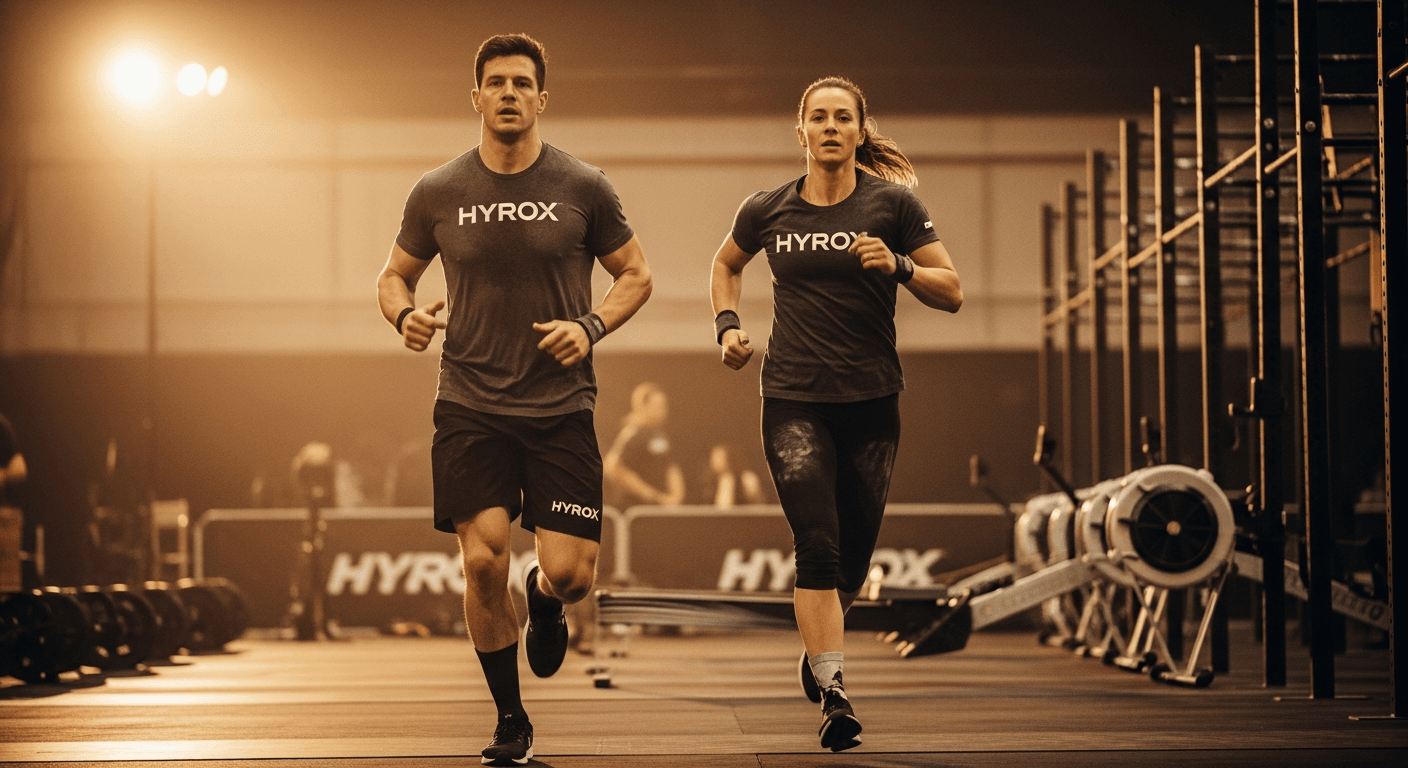
The 2026 HYROX World Championships in Stockholm are shaping up to deliver the most competitive Elite Doubles field the sport has ever produced. With both men's and women's world records falling in the weeks leading up to the event, the performance bar has been raised to a level that will demand more than raw fitness from every pair on the start line. It's going to take strategy, chemistry, and near-perfect execution.
Here's what you need to understand about who's positioned to take gold, and why the doubles format rewards a very specific kind of athlete pairing.
The Record-Breaking Context That Changes Everything
Before you can assess the doubles field, you have to understand the conditioning benchmark that's been set. Filip Roncevic's sub-52-minute solo performance and Anja Wietrzyk's new women's world record at Warsaw have collectively signaled that elite HYROX athletes are operating at a physiological level the sport has never seen before.
Those numbers matter for the doubles event because they establish what peak-condition athletes can sustain individually. In doubles racing, two athletes of that caliber sharing the workload doesn't simply halve the effort. It changes the metabolic equation entirely. Pairs built around athletes performing at or near those solo benchmarks enter Stockholm with a conditioning floor that previous doubles fields simply didn't have.
The Warsaw performances also shifted how coaches and pairs are approaching their final preparation blocks. Recovery nutrition, particularly the kind of anti-inflammatory dietary strategy now common among elite hybrid athletes, has become a priority. Plant-based eating combined with structured training has been shown to reduce systemic inflammation, which is particularly relevant when athletes are compressing hard race efforts into a short pre-championship window.
Why Doubles Strategy Is a Completely Different Sport
If you've only watched HYROX solo racing, the doubles format can look deceptively similar. It isn't. The competitive dynamics shift in three fundamental ways: pacing agreements, station handoffs, and load-sharing on the sled push.
Pacing agreements are the first variable. In solo racing, your pace is dictated by your own aerobic ceiling. In doubles, two athletes must agree on a shared running pace that doesn't burn either partner out before the functional stations. If one athlete is a stronger runner and the pair runs at their tempo, the weaker runner arrives at stations already compromised. The pairs that win are almost always the ones who've done enough training together to find a sustainable shared pace, not just the ones with the two fastest individual run splits.
Station handoffs create timing pressure that doesn't exist in solo racing. Each transition between partners has to be clean and pre-planned. In high-stakes championship conditions, a fumbled handoff or a miscommunication on who's taking which rep costs seconds you can't recover. The pairs with race experience together, specifically championship-level experience, carry a measurable advantage here.
Sled push load-sharing is where doubles racing gets genuinely tactical. The weight on the sled in the Elite Doubles category is significant, and how pairs split that work, whether they alternate full lengths or break it into shorter efforts, is a decision that can define a race. Pairs where both athletes have comparable lower-body strength profiles tend to split the sled work more efficiently. Pairs with a strength mismatch often burn the stronger partner disproportionately early.
What the Deepest Field in HYROX History Actually Means
Coverage from the lead-up to the 2026 Stockholm championships has consistently described the Elite Doubles field as the deepest in the sport's history. That's not marketing language. It reflects a real structural shift in how top athletes are prioritizing the doubles event.
For several years, doubles was treated by many elite athletes as a secondary event, something to enter alongside their solo bid. The prize structure, the growing global broadcast audience, and the prestige now attached to a doubles world title have changed that calculation. Several athletes who would previously have focused entirely on solo racing have committed to doubles-first preparation cycles for Stockholm.
That shift in prioritization means you're looking at a field where the top pairs have trained specifically as pairs, not two individuals who showed up to race together. The difference in race cohesion between a pair with 12 months of joint training versus one with six weeks together is visible on the course. It shows up in the transitions, in the running rhythm, and particularly in how they manage the back half of the race when both athletes are under real metabolic stress.
The broader trend toward evidence-based performance nutrition has also played a role in elevating the field's ceiling. The sports nutrition landscape in 2026 has shifted toward individualized fueling protocols that allow athletes to sustain higher intensities for longer, which compresses the performance gap between the top pairs and the mid-field. A deeper field, in practical terms, means more pairs capable of winning if conditions break their way.
The Pairs to Watch in Stockholm
Without confirmed official start lists at time of writing, the analysis here is built on recent competitive results and the structural characteristics that favor specific pairing types in Elite Doubles.
The pairs that carry the strongest pre-race profiles share several traits:
- Matched aerobic ceilings. Pairs where both athletes can sustain a sub-4:00 per kilometer running pace without accumulating excessive lactate arrive at functional stations in a position to execute. Pairs with a 20-second per kilometer gap between partners are already managing a structural problem before the first station.
- Complementary strength profiles. The ideal doubles pair isn't two identical athletes. It's two athletes whose physical strengths cover the other's relative weaknesses. A partner who excels in the ski erg and rowing stations paired with one who dominates the sled push and farmer's carry creates a division of labor that maximizes total output.
- Championship co-experience. Pairs who have raced a major HYROX event together before Stockholm, particularly at the Pro or Elite level, demonstrate measurably cleaner handoffs and more stable shared pacing. First-time doubles partnerships, regardless of individual quality, carry execution risk.
- Optimized recovery capacity. In a field this competitive, the ability to show up to the start line physically recovered from an intensive pre-championship training block matters. Research consistently links reduced inflammatory markers to faster recovery between high-intensity efforts, which is directly applicable to athletes managing a taper while maintaining race sharpness.
The Physical Demands That Separate Contenders From Pretenders
Elite Doubles at Stockholm will be won somewhere in the 50 to 56-minute bracket for the men's field, and the women's contenders are tracking toward a similar compression of times at the top. The margins between first and fourth place in a field this deep could be under two minutes. That context makes the execution variables, the handoffs, the pacing discipline, the sled split decisions, disproportionately important.
Running efficiency under accumulated fatigue is the physical quality that will matter most in the back half. Athletes who maintain their running economy through the sixth and seventh stations are the ones who close strong. This is where training background beyond HYROX-specific work becomes relevant. Pairs with a foundation in competitive endurance sport, whether running, cycling, or triathlon, tend to carry more efficient movement patterns at high intensities. The endurance lessons that apply to long-distance running translate directly to managing the aerobic component of a HYROX race, even in the doubles format where the effort is shared.
Muscle endurance across repeated functional movements is the second physical priority. The roxzone stations don't allow for passive recovery. By the time a pair reaches the final wall balls and the closing run, both athletes have accumulated significant muscular fatigue regardless of how well they've split the work. The pairs who can sustain quality movement under that fatigue, rather than grinding through compromised mechanics, preserve time and reduce injury risk simultaneously.
How Stockholm Changes the Doubles Landscape Going Forward
Whatever happens in Stockholm, the 2026 Elite Doubles result will reset the reference point for the event. A sub-50-minute men's doubles performance at this championship level would mark a structural shift equivalent to what Roncevic's solo time did for the individual event. The field's conditioning suggests that's within reach if race conditions cooperate.
For the broader HYROX community watching from the US, UK, Canada, and Australia, the Stockholm doubles field is also a signal about where the sport is heading. As the elite doubles event becomes a genuine priority for the world's best hybrid athletes rather than a secondary entry, the tactical sophistication of the racing will continue to evolve. The strategy conversations happening in elite training camps right now about handoff timing and sled load distribution will filter down to age-group doubles racing within a season or two.
You don't have to be racing in Stockholm to learn something from what happens there. The pairs who take the podium in Elite Doubles will do so because they solved the strategy problems that every doubles team, at every level, is working through. Watch the transitions. Watch the sled. The answer to who wins will be visible in those moments before the final running split even matters.