
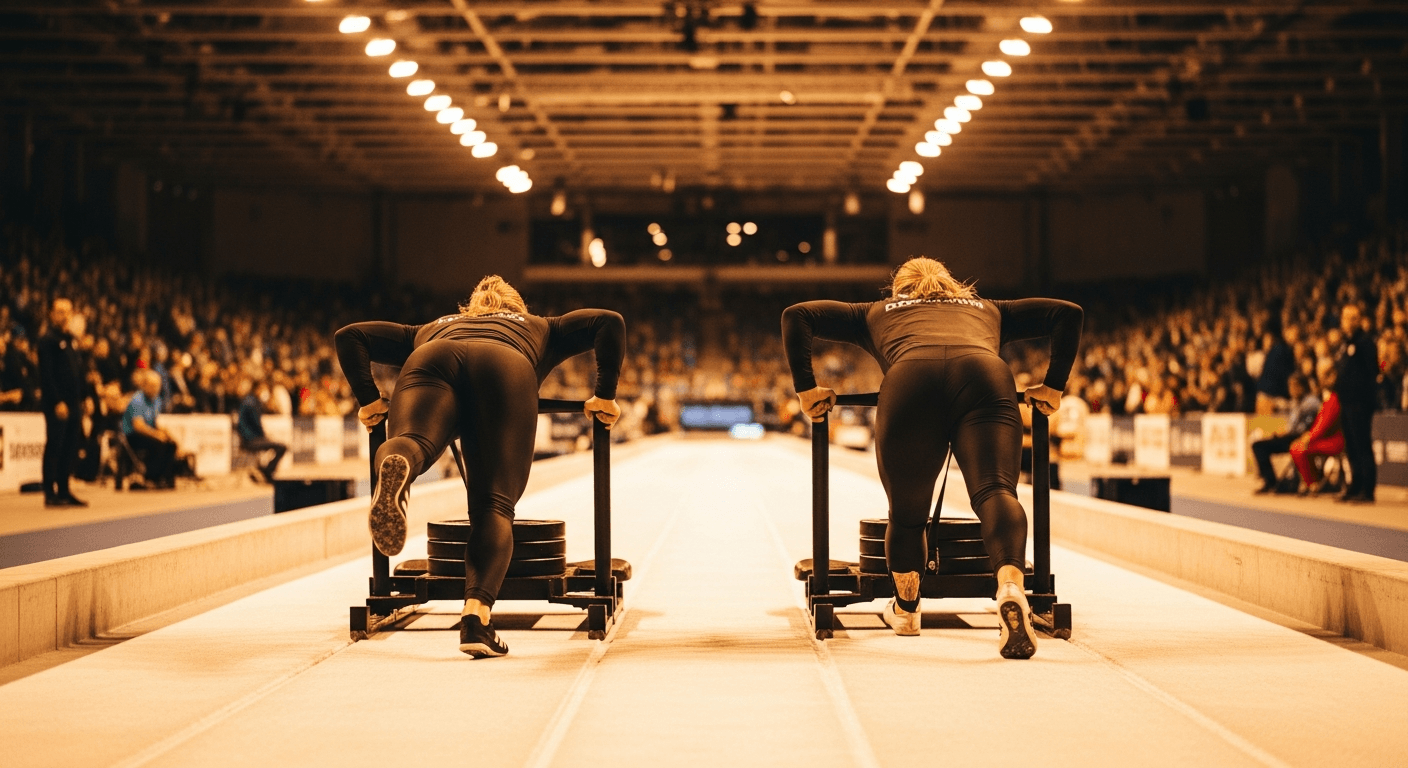
Lauren Weekes and Vivian Tudo didn't come to Warsaw to compete. They came to rewrite the record books. At HYROX Warsaw 2026, the pair delivered one of the most dominant doubles performances the sport has ever seen, setting a new women's doubles world record that signals a clear shift in what elite partnerships can achieve in this format.
Meanwhile, the men's race turned into something else entirely. Razor-thin time margins between leading teams and a series of contentious penalty decisions made the men's doubles one of the most debated finishes in recent HYROX history. Here's what actually happened, what the numbers mean, and why Warsaw matters beyond the podium.
The Record That Changes the Benchmark
Weekes and Tudo crossed the finish line in a time that now stands as the fastest women's doubles performance ever recorded at a HYROX sanctioned event. The record isn't just a number. It's a statement about where the doubles format is heading.
What made the run exceptional wasn't a single standout station. It was the consistency. In doubles, transitions between partners are where time is gained or lost, and the pair moved through the eight stations with a mechanical efficiency that most elite teams only approach on their best days. Their ski erg split, in particular, was well ahead of the previous record pace.
Weekes has been building toward this kind of performance for several competitive cycles. Tudo brings a raw output capacity that complements Weekes's tactical discipline. Together, they've developed one of the most balanced load-sharing strategies in the women's doubles field. Neither athlete is carrying the other. That's what separates this pairing from previous record holders.
For context, the women's doubles format demands that athletes split every running segment and every station between them. That means fueling, pacing, and recovery decisions have to work across two bodies with different metabolic rates and fatigue profiles. Getting that coordination right under race pressure is genuinely hard. Long-duration sports nutrition strategies for endurance events increasingly treat doubles racing as its own category, and the approach Weekes and Tudo applied reflects that evolution.
What the Time Actually Means
World records in HYROX are tricky to interpret without context. Course conditions, heat, starting wave congestion, and floor surface all affect output. Warsaw's venue configuration is known for a relatively clean layout with minimal congestion in early stations, which can benefit leading teams who get out front quickly.
That said, the margin by which Weekes and Tudo beat the previous record makes environmental factors largely irrelevant. You don't close a gap of that size on a lucky draw. The performance holds up under scrutiny.
The deeper story is what this does to competitive expectations going into the back half of the 2026 season. The previous record had stood long enough to become the working ceiling for women's doubles preparation. That ceiling is now gone. Expect the top three or four competing partnerships globally to rebuild their training targets around this new benchmark. That process typically takes one to two competitive cycles, which means the women's doubles field is about to get significantly faster across the board.
With Stockholm Worlds approaching as the season's defining doubles showdown, the Warsaw record gives Weekes and Tudo a psychological edge that's hard to quantify but very real. They've already proven they can run that time. Every other team is still chasing it.
The Men's Race: Tenths of Seconds and Contested Calls
The men's doubles in Warsaw was a different kind of story. Where the women's race delivered clarity, the men's race delivered chaos, and not the entertaining kind.
Multiple leading teams finished within margins that, in a sport measured to the second, were genuinely extraordinary. The time gaps between the top finishers were small enough that penalty minutes became the deciding factor rather than raw athletic performance. That's when the controversy started.
At least two penalty decisions in the men's race were disputed by teams and drew significant scrutiny from observers on the floor. HYROX penalties are awarded for station violations, typically incomplete repetitions or failure to meet movement standards at the functional stations. The problem is that enforcement consistency at elite level has been an ongoing concern in the sport for several seasons.
When a one-minute penalty is the difference between first and fourth place, the standard for how that penalty is applied needs to be airtight. In Warsaw, at least some of those decisions didn't appear to meet that threshold, based on footage reviewed by those present. Athletes and coaches on the ground raised objections through official channels during and after the race.
This isn't a new problem in HYROX. As prize money grows and qualification points for major championships become more consequential, the pressure on officiating increases. A sport that's built its brand on objective measurement needs officiating infrastructure that matches that identity. Warsaw exposed a gap between those two things.
Why Penalty Officiating Needs to Scale
The structural challenge is straightforward. HYROX events run multiple waves simultaneously across a large venue. Elite athletes compete at one end of the capacity spectrum, but they share the same floor and often the same officiating pool as age-group competitors. Deploying consistent, qualified officials specifically to elite heats requires investment and organizational commitment that not every race has delivered uniformly.
Other high-stakes hybrid sports have dealt with this by separating elite officiating entirely from the general competition structure. That model costs more to run but removes the ambiguity that undermined confidence in Warsaw's men's result.
The athletes affected by the Warsaw decisions are right to push for clarity. Not because they're wrong to accept that penalties are part of the sport, but because they're entitled to know those penalties are being applied by officials who are equipped, trained, and consistent. That's a reasonable expectation at the elite level of any sport.
The Physical Demands Behind the Numbers
It's worth stepping back for a moment and appreciating what both the men's and women's doubles fields are actually doing physically. A top-end HYROX doubles completion involves roughly the same total workload as a strong open performance, distributed across two athletes. The cardiovascular and muscular demands are severe, particularly through the back half of the race when accumulated fatigue starts compromising movement quality.
For athletes training at this level, nutrition and recovery aren't peripheral concerns. They're central to whether you can hold technical standards under fatigue. Movement standard failures late in a race are often less about technique and more about the physiological cost of sustaining output. Understanding how protein timing supports muscle recovery between high-intensity efforts is one area where elite doubles teams are increasingly focused, particularly when races cluster across a competitive weekend.
The gut also plays a larger role than most recreational athletes realize. Maintaining absorption and reducing GI distress during sustained output at HYROX intensity is a genuine challenge, and the evidence linking gut health to sustained athletic performance is increasingly relevant to how elite HYROX athletes approach their preparation.
What Warsaw Tells You About the 2026 Season
Pull back to the season-level view and a few things become clear from Warsaw.
- Women's doubles is accelerating. The Weekes and Tudo record isn't an outlier. It's the leading edge of a performance wave that's been building across multiple events. The format is maturing, and the athletes competing in it are more specialized than ever.
- Men's doubles is increasingly competitive at the top. The tight margins in Warsaw reflect a field where the difference between first and fifth is increasingly about execution and tactical decisions rather than raw fitness gaps. That makes officiating precision even more critical.
- HYROX's officiating framework is under pressure. As the sport grows and prize structures increase, the gap between what athletes deserve in terms of officiating quality and what they're currently receiving needs to close. Warsaw made that visible in a way that's hard to ignore.
- Stockholm is going to be exceptional. With a world record already on the books and a highly motivated men's field looking to settle unfinished business, the doubles competition at Stockholm Worlds carries more weight than any previous edition.
Warsaw delivered a landmark moment in women's doubles and a messy lesson in men's officiating. Both deserve your attention, and both will shape how the season ends.
The record belongs to Weekes and Tudo. The questions belong to the sport.