
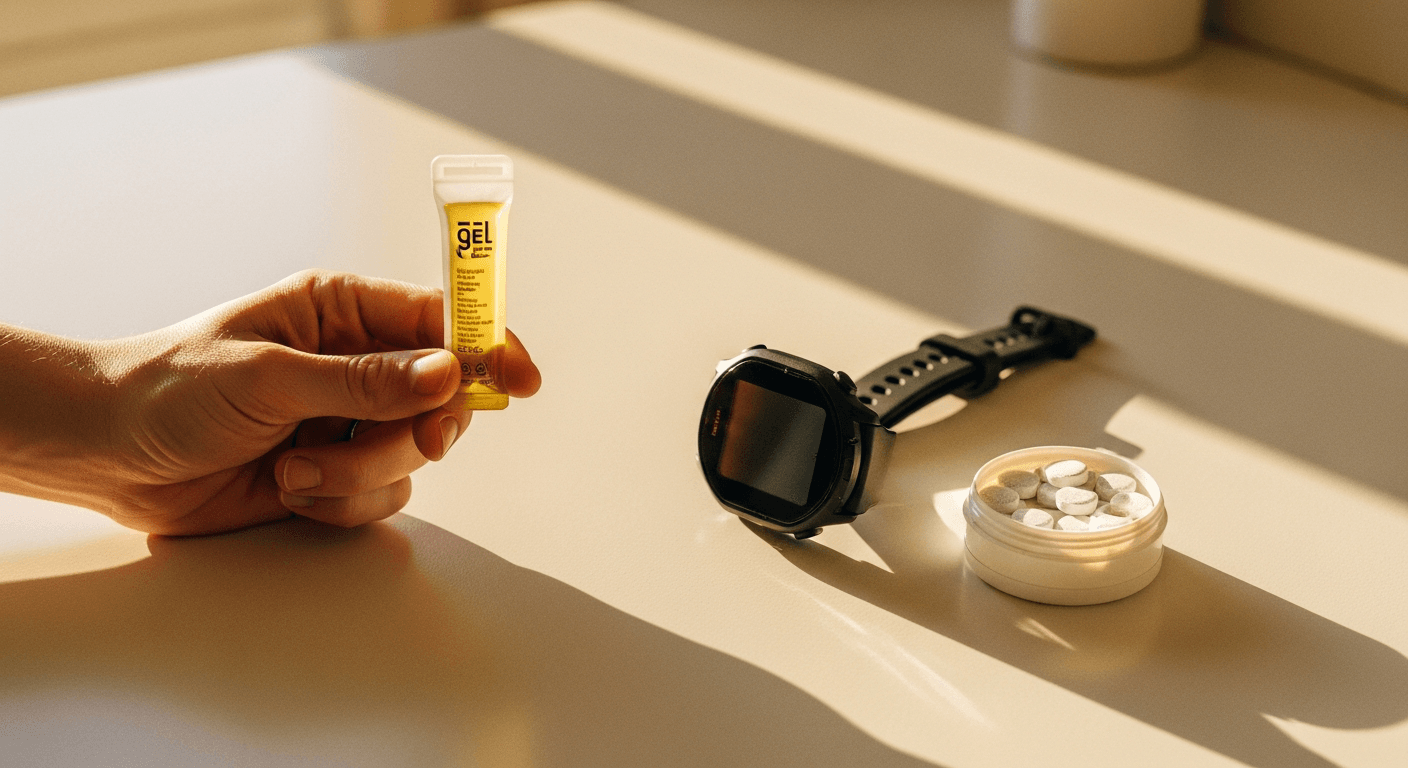
If you've been fueling long training sessions the same way for years, it's worth asking whether the science has moved on without you. It has. The field of endurance nutrition has shifted considerably in the past decade, and the gap between what research supports and what most athletes actually do is still surprisingly wide.
This guide covers what the current evidence says about fueling efforts lasting 60 minutes or more, from the carbohydrate sources you use to how much sodium you actually need, to why your gut may be the limiting factor nobody told you about.
The Carbohydrate Question Has a Clearer Answer Now
For years, the standard advice was simple: eat carbs before, during, and after. The recommendation hovered around 30 to 60 grams of carbohydrate per hour for efforts lasting beyond 60 minutes. That's still a useful baseline, but it misses a critical detail about how your body actually absorbs and oxidizes those carbs.
Glucose and fructose use different intestinal transporters. Glucose relies on the SGLT1 transporter, which saturates at roughly 60 grams per hour. Once that ceiling is hit, adding more glucose doesn't increase absorption. It just increases the likelihood of gastrointestinal distress. Fructose, by contrast, uses the GLUT5 transporter and can be absorbed alongside glucose without competing for the same pathway.
This is why the dual-source approach matters. Research consistently shows that combining glucose and fructose in a ratio of approximately 2:1 allows total carbohydrate oxidation rates to reach 90 grams per hour or even higher in trained athletes. That's a meaningful increase in available fuel, and it translates directly to sustained power output and delayed fatigue in efforts lasting two hours or more.
Practically, this means you're looking for products or food combinations that list both glucose (or maltodextrin, which breaks down into glucose) and fructose on the label. Many modern sports gels and drink mixes are now formulated with this ratio in mind. If you're using whole foods, combining a banana with a small amount of fruit juice or a fructose-containing energy bar achieves a similar effect.
For efforts under 75 minutes at moderate intensity, you likely don't need to be this precise. The dual-source strategy becomes most relevant when you're pushing beyond 90 minutes and aiming to sustain high output. That's when every percentage point of carbohydrate oxidation efficiency starts to matter.
Sodium Needs Are Individual. Stop Treating Them Otherwise
Walk into any running store and you'll find sodium products marketed with specific dosing instructions as if they apply universally. They don't. Sweat sodium concentration varies enormously between individuals, with research showing a range from roughly 200 milligrams per liter to over 1,700 milligrams per liter. That's not a small margin of error. That's a nearly tenfold difference.
Your sweat rate compounds this further. A heavier athlete training hard in summer heat may lose two liters of sweat per hour. A smaller athlete at moderate intensity in cool conditions might lose 0.5 liters. The sodium loss difference between those two scenarios is dramatic, and no single product recommendation bridges that gap reliably.
The practical implication is that you need to know something about your own sweat profile before committing to a sodium strategy. At-home sweat patch testing kits have become more accessible, and several sports science labs now offer formal sweat testing for around $100 to $200. For most recreational endurance athletes, this is a one-time investment that pays off across years of training and racing.
In the absence of testing, the signs of sodium imbalance are worth recognizing. Cramping, swelling in the hands or face during exercise, and excessive thirst relative to sweat rate can all indicate sodium issues, though none are definitive diagnostic markers on their own. The old assumption that cramps equal low sodium is now considered an oversimplification by exercise physiologists.
A reasonable starting point for most athletes training between 60 and 120 minutes is 500 to 700 milligrams of sodium per hour in moderate conditions, adjusted upward for heat, humidity, and individual sweat rate. But treat this as a hypothesis to test, not a prescription to follow blindly.
Gut Training Is the Variable Most Athletes Ignore
Here's something the supplement industry undersells: your gut is trainable. The intestinal transporters that absorb glucose and fructose can upregulate in response to regular carbohydrate intake during exercise. Athletes who consistently practice high-carbohydrate fueling during training develop a measurably greater capacity to absorb and oxidize carbohydrates compared to those who train fasted or with minimal fuel.
This has significant practical consequences. If you spend months training with low carbohydrate intake and then attempt to consume 80 to 90 grams per hour during a race, you're asking your gut to do something it hasn't been trained to do. The result is often nausea, bloating, or worse. Gut distress is one of the leading causes of performance failure in endurance events, and much of it is preventable through deliberate gut training.
Product innovation in this space is accelerating. Several nutrition companies are now formulating products specifically around gut adaptation protocols, including lower-osmolality gels designed to reduce gastric emptying delays, and staged intake systems that gradually increase carbohydrate load across a training block. This is a genuine shift from simply optimizing nutrient composition toward optimizing absorption capacity itself.
If you want to build gut tolerance, the approach is methodical. Start at the lower end of your carbohydrate intake target during easy training sessions and progressively increase over four to eight weeks. Practice your race-day fueling strategy during long training runs or rides, not just during the event. This is especially important if you're targeting anything longer than a half marathon or a two-hour cycling effort.
The broader nutrition landscape is shifting in ways that parallel this. Just as gut health has become central to understanding inflammation and recovery in general wellness contexts, as covered in Plant-Based Eating Plus Exercise: The Anti-Inflammatory Combo, endurance sport is recognizing that the digestive system is a performance variable, not just a delivery mechanism.
Periodizing Your Fuel Strategy Across a Training Block
Not every session requires maximum carbohydrate intake. This is where periodized fueling comes in, and it's one of the more nuanced developments in applied sports nutrition over the past several years.
The concept involves deliberately varying your carbohydrate availability depending on the training goal for a given session. High-intensity intervals and long race-pace workouts benefit from full carbohydrate availability. Some lower-intensity aerobic sessions can be completed with reduced carbohydrate intake, which may enhance mitochondrial adaptations over time. This isn't about chronic carbohydrate restriction. It's about strategic timing to amplify specific training signals.
Research on this approach is ongoing and the optimal protocols are still being refined. What's clear is that the old binary thinking around carbohydrates. either load aggressively or avoid them. is too simplistic for athletes who want to optimize both performance and metabolic adaptability. The emerging guidance, summarized well in recent applied research reviews, points toward a train-high, race-high model for most competitive endurance athletes, with selective low-availability sessions used sparingly and intentionally.
Recovery nutrition fits into this periodization framework too. The post-exercise window for carbohydrate and protein intake remains relevant, particularly for athletes training twice daily or on back-to-back days. A target of 1.0 to 1.2 grams of carbohydrate per kilogram of body weight in the first two hours after a long effort, combined with 20 to 40 grams of protein, supports glycogen resynthesis and muscle protein synthesis simultaneously. For a broader view of what recovery tools are earning their place in evidence-based practice, Recovery Tools in 2026: What the Evidence Actually Supports is a useful reference.
What to Actually Buy and Use
The market for endurance nutrition products in the US is worth over $2 billion and growing. The volume of options is overwhelming, and the marketing often outruns the evidence. Here's a practical filter for evaluating products:
- Check the carbohydrate sources. For efforts over 90 minutes, look for products that combine maltodextrin or glucose with fructose in a roughly 2:1 ratio. Single-source glucose products hit an absorption ceiling that limits how much fuel you can actually use.
- Assess osmolality when possible. Lower-osmolality formulations generally empty from the stomach more quickly, which reduces the risk of GI distress at high intake rates. Some brands now include this on their labels or product pages.
- Ignore blanket sodium claims. Products marketing a specific sodium dose as universally correct for endurance sports are oversimplifying. Use their sodium content as raw data and adjust based on your own sweat profile and conditions.
- Prioritize products you've practiced with. No matter how well-formulated a gel or drink mix is, using it for the first time during a race is a risk. Gut training requires repetition with the actual products you'll use.
- Don't overlook real food. Boiled potatoes with salt, rice cakes, bananas, and dates have been used successfully by endurance athletes for decades. They're not inferior to engineered products. They're just less convenient at high intensities.
The innovation happening in sports nutrition right now is genuinely useful, but it's layered on top of fundamentals that haven't changed. If you're curious about how broader nutrition science is evolving alongside these developments, Sports Nutrition in 2026: What's Actually Working Now covers the wider landscape, and What Traditional Food Systems Teach Modern Nutrition Science offers a useful counterpoint on why older fueling approaches still have something to teach us.
Building Your Protocol
The practical takeaway from current evidence is that long-duration fueling works best when it's individualized, practiced, and periodized. That means knowing your carbohydrate absorption targets and using dual-source products to hit them, understanding your sweat rate and sodium needs rather than relying on generic product dosing, and treating your gut as a system that requires its own training stimulus.
You don't need to overhaul everything at once. Start with one variable. If you've never used a glucose-plus-fructose product for efforts over 90 minutes, that's the most evidence-supported change you can make today. Build from there, and keep testing what works for your physiology, your training load, and your conditions.
The athletes getting this right aren't necessarily using the most expensive products. They're the ones who've taken the time to understand the mechanisms, build their gut tolerance, and match their fueling strategy to the actual demands of their sport.