
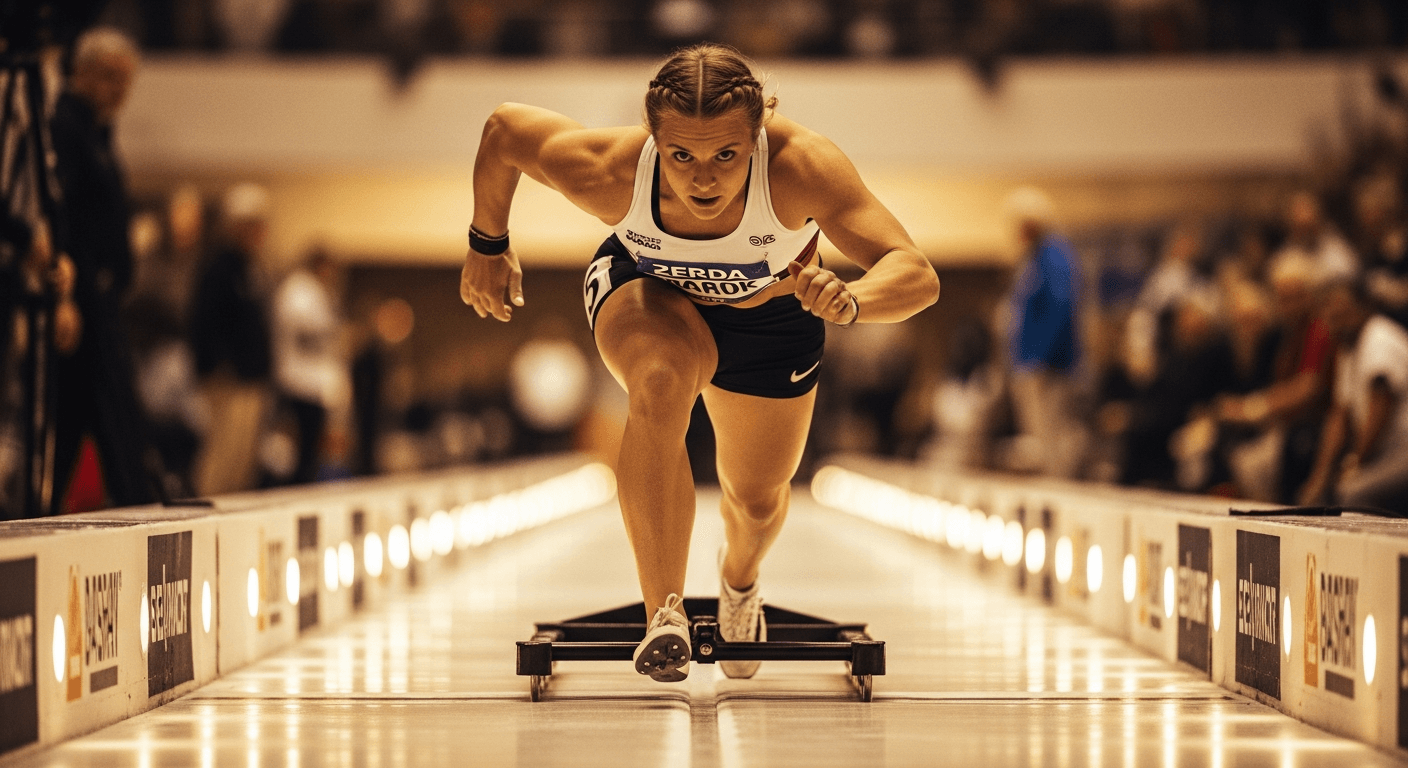
Wietrzyk's Warsaw World Record: What It Means for HYROX's Elite Era
Joanna Wietrzyk just rewrote the women's record books at the Warsaw Major, and the timing couldn't be more significant. With the 2026 HYROX World Championships in Stockholm now on the horizon, her performance doesn't just raise the bar. It relocates it entirely.
What happened in Warsaw wasn't an isolated breakthrough. It was the clearest signal yet that elite HYROX is entering a new performance tier, one where the athletes who built this sport's credibility are now systematically dismantling its previous limits.
The Record That Changes the Conversation
Wietrzyk's new world record at the Warsaw Major extends a dominance that has defined the Elite Women's category for the past two seasons. Her split data tells the full story. This wasn't a single explosive workout station or a fortunate pairing of fitness and race conditions. It was a complete performance, optimized across every discipline the format demands.
HYROX races combine eight functional workout stations with 1km running segments between each one. The balance between running economy and muscular endurance is unforgiving. You can't fake fitness here, and you can't overspecialize. Wietrzyk's record reflects an athlete who has closed the gap between those two demands almost completely.
Her splits through the running kilometers showed consistent pacing rather than front-loaded aggression. The discipline to hold back in the early stages and maintain form through the ski erg, sled work, and burpee broad jumps in the final third is precisely where most athletes, even elite ones, begin to fracture. She didn't.
Why Stockholm Now Looks Like Her Race to Lose
The HYROX World Championships in Stockholm represent the sport's highest stage. Every athlete on the Elite Women's circuit has circled the date. But Wietrzyk's Warsaw performance changes the psychological dynamic heading into that event in a way that raw rankings don't capture.
When you set a world record weeks before the biggest race of the season, you're not just demonstrating fitness. You're communicating it to every competitor in your field. The athletes who will line up in Stockholm have now seen exactly what's possible, and they know Wietrzyk has more in reserve. World records at majors are rarely a full effort. They're proof of form.
That creates a specific kind of pressure on the rest of the Elite Women's field. Matching the record at Worlds requires a near-perfect race from someone who hasn't yet shown that ceiling. Beating it requires something exceptional. The strategic calculus for every other podium contender has shifted.
For fans who follow the sport closely, this mirrors the dynamics seen in elite marathon racing, where a dominant athlete's pre-championship performance reshapes how competitors approach their own pacing and risk tolerance. average marathon finishing times have been dropping across the board in 2026, and endurance sport culture broadly is adjusting to a new normal where records are being challenged with increasing frequency. HYROX's elite tier is part of that same wave.
Reading the Split Data: Where Wietrzyk Wins
Performance analysis in HYROX has matured significantly. Athletes and coaches now dissect split data the way competitive swimmers analyze stroke rates or cyclists study power output. Wietrzyk's record provides a roadmap that will be studied across the circuit before Stockholm.
A few patterns stand out from her Warsaw race:
- Running economy through fatigue. Her kilometer split times in the back half of the race degraded far less than the field average. This reflects either superior aerobic conditioning, more efficient running mechanics under load, or both.
- Transition efficiency. The transitions between running and workout stations represent underappreciated time. Wietrzyk's consistency here suggests a race execution model that treats transitions as part of the training, not just connective tissue.
- Wall ball and sled push output. The final two stations are where accumulated fatigue becomes most visible. Her output on both suggests she was running a conservative enough early pace to preserve power for the finish, which is a strategic decision as much as a physical one.
For athletes training toward Stockholm or any upcoming HYROX qualifier, this split profile is worth studying. It outlines a pacing architecture that prioritizes the back half of the race rather than chasing early splits.
Roncevic and the 52-Minute Barrier: A Parallel Breakthrough
Wietrzyk's record didn't happen in isolation. At the same competitive window in Warsaw, Alexander Roncevic broke the 52-minute barrier in the men's Elite field. Two world records falling in the same event is statistically remarkable. As a signal about where the sport is heading, it's significant.
The 52-minute threshold in men's HYROX has carried symbolic weight the way sub-two-hour marathon running once did in road racing. It's the mark that separates exceptional from historic. Roncevic's crossing of that line, combined with Wietrzyk's women's record, means Warsaw 2026 will be referenced as an inflection point in HYROX's competitive timeline.
These parallel breakthroughs also raise questions about what's driving performance gains at this level. Training methodology, race strategy, and equipment have all evolved. But nutrition science has moved alongside them. The growing body of research on inflammation management and recovery is increasingly reflected in how elite endurance and functional fitness athletes fuel their training blocks. sports nutrition practices in 2026 look meaningfully different from even three years ago, with a sharper emphasis on recovery quality and systemic inflammation reduction as performance levers.
What This Means for the Broader Elite Women's Field
It would be easy to frame Wietrzyk's dominance as a story about one athlete. But the more interesting story is what her record does to the women around her.
Elite HYROX, particularly on the women's side, has developed a deep competitive field. The athletes challenging for podiums at Worlds are not far behind the pace at the top. The margins are narrow. What a world record does is force every athlete in that field to reassess what an optimal race looks like and whether their current preparation is calibrated for it.
That recalibration happens at the training level, the nutrition level, and the tactical level. Some athletes will respond by pushing their running volume. Others will prioritize station-specific strength work. The record sets a reference point, and the competitors who respond most intelligently to that reference point, rather than reacting emotionally to it, will be the ones making podium noise in Stockholm.
Recovery and anti-inflammatory nutrition protocols have become a meaningful part of that response strategy for high-volume HYROX athletes. The training loads required to compete at this level are substantial, and managing the cumulative stress between majors is where championships are often won or lost. the combination of plant-based eating and structured exercise has shown measurable anti-inflammatory effects that translate directly into recovery capacity and training consistency, two factors that define elite performance at this stage of a season.
HYROX at an Inflection Point
The sport has grown from a niche functional fitness format into a global competitive circuit with serious prize structures, broadcast partnerships, and a World Championships that draws elite athletes from across endurance and functional fitness backgrounds. Warsaw 2026 crystallizes where that growth has led.
You're watching a sport in the process of defining its own performance ceiling, and that ceiling keeps moving. The two records set in Warsaw signal that the athletes currently competing at the top level are not merely maintaining existing standards. They're accelerating past them.
Stockholm will be the next test of how far that acceleration can go. Wietrzyk arrives as the benchmark. The question now is whether the women chasing her in Sweden have found something in their preparation that she hasn't shown yet, or whether Warsaw was the preview of what Worlds will look like.
Either outcome makes Stockholm one of the most compelling HYROX events in the sport's history. The records set in Warsaw didn't just matter in Warsaw. They've already shaped what happens next.
For athletes preparing for their own HYROX qualifiers this season, the Warsaw data offers a concrete training reference. And for anyone tracking the competitive arc of functional fitness at its highest level, the lessons coming out of elite endurance events in 2026 apply broadly to how pacing, preparation, and performance psychology interact when the stakes are highest.