
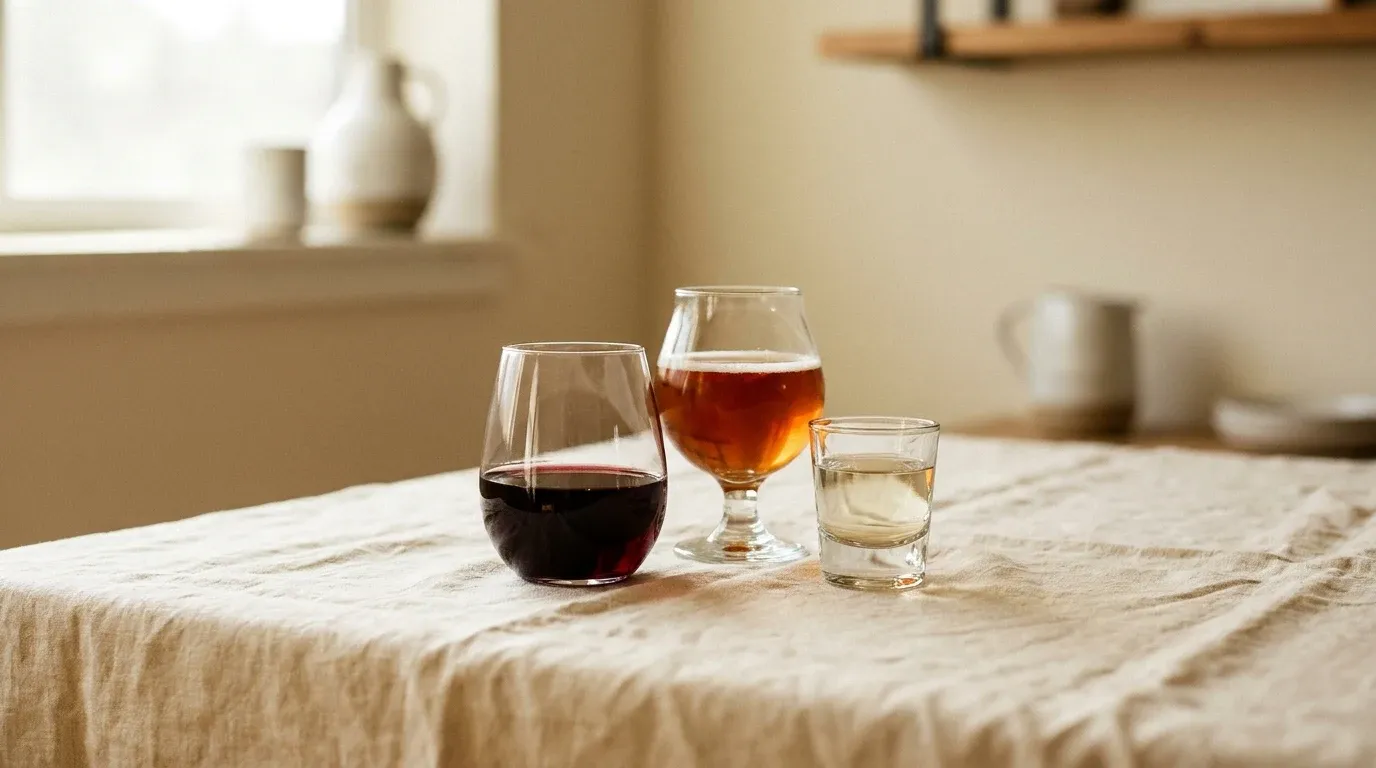
A wave of new cardiovascular research is forcing a more nuanced conversation about alcohol. Rather than treating every drink as equally damaging, recent data suggests the type of alcohol consumed carries its own risk profile. For athletes and regular exercisers, that finding lands in familiar territory. Exercise physiology has been making the same argument for years: a post-race beer and a double whiskey before bed are not the same intervention. They land differently in your body, and they affect your training differently.
This isn't a license to drink freely. It's a framework for thinking more precisely about what you're actually doing when you combine alcohol with a serious training schedule.
Why Type Matters, Not Just Quantity
The cardiovascular research draws a distinction between fermented drinks like wine and beer, and distilled spirits, with some evidence suggesting moderate wine consumption correlates with lower inflammatory markers compared to equivalent alcohol doses from spirits. The mechanism likely involves polyphenols in red wine, particularly resveratrol, which carry antioxidant properties independent of alcohol content.
From a performance standpoint, the parallel holds. The matrix of a drink, its carbohydrate content, polyphenol load, carbonation, and congener profile, shapes how your body processes it in a training context. Treating two glasses of Pinot Noir and two shots of vodka as identical because they contain roughly the same ethanol is like treating a bowl of oatmeal and a candy bar as equivalent because they share a similar calorie count.
Ethanol itself remains the primary disruptor. It inhibits protein synthesis, blunts testosterone response, and elevates cortisol acutely. Those effects are consistent across all alcohol types. But the surrounding metabolic context shifts depending on what you're drinking.
Beer and the Post-Training Carbohydrate Problem
Beer occupies a genuinely complicated position in sports nutrition. It contains carbohydrates, typically 10 to 15 grams per standard 12-ounce serving, which makes it superficially appealing after a hard session. Some research on post-exercise beer consumption shows it doesn't significantly impair rehydration compared to water when consumed in moderate quantities, and the carbohydrate content contributes to early glycogen replenishment.
The problem is that this framing creates a false equivalence. Yes, beer provides carbohydrates. But it's also delivering ethanol simultaneously, which suppresses the hormonal cascade that drives muscle repair. Studies examining alcohol's effect on muscle protein synthesis after resistance training consistently show a dose-dependent reduction even when protein intake is controlled. You're replenishing glycogen in one hand while undermining the adaptive response with the other.
Beer also carries a caloric density that athletes underestimate. A 12-ounce IPA can run 200 to 250 calories with minimal micronutrient return. If you're managing energy balance carefully for body composition or performance, two post-workout beers add 400 to 500 mostly empty calories. That's a meaningful number. For context on how to structure calories around training more precisely, fueling training without accumulating fat breaks down the periodization logic in detail.
The carbohydrate argument for beer also collapses when you compare it against actual recovery nutrition. A banana and a protein shake will outperform a beer on every relevant metric: glycogen replenishment, amino acid availability, hydration, and hormonal environment.
Wine and Spirits: Different Vectors, Shared Problem
Wine, particularly red wine, brings polyphenols that may genuinely attenuate some exercise-induced oxidative stress. That sounds like a performance benefit, but the effect size is small and the alcohol load that accompanies it is not. If polyphenols are your goal, tart cherry juice and blueberries deliver a significantly higher dose without the tradeoff.
Spirits present a different metabolic profile. With negligible carbohydrates and no meaningful micronutrients, spirits deliver a relatively clean ethanol hit. For athletes tracking macros tightly, this can seem appealing. Vodka soda is a fixture of "low-calorie drinking" culture for a reason. But the absence of carbohydrates can actually accelerate the rate of alcohol absorption and exaggerate blood glucose dysregulation, particularly after a session that has already depleted liver glycogen.
Congeners, the chemical byproducts of fermentation that give darker spirits their flavor, are associated with more severe next-day impairment. Bourbon, whiskey, and dark rum consistently perform worse in hangover severity studies compared to clear spirits like vodka or gin. For athletes training the morning after a social event, that difference is real and measurable in performance output.
Sleep Is Where Every Type of Alcohol Causes the Same Damage
Here's where the type-based distinctions collapse entirely. Any alcohol consumed within four hours of sleep disrupts sleep architecture in ways that are consistent across beverages. The mechanism is straightforward: ethanol is sedating in its initial phase, which shortens sleep onset latency and increases slow-wave sleep in the first half of the night. That sounds beneficial. It isn't.
As alcohol metabolizes, the rebound effect in the second half of the night fragments sleep, suppresses REM duration, and increases nighttime wakefulness. REM sleep is where emotional processing, memory consolidation, and much of the hormonal recovery work happens. Growth hormone release is predominantly tied to slow-wave sleep in the first sleep cycle, and alcohol disrupts this architecture even at relatively modest doses, around 0.5 grams per kilogram of body weight.
For a 180-pound athlete, that's roughly two standard drinks consumed within the pre-sleep window. This is not a large amount. And the consequences for training adaptation are significant. Sleep is arguably the highest-leverage recovery tool available, more impactful than ice baths, compression, or most supplements. Current sleep research is actively investigating the mechanisms behind sleep's role in tissue repair and metabolic regulation, and the consensus direction is that the recovery window you lose to alcohol-impaired sleep is not recoverable through other means.
If you're already navigating recovery limitations, it's worth noting that alcohol isn't the only compounding variable. ultra-processed food consumption creates its own disruption to the inflammatory and hormonal environment that governs recovery, and the two factors together are substantially worse than either alone.
Practical Thresholds for Athletes Who Train Four or More Times Per Week
If you train seriously and you drink socially, the goal isn't abstinence. It's intelligent placement. Here's a framework based on the available evidence:
- Timing relative to training: Place drinking on rest days or on the evening following a low-intensity session. Never consume alcohol within two hours post-workout if the goal of that session was hypertrophy or high-intensity adaptation. The protein synthesis window is active for several hours post-exercise and alcohol suppresses it directly.
- Timing relative to sleep: Stop drinking at least four hours before you intend to sleep. This is the single most evidence-supported rule in this space. It applies regardless of whether you're drinking wine, beer, or spirits.
- Quantity ceiling: The research consistently places meaningful performance disruption at or above two standard drinks in a single session. One drink on an off-day, consumed more than four hours before sleep, creates minimal measurable impact for most trained individuals. Two or more drinks compound the effects non-linearly.
- Choose lower-congener options when drinking spirits: Clear spirits cause less next-morning impairment than dark ones. If you have a morning training session, the choice between clear and dark liquor is not trivial.
- Don't use beer as a recovery tool: The carbohydrate content is not sufficient justification. Eat real food, drink water, and have a beer later in the evening if you want one. That sequence produces a meaningfully better outcome than treating beer as a recovery drink.
- Protein distribution still matters: Alcohol blunts muscle protein synthesis, so the protein you eat around drinking events becomes more important, not less. protein distribution across the day explains why timing and spacing your intake can partially offset some of the anabolic disruption alcohol creates.
The Bigger Picture for Serious Exercisers
The emerging cardiovascular data is a useful reminder that blanket rules around alcohol tend to obscure more than they reveal. Context, type, timing, and quantity all interact. That's the same framework that governs most nutrition decisions in sport.
What the evidence doesn't support is the idea that alcohol is performance-neutral if you manage the type carefully. It isn't. The ethanol is always doing something, and in the context of a training schedule that demands consistent recovery, the cumulative effect of regular alcohol consumption adds up faster than most people account for.
Athletes managing body composition or metabolic health through pharmaceutical support face an additional layer of complexity here. muscle preservation strategies during GLP-1 use addresses how the anabolic environment is already under pressure in those contexts, making alcohol's inhibitory effect on protein synthesis particularly costly.
The goal is a framework you can actually use. Know your drink's profile. Respect the sleep window. Keep quantity below two drinks in a session. Place drinking on days when the recovery cost is lowest. That approach won't eliminate the tradeoff, but it will minimize the damage without requiring you to treat every social event as a threat to your performance.