
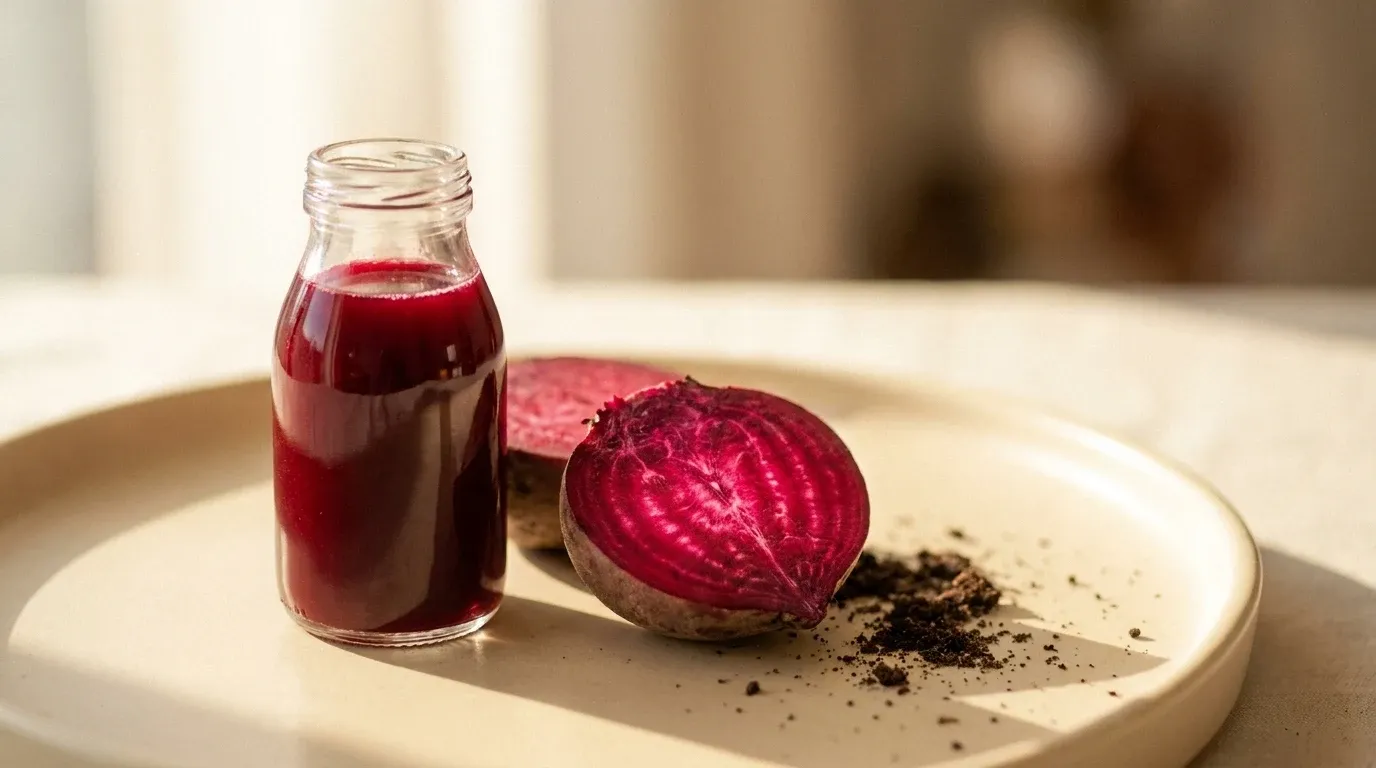
Beetroot juice has moved well past the "interesting but niche" category. There's now a solid body of research behind its primary active compound, dietary nitrate, and how it affects oxygen efficiency, blood flow, and exercise performance. What's less clear for most people is how to actually use it. Timing, dose, and form all matter more than the general advice of "drink some beet juice before training" suggests.
This guide cuts through the noise and gives you a workable protocol, whether you're training for a 5K, hitting the weights four times a week, or already using a stimulant-based pre-workout and wondering where beetroot fits.
What Nitrates Actually Do in the Body
When you consume dietary nitrate, bacteria in your mouth and gut convert it to nitrite, which then converts to nitric oxide. Nitric oxide is a vasodilator. It relaxes and widens blood vessels, which improves blood flow and reduces the oxygen cost of exercise. That last part is the key: your muscles can produce the same amount of work using slightly less oxygen. In endurance and high-intensity contexts, that's a meaningful edge.
Research consistently shows benefits at submaximal intensities, meaning the kind of sustained effort that makes up most training. Cycling time trials, rowing ergometer tests, and strength endurance protocols have all shown improvements in the 1 to 3 percent range, which sounds modest but translates to real seconds and repetitions at meaningful outputs.
The nitric oxide pathway also reduces the accumulation of metabolites linked to fatigue, which is part of why some users report being able to sustain harder efforts before hitting the wall. This isn't a stimulant effect. Your heart rate doesn't spike. Your perceived exertion may actually decrease at a given intensity.
Dose Matters More Than Most People Think
Here's where a lot of people go wrong. Not all beetroot products deliver the same nitrate content, and the research showing performance benefits was done at specific doses. The threshold most studies use is around 300 to 500 milligrams of dietary nitrate. Getting there requires more than a small glass of standard beet juice from a carton.
Here's a rough breakdown by source:
- Whole cooked beetroot: Roughly 100 to 150 mg of nitrate per 100g serving. You'd need around 200 to 300g to approach the effective range, which is roughly two to three medium beets.
- Cold-pressed beetroot juice (bottled): Nitrate content varies widely by brand and processing. Most sit between 150 and 250 mg per 250ml serving. Check the label if it's listed. Many don't declare it.
- Concentrated beetroot shots: These are the most reliable and consistent format. Products standardized to 400 mg of nitrate per 70ml shot have been used extensively in research settings. Brands like Beet It have published their nitrate content. Expect to pay $3 to $5 per shot for quality concentrated products.
Processing also strips nitrates. Heat, pasteurization, and long storage reduce nitrate levels in juices significantly. Cold-pressed and refrigerated formats retain more. Shelf-stable cartons of beetroot juice are often the weakest option despite looking like the most convenient choice.
If you're eating whole beets, roasting is fine but boiling leaches nitrates into the cooking water. Roasting or eating them raw preserves more of what you're after.
Timing: When You Drink It Changes What You Get
Nitrate doesn't hit your bloodstream instantly. The conversion chain from nitrate to nitric oxide takes time, and peak blood nitrite levels typically occur two to three hours after consumption. Most research protocols dose participants two to two-and-a-half hours before exercise, and that's the window where benefits are most consistently demonstrated.
Drinking a beetroot shot 20 minutes before training, the way many people treat it like a standard pre-workout, is likely too late for the nitric oxide pathway to be operating at full capacity when your warm-up ends.
A practical timing protocol:
- Optimal window: 2 to 2.5 hours before training starts
- Acceptable window: 90 minutes before, especially with concentrated shots
- Avoid: Less than 60 minutes before, which limits the vasodilatory effect during peak training intensity
For early-morning sessions, this creates a real-world challenge. If you train at 6am, drinking beetroot juice at 3:30am isn't realistic. In that case, some researchers have explored "nitrate loading" over several days to maintain elevated nitrite levels consistently, though this requires daily consumption for at least three to six days to show reliable carryover effects.
Caffeine and Nitrates: Do They Work Together?
Most pre-workout supplements on the market are built around caffeine, often alongside beta-alanine, creatine, and various vasodilating compounds. If you're already using one of these products, the question of whether to also add a beetroot source is legitimate and the research gives a nuanced answer.
Some earlier studies suggested caffeine might blunt nitrate's vasodilatory effects by counteracting nitric oxide signaling. More recent work has largely walked that back. The current picture suggests that when consumed at moderate caffeine doses (around 3 mg per kilogram of bodyweight or less), the two compounds are largely complementary rather than competing.
What's particularly relevant is that dietary nitrate may reduce cardiovascular strain during intense exercise. Studies have shown lower heart rates and reduced systolic blood pressure at submaximal intensities when participants are in a nitrate-loaded state. For athletes who already feel significant cardiovascular stress from a stimulant-heavy pre-workout, adding a beetroot source may allow them to sustain similar performance outputs without the heart rate spike that sometimes accompanies high-stim products.
This doesn't mean stacking more and more compounds is always the answer. If you're stuck at the same weights and looking to break a lifting plateau, addressing your training structure and recovery is more impactful than adding supplements. Nitrates are a modest, evidence-backed addition, not a shortcut to a different category of performance.
A Practical Pre-Workout Protocol Using Beetroot
Here's how to structure this in real-world terms:
- Choose a standardized source. A concentrated beetroot shot with declared nitrate content of 300 to 400 mg is your most reliable option. Whole beets work but require more precise portioning.
- Time it correctly. Consume your beetroot source two to two-and-a-half hours before training. Set a phone reminder if you need one.
- Keep caffeine moderate. If you use a caffeine-based pre-workout, take it 30 to 45 minutes before training as usual. At standard doses, it won't meaningfully cancel the nitrate benefit.
- Be consistent. Single-dose studies show benefits, but multi-day protocols show stronger and more consistent results. Daily consumption for at least three to six days before a key session or event produces more reliable nitrate loading.
- Watch your mouthwash use. Antibacterial mouthwash kills the oral bacteria responsible for converting nitrate to nitrite, which significantly reduces the pathway's effectiveness. Avoid mouthwash in the two hours after consuming your beetroot source.
It's also worth thinking about how this fits with rest and recovery strategy. If you're optimizing your nitrate protocol but ignoring how long you're resting between sets, you're leaving more performance on the table from the training side than any supplement can recoup.
Who Benefits Most From Beetroot Supplementation
The research shows the strongest effects in recreational athletes and trained non-elite performers. Highly trained elite athletes show blunted responses, likely because their cardiovascular systems are already highly adapted and nitric oxide signaling is already optimized through training.
If you're an intermediate gym-goer, a recreational endurance athlete, or someone whose training involves sustained submaximal effort (cycling, rowing, CrossFit-style metabolic conditioning, team sports), beetroot supplementation is worth the small investment and planning involved.
Older adults may also see disproportionate benefits. Nitric oxide production declines with age, and dietary nitrate effectively supplements a system that's working less efficiently. Studies on older populations show meaningful improvements in walking economy and functional exercise capacity. Given the broader evidence that exercise consistency matters for long-term health, including data showing that more movement slows Parkinson's progression, optimizing what you get from each session has value well beyond performance metrics.
What to Expect and What Not To
Beetroot juice will make your urine and sometimes your stool appear pink or red. This is called beeturia and it's harmless. It can be alarming if you're not expecting it.
You're not going to feel a rush the way you do with caffeine. There's no tingling (that's the beta-alanine in most pre-workouts), no elevated heart rate, and no sharp mental alertness. The effect is physiological and largely invisible, but it shows up in sustained performance outputs when you push hard enough.
For strength-focused athletes, the benefit is more modest than for endurance athletes, but research on strength training's systemic metabolic effects is expanding, and the cardiovascular efficiency gains from nitrate loading can still support higher training density and faster recovery between hard sets.
Start with a three-day loading protocol before your next serious training block. Consume one standardized beetroot shot daily, timed properly, and assess whether your perceived exertion at your usual training intensities changes. That's the most direct, practical test available to you outside a lab.