
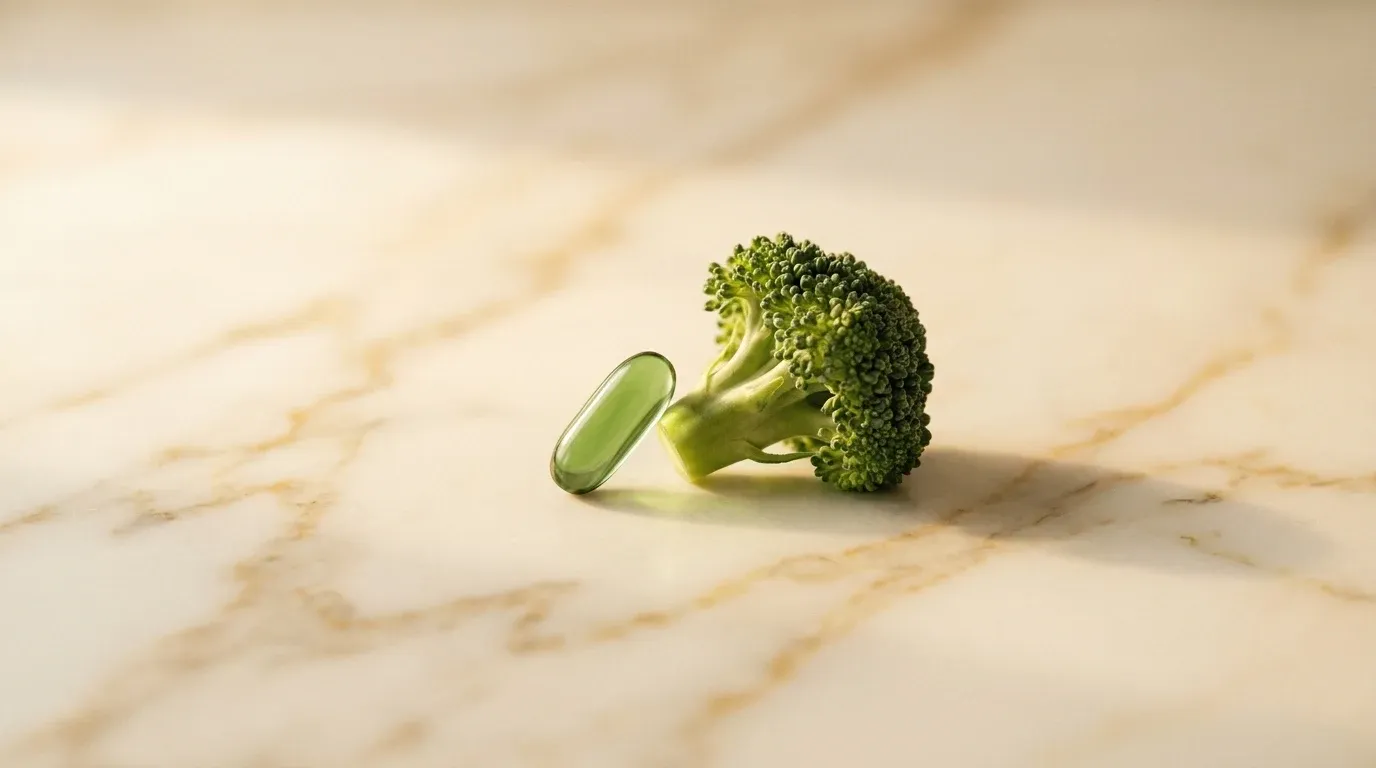
If you've ever taken a broccoli sprout extract and wondered whether it was actually doing anything, you're not alone. Sulforaphane has real research behind it. The problem was never the compound itself. It was the delivery. A newer generation of supplements has changed the mechanics of how sulforaphane reaches your system, and the difference matters more than most product marketing lets on.
Why Traditional Sulforaphane Supplements Were a Gamble
Most sulforaphane supplements on the market don't actually contain sulforaphane. They contain glucoraphanin, a precursor compound found naturally in broccoli and other cruciferous vegetables. To become active sulforaphane, glucoraphanin needs to be converted by an enzyme called myrosinase.
In whole broccoli, myrosinase is present in the plant itself. Chewing releases it, the conversion starts, and your body absorbs sulforaphane relatively efficiently. But when manufacturers process broccoli into capsules or powders, heat and drying typically destroy myrosinase. What you're left with is glucoraphanin sitting in a capsule, waiting for conversion that now has to happen in your gut.
Here's where it gets unreliable. Your gut microbiome contains bacteria that can perform this conversion, but the efficiency varies dramatically between individuals. Research has shown that sulforaphane bioavailability from glucoraphanin-only supplements can differ by as much as three to tenfold depending on a person's gut bacteria composition. That means two people taking the identical product at the identical dose could have completely different physiological outcomes. One person absorbs meaningful amounts. Another absorbs almost none.
This variability is the core reason sulforaphane's clinical reputation has sometimes struggled to match its lab-bench promise. The compound works. Getting it into your bloodstream consistently was the obstacle.
What the New Format Actually Changes
The newer approach moves the conversion step outside the body entirely. By combining glucoraphanin and active myrosinase in a stabilized form before the supplement reaches you, manufacturers allow the glucoraphanin-to-sulforaphane conversion to happen before ingestion. You're not swallowing a precursor and hoping your gut bacteria do the work. You're swallowing sulforaphane that's already been converted and ready to absorb.
The technical challenge was stability. Myrosinase is an enzyme, which means it's vulnerable to heat, moisture, and acidic environments. Early attempts to include active myrosinase in supplements failed because the enzyme degraded before it could do its job. The newer stabilization methods, including encapsulation technologies and controlled-release formats, have addressed this. Some products use a two-chamber capsule design that keeps glucoraphanin and myrosinase physically separated until the moment of digestion, triggering conversion in the gut but at a point where the enzyme remains active. Others complete conversion in the manufacturing process and use enteric coating to protect the sulforaphane through stomach acid.
If you want a broader picture of how delivery technology is reshaping supplement efficacy across the board, New Supplement Delivery Tech: What Actually Changes for You is worth reading alongside this.
The practical result is a supplement that performs closer to a controlled dose than a lottery ticket. Clinical measurements of urinary sulforaphane metabolites, a reliable proxy for absorption, show significantly higher and more consistent levels in subjects using active-form products compared to glucoraphanin-only capsules.
What Sulforaphane Actually Does in the Body
Sulforaphane's primary mechanism involves activating a protein called Nrf2, which functions as a master regulator of the body's antioxidant and detoxification pathways. When Nrf2 is activated, it triggers the production of endogenous antioxidant enzymes including glutathione, superoxide dismutase, and catalase. These are not antioxidants you're adding from outside. They're antioxidants your own cells produce in response to the compound.
This is a meaningful distinction. Rather than simply neutralizing a fixed number of free radicals the way a vitamin C tablet does, sulforaphane effectively upregulates your body's own defense systems for hours after ingestion. Studies suggest Nrf2 activation from a single dose can sustain elevated antioxidant enzyme production for 48 to 72 hours.
For athletes and active adults, this has specific relevance. Intense exercise generates oxidative stress as a byproduct. A controlled amount of this stress is actually part of the adaptation signal. But excessive or unresolved oxidative stress is linked to slower recovery, increased muscle soreness, and systemic inflammation. Sulforaphane's Nrf2-activating effect positions it as a recovery support tool rather than a performance stimulant, which is an important framing for how to use it.
The anti-inflammatory angle overlaps here. Sulforaphane also inhibits NF-kB, a signaling molecule that drives pro-inflammatory gene expression. Chronic low-grade inflammation is a common background condition in people who train hard without sufficient recovery infrastructure. If you're optimizing for longevity alongside performance, the NF-kB pathway matters. Research on Metabolic Health Supplements: What the Science Says Now covers related compounds and mechanisms if you're building a broader stack.
The Athlete and Active Adult Case
Sulforaphane isn't a pre-workout. It doesn't raise your heart rate, sharpen focus, or give you an acute performance edge you'll feel on a Tuesday morning. Its value is structural. It works on the chronic inflammation and oxidative load that accumulates over weeks and months of training, and it does so through mechanisms your body actually uses rather than overriding them.
This makes it particularly relevant for older active adults, who tend to face higher baseline inflammation and slower recovery curves. The same demographic benefits from understanding the interaction between training volume and longevity outcomes. How Much Lifting Per Week to Actually Live Longer covers the volume side of that equation, and sulforaphane's anti-inflammatory support fits naturally into that picture.
The compound also appears to support insulin sensitivity through pathways involving Nrf2 and mitochondrial function, though the human evidence here is more preliminary than its antioxidant data. Early-stage research in metabolic contexts is promising, but it's not yet the primary reason to take it.
How to Compare Products on the Shelf
Now that you understand what to look for, here's how to evaluate a label without getting lost in marketing language.
- Look for "active sulforaphane" or "stabilized myrosinase" on the label. If the label only lists "broccoli sprout extract" or "glucoraphanin," you're buying the precursor format, not the converted form.
- Check for third-party testing. NSF Certified for Sport or Informed Sport certification tells you the stated dose is actually in the capsule and that the product is free of contaminating substances. This matters more for sulforaphane than many supplements because the manufacturing process is more complex.
- Dose range matters. Most research uses doses between 10 and 40 mg of active sulforaphane per day. Products listing glucoraphanin equivalent weights can make dosing comparisons misleading. Focus on the converted sulforaphane figure.
- Ignore proprietary blend language unless it's backed by published bioavailability data. Some companies publish internal absorption studies. That's a positive signal. General claims without data are not.
Pricing for quality active-form sulforaphane supplements typically runs between $40 and $75 per month in the US market. Products significantly below that range are almost certainly selling the glucoraphanin precursor format with no active myrosinase included. You're not saving money. You're buying a different, less reliable product.
Where Sulforaphane Fits in a Broader Protocol
Sulforaphane works best when it's one part of a recovery and inflammation management strategy, not a standalone fix. Sleep quality is a large part of that equation. Chronic oxidative stress and inflammation are substantially worsened by poor sleep, and no supplement compensates for structural sleep deficits. If your recovery feels off, address the sleep variables before layering in supplements.
Similarly, other evidence-based tools fit alongside sulforaphane without conflict. Pre-workout nutrition using compounds with strong bioavailability data is worth the same level of scrutiny you'd apply here. The Beetroot Juice Before a Workout: The Practical Guide is a good example of a compound with a clear mechanism, consistent delivery, and measurable effects. The same critical lens applies.
Sulforaphane doesn't interact negatively with caffeine, creatine, or standard protein intake at typical doses. It's not hormonally active in a way that requires cycling. Most people taking it for anti-inflammatory and antioxidant support treat it as a daily background compound rather than a situational one.
The Bottom Line
Sulforaphane's science is solid. Its problem has always been getting the active compound reliably into your body at a meaningful dose. The shift toward pre-converted, stabilized formats genuinely solves the core delivery problem that made older glucoraphanin-only supplements so inconsistent. If you've tried sulforaphane before and written it off, the format you took almost certainly wasn't delivering what the label implied.
The new generation of products costs more. That's a real consideration. But paying for a supplement that actually reaches your bloodstream at a therapeutic dose is different from paying more for marketing. In this case, the premium reflects a genuine technical improvement. Whether it fits your budget and training priorities is your call. What it shouldn't be is an uninformed one.