
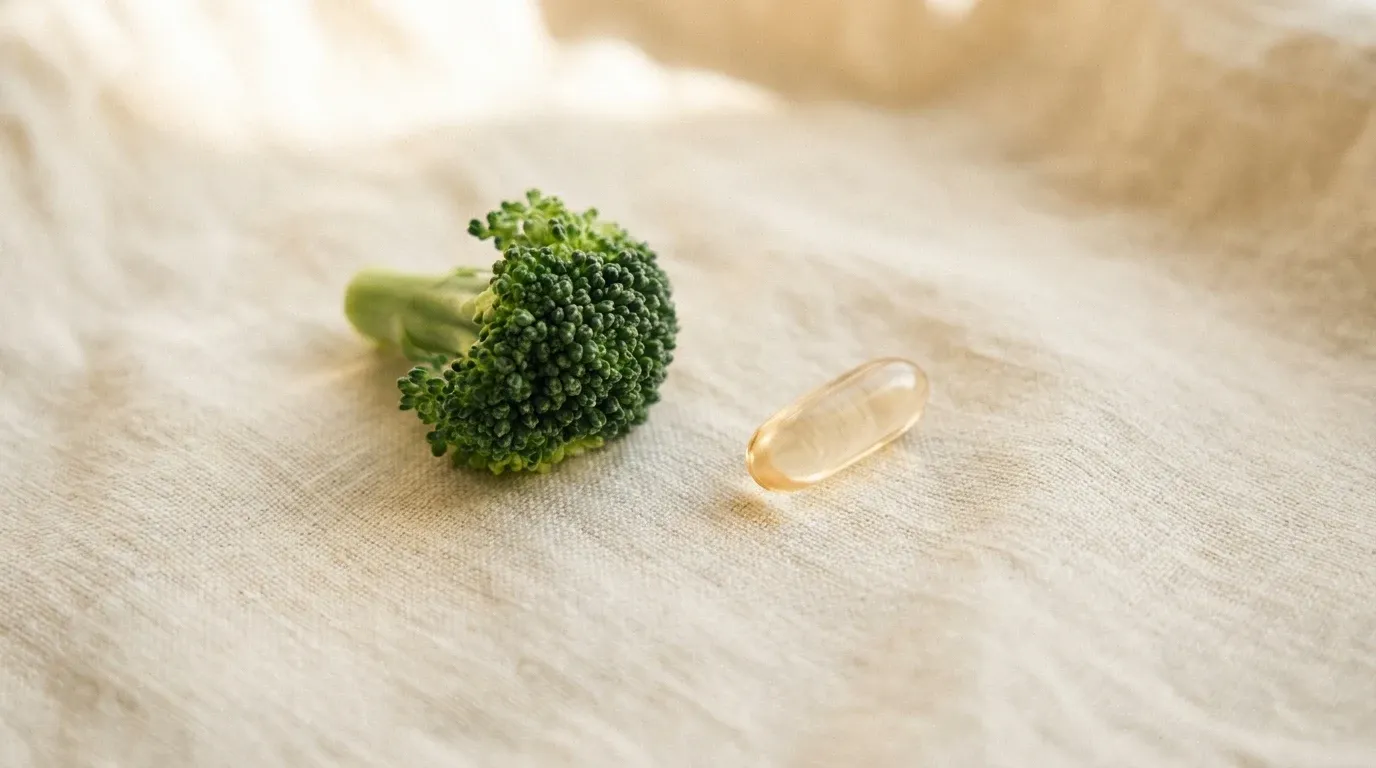
Sulforaphane has earned serious attention in nutrition research over the past decade. It activates the Nrf2 pathway, a cellular defense mechanism that upregulates antioxidant enzymes, supports detoxification, and reduces chronic inflammation. The problem is that getting a reliably effective dose, whether from food or a bottle, is more complicated than most coverage admits.
A new category of pre-converted sulforaphane supplements is now hitting the market, claiming to solve the bioavailability issues that have plagued this space for years. That makes this a good moment to cut through the noise and give you a clear, evidence-grounded comparison of both approaches.
How Sulforaphane Actually Works in Broccoli
Raw broccoli doesn't contain sulforaphane directly. It contains glucoraphanin, a stable precursor, alongside an enzyme called myrosinase. When you chew raw broccoli, the cell walls break down, glucoraphanin and myrosinase mix, and sulforaphane is produced. It's an elegant, built-in conversion system.
The catch is temperature. Myrosinase is destroyed at cooking temperatures above roughly 140°F (60°C). Boil your broccoli for ten minutes and you've effectively eliminated most of the enzyme responsible for sulforaphane production. Studies have shown that boiling broccoli reduces sulforaphane availability by 60 to 90 percent compared to eating it raw.
Light steaming, however, is a different story. Steaming broccoli for two to three minutes preserves a meaningful portion of myrosinase activity. Research suggests this approach retains around 30 to 40 percent of the sulforaphane potential of raw broccoli, which is a workable trade-off if you prefer cooked vegetables.
There's also a practical workaround: add raw mustard seed, daikon radish, or even a small amount of raw broccoli to your cooked broccoli dish. These foods contain active myrosinase that can substitute for the enzyme lost during cooking, partially restoring conversion. It sounds fussy, but it works.
What Counts as an Effective Dose?
Most research showing meaningful effects has used sulforaphane doses in the range of 10 to 40 micromoles per day. To put that in food terms, 100 grams of raw broccoli florets provides roughly 40 to 60 micromoles of glucoraphanin, but actual sulforaphane yield varies significantly depending on the individual's gut microbiome, chewing behavior, and stomach acidity.
Broccoli sprouts are a notable exception. They contain 10 to 100 times more glucoraphanin per gram than mature broccoli, making a small handful of sprouts a genuinely high-dose food option. If you're eating sprouts raw and chewing them well, you're likely getting clinically relevant sulforaphane levels from a modest serving.
Mature broccoli can still contribute meaningfully, but you'd need to eat it consistently, raw or lightly steamed, and in reasonable quantities, around two to three cups per week as part of a broader dietary pattern. That's achievable for most people without any supplementation.
The Problem With Most Sulforaphane Supplements
Here's where the supplement industry has historically struggled. Most sulforaphane supplements don't actually contain sulforaphane. They contain glucoraphanin, the same precursor found in broccoli, and rely on your gut bacteria to complete the conversion. The problem is that myrosinase-like bacterial activity varies enormously between individuals.
Research on glucoraphanin supplements has shown that plasma sulforaphane levels after supplementation can differ by a factor of eight or more between people with similar demographics. That's not a small margin of error. For some users, a glucoraphanin-only supplement produces negligible active sulforaphane. For others, it works reasonably well. You have no reliable way to know which group you're in without biomarker testing.
This is the gap that newer pre-converted sulforaphane formats are attempting to close. By delivering stabilized, already-converted sulforaphane rather than its precursor, these products remove the gut bacteria conversion step entirely. Early data suggests more consistent plasma levels across a wider range of individuals, though long-term comparative trials are still limited.
If you're evaluating any supplement in this category, New Supplement Delivery Tech: What Actually Changes for You offers a useful framework for assessing whether a delivery mechanism genuinely improves bioavailability or is primarily a marketing claim.
Stabilized Sulforaphane: What's Changed
Sulforaphane is an unstable molecule. It degrades quickly at room temperature and is difficult to encapsulate without losing potency during storage. Earlier attempts at direct sulforaphane supplements often delivered significantly less active compound than their labels claimed by the time they reached the consumer.
The newer generation of products addresses this through cyclodextrin complexation and enteric coating, technologies that protect the molecule through manufacturing, storage, and digestion. Third-party tested products in this format have shown label-accurate potency in independent analysis, which is a meaningful step forward from earlier iterations in this category.
That said, higher bioavailability doesn't automatically mean better outcomes. Most of the human clinical evidence on sulforaphane's effects on inflammation, cardiovascular markers, and cellular resilience was built using food-based sources or earlier-generation glucoraphanin supplements. Extrapolating those findings directly to newer delivery formats requires some caution.
For broader context on where sulforaphane fits within the current evidence landscape for metabolic support, Metabolic Health Supplements: What the Science Says Now is worth your time.
Food First, Then Supplements: The Practical Framework
For most active adults eating varied diets, broccoli and broccoli sprouts remain the most sensible primary source of sulforaphane. The co-occurring compounds in whole food, including fiber, vitamins C and K, folate, and other glucosinolates, create a biological context that isolated supplements don't replicate. That synergy likely matters, even if it's difficult to quantify precisely.
Where supplementation makes sense is during periods of elevated oxidative stress or inflammation, when your baseline dietary intake may not be sufficient. Intensive training blocks, recovery from illness, significant sleep disruption, or high environmental pollution exposure are all situations where a reliable, pre-converted sulforaphane supplement could provide a meaningful, targeted contribution.
This mirrors the logic behind other well-researched ergogenic and protective compounds. With beetroot nitrates, for example, food-first approaches work well for most people, but concentrated supplementation has specific utility around performance or cardiovascular stress. Beetroot Juice Before a Workout: The Practical Guide covers this distinction well if you want a comparable reference point.
The framework, practically speaking, looks like this:
- Daily baseline: Two to three servings per week of raw or lightly steamed broccoli, or a small handful of raw broccoli sprouts several times per week.
- Higher oxidative stress periods: Consider a stabilized, third-party tested sulforaphane supplement (look for pre-converted formats with enteric coating) at doses of 10 to 30 milligrams of active sulforaphane per day.
- Cooking practice: Steam rather than boil, or add a raw mustard-containing element to cooked cruciferous vegetables to partially restore myrosinase activity.
- Sprouts as a high-density option: If you're willing to add them to salads or smoothies, broccoli sprouts are genuinely the most efficient food-based sulforaphane source available.
The Training and Lifestyle Connection
Sulforaphane's Nrf2-activating effects are particularly relevant for people with demanding physical routines. High-intensity training generates significant oxidative stress and inflammation as a normal part of the adaptation process, but chronic or excessive oxidative load without adequate antioxidant support can impair recovery and long-term cellular health.
This doesn't mean you should be aggressively supplementing antioxidants around every workout. The current evidence suggests that too much exogenous antioxidant load can blunt training adaptations by interfering with the signaling that drives them. Sulforaphane works differently. Rather than directly neutralizing free radicals, it upregulates your body's own antioxidant enzyme production, which is a more targeted and physiologically coherent mechanism.
If you're structuring your training around longevity as well as performance, the research on resistance training frequency is worth pairing with your nutritional strategy. How Much Lifting Per Week to Actually Live Longer outlines the evidence on training volume and lifespan outcomes, which provides useful context for understanding where nutritional interventions like sulforaphane fit in the bigger picture.
Sleep is also worth factoring in here. Oxidative stress compounds during periods of poor or shortened sleep, which increases the relevance of protective compounds like sulforaphane. This Sleep Stage Cuts Risk of 83 Diseases covers the cellular repair mechanisms that occur during deep sleep, many of which overlap with the pathways sulforaphane supports during waking hours.
How to Choose a Supplement If You Go That Route
If you decide supplementation fits your needs, the label matters more in this category than most. Look for:
- Pre-converted sulforaphane rather than glucoraphanin alone, unless you have evidence your gut microbiome converts efficiently.
- Third-party testing from NSF, Informed Sport, or USP, confirming label accuracy and absence of contaminants.
- Enteric coating or cyclodextrin stabilization to protect the molecule from degradation before absorption.
- Transparent dosing with sulforaphane quantified in milligrams or micromoles of active compound, not just glucoraphanin content.
Prices for quality sulforaphane supplements currently range from around $40 to $80 per month in the US market. Products at the lower end of that range tend to rely on glucoraphanin without stabilization. If you're paying for a pre-converted stabilized format, expect to be at the higher end, and verify the third-party testing before committing.
The bottom line is that food works, provided you're eating it in a form that preserves myrosinase activity. Supplements have a legitimate role for specific contexts and individuals, and the newer stabilized formats represent a genuine improvement over earlier products. Neither approach requires you to be rigid. A diet that includes broccoli regularly, prepared correctly, will serve most people well. A high-quality supplement is a useful tool for the moments when it isn't enough.