

Walk into any supplement aisle today and something has changed. The labels no longer just say "vitamin C" or "magnesium." They say "sustained energy," "all-day stamina," "mental clarity by 3pm." The products haven't necessarily changed. The language has.
This is benefit-led positioning, and it's now the dominant force in global supplement launches. Understanding what's driving it, and whether it actually delivers anything different for you, is worth your time before your next purchase.
Energy and Stamina Are Running the Show
According to Glanbia's latest market data, energy and stamina claims now lead all supplement product launches globally. That's not a minor trend. It represents a fundamental reorientation of how the industry talks to consumers, away from nutrients and toward outcomes.
The appeal is obvious. "Take this for energy" is a far easier sell than "this product contains 400mg of magnesium glycinate." You're buying a feeling, not a compound. And in a market where attention is scarce and decisions happen fast, outcome-based framing converts.
The question isn't why brands are doing this. The question is what it means for the product inside the bottle.

Multivitamins Still Anchor the Category
Despite the surge in targeted, benefit-led launches, multivitamins remain the foundation of supplement use, even among the heaviest supplement consumers. Research consistently shows that benefit-led products are added on top of a multivitamin base, not in place of it.
That matters for a few reasons. It suggests that consumers, at least the informed ones, still understand the difference between broad nutritional coverage and specific functional support. A multivitamin addresses gaps. A "stamina" product is supposed to do something more precise.
The problem is that "more precise" doesn't always mean more effective. Sometimes it just means more targeted marketing around the same basic ingredients.
The Functional Food Parallel
If this trajectory feels familiar, that's because it is. The supplement market is now following the same arc that functional foods traced a decade earlier. Yogurts that promised immunity. Juices that claimed to reduce stress. Waters enriched with adaptogens.
Some of those products were genuinely well-formulated. Many were not. The claims were compelling; the delivery was inconsistent. Consumer trust eroded once people realized that "contains probiotics" on a label didn't necessarily mean a clinically meaningful dose of probiotics.
The same dynamic is now playing out with supplements. Why Diet and Exercise Together Beat Either One Alone remains a core truth in wellness, but that hasn't stopped brands from positioning single-ingredient products as transformative standalone solutions. The supplement industry has learned the functional food playbook and is executing it with considerably more sophistication.
What Benefit-Led Framing Can Hide
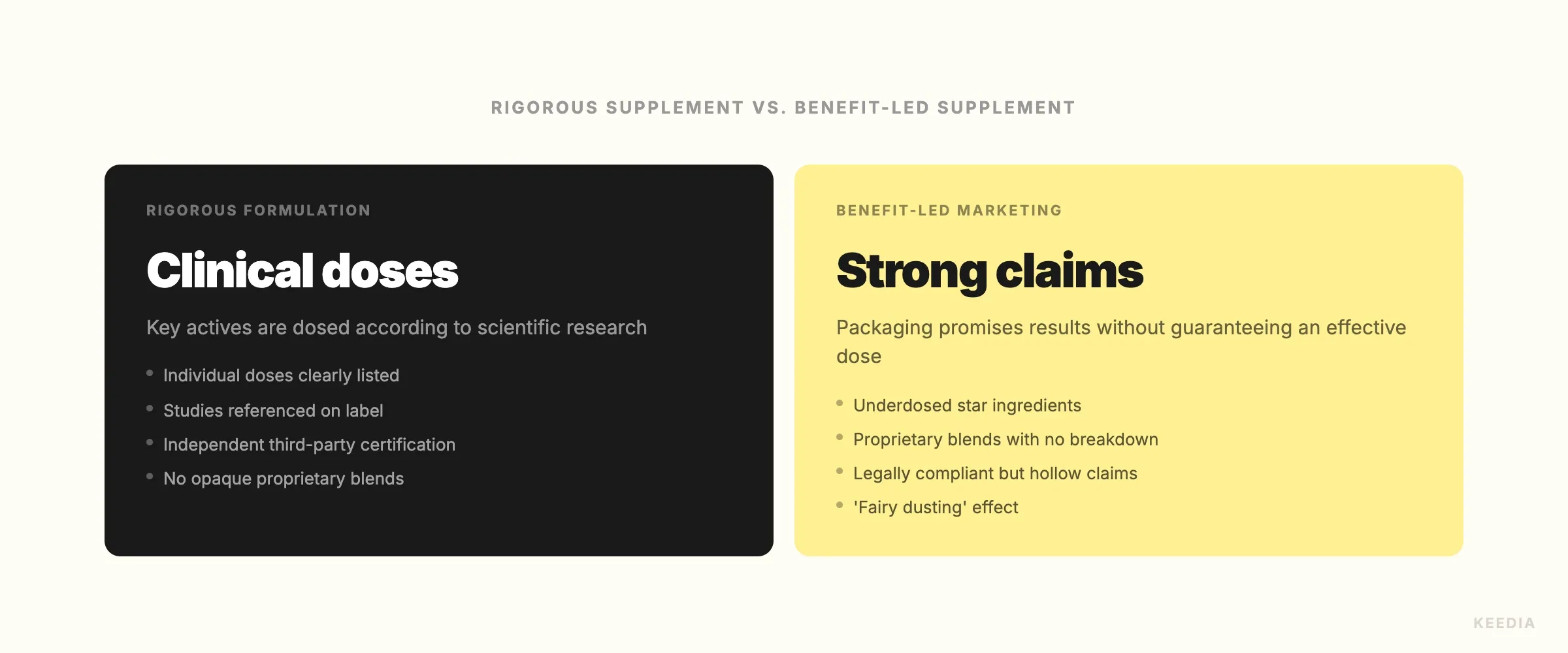
Here's the structural problem with outcome-based labeling: the claim on the front of the package says nothing about the dose inside. A product can legally carry an "energy support" claim while containing a fraction of the clinically studied dose of its active ingredient.
This is called pixie-dusting. A manufacturer adds a trendy ingredient, say ashwagandha, lion's mane, or rhodiola, at a dose too small to produce any measurable effect, and then uses that ingredient's reputation to justify a benefit claim. The label is technically accurate. The product isn't technically doing what you think it is.
This isn't fringe behavior. It's widespread. Proprietary blends make it even harder to evaluate, since they allow brands to list multiple ingredients without disclosing individual doses. You see the ingredients. You don't see whether any of them are present in meaningful amounts.
How to Read Past the Claim
The good news is that there are specific things you can check before spending $40 to $80 on a benefit-led supplement. None of them require a biochemistry degree.
- Look for clinically studied doses. If a product contains ashwagandha and claims stress or stamina support, the dose backed by research typically sits between 300mg and 600mg of a standardized extract. If the label shows 50mg in a proprietary blend, that's a signal.
- Avoid proprietary blends where possible. These hide individual ingredient quantities. Any brand confident in its formulation should be willing to show you exactly what's in each serving.
- Check the form of the ingredient. Magnesium oxide and magnesium glycinate are both "magnesium," but their bioavailability differs substantially. Benefit-led products sometimes use cheaper forms of ingredients that are harder for your body to absorb.
- Find the evidence behind the claim. Legitimate efficacy claims link to human clinical trials, not in vitro studies or animal research. If the brand's website cites no studies, or only links to studies on a different form or dose than what's in the product, treat that as a red flag.
- Check for third-party certification. NSF Certified for Sport, Informed Sport, or USP verification means an independent body has tested what's on the label against what's in the capsule. It doesn't guarantee efficacy, but it guarantees honesty about content.
The Ingredients Worth Taking Seriously
Not everything in the benefit-led category is smoke and mirrors. Some ingredients have accumulated genuine clinical support, and some brands are building real formulations around them.
Creatine monohydrate remains one of the most studied performance compounds in existence, with consistent evidence supporting strength, power output, and cognitive function under fatigue. It's not glamorous, but its dose-response relationship is well understood. If a stamina product contains 3 to 5 grams of creatine monohydrate, that's a credible foundation.
Rhodiola rosea has reasonable evidence behind it for reducing perceived exertion and mental fatigue, particularly in the 200mg to 600mg range of a standardized extract. Beta-alanine has solid support for buffering muscle fatigue during high-intensity efforts, though the effective dose (3.2 to 6.4 grams daily) is higher than most products provide.
The pattern here is consistent: meaningful doses of well-studied compounds outperform exotic ingredient lists at sub-therapeutic amounts. This matters especially if you're already doing the foundational work. Resistance training is one of the most evidence-backed tools for long-term health, and supplementation should support that work, not substitute for it.
Energy Claims and the Bigger Picture
It's worth stepping back and asking why energy and stamina are the claims that are winning right now. The honest answer is that fatigue is near-universal. Chronic tiredness is one of the most commonly reported health complaints across the US, UK, Australia, and Canada. Brands are selling a solution to something most people feel every day.
But sustained energy isn't primarily a supplement problem. It's a sleep problem, a movement problem, and a diet problem. Research on how physical activity affects metabolic function, including how exercise rewires your metabolism through hormonal pathways, makes clear that no capsule is replacing the upstream drivers of real energy.
Similarly, nutritional gaps in everyday diets can contribute to fatigue in ways that a targeted "energy" supplement won't fix if the foundational deficit isn't addressed first. If you're low in iron, B12, or vitamin D, that's where intervention starts, not with an adaptogen blend.
What the Industry Needs to Do
The benefit-led trend isn't going away. Consumer demand for outcome-specific products is real, and there's nothing wrong with wanting a product designed for a particular purpose. The issue is accountability.
Regulators in the US, UK, and Australia have varying frameworks for how supplement claims can be made, but enforcement is inconsistent and underfunded. The FDA's structure means that most supplements reach market without pre-approval of efficacy claims. The burden falls on the consumer to evaluate what they're buying.
The brands that will earn sustained trust are those that publish full ingredient disclosure, cite human clinical evidence for the doses they use, and invest in third-party testing. Some already do. Many don't, and yet they carry identical benefit claims on their labels.
The Standard You Should Hold Supplements To
You don't need to become a formulation expert. But you do need a basic framework. Here's a practical one:
- Start with the foundation. Cover your nutritional bases with a quality multivitamin before layering on targeted products.
- Define your actual goal. "More energy" is too vague to evaluate. If you mean reduced perceived fatigue during workouts, that narrows down which ingredients have relevant evidence.
- Demand transparency. Full label disclosure, cited doses, and third-party certification are not premium features. They're the minimum standard.
- Be skeptical of proprietary blends. They exist to protect competitive formulas in some cases, but they more often exist to protect brands from scrutiny about underdosing.
- Give it time and track it honestly. Placebo response in supplement studies is significant. If you feel better immediately after starting a new product, that's not necessarily evidence the product is working.
The shift to benefit-led supplements reflects genuine consumer demand for products that do specific things. That's not irrational. What's irrational is accepting a compelling claim as a substitute for a credible formulation. The label is the marketing. The dose is the product.