
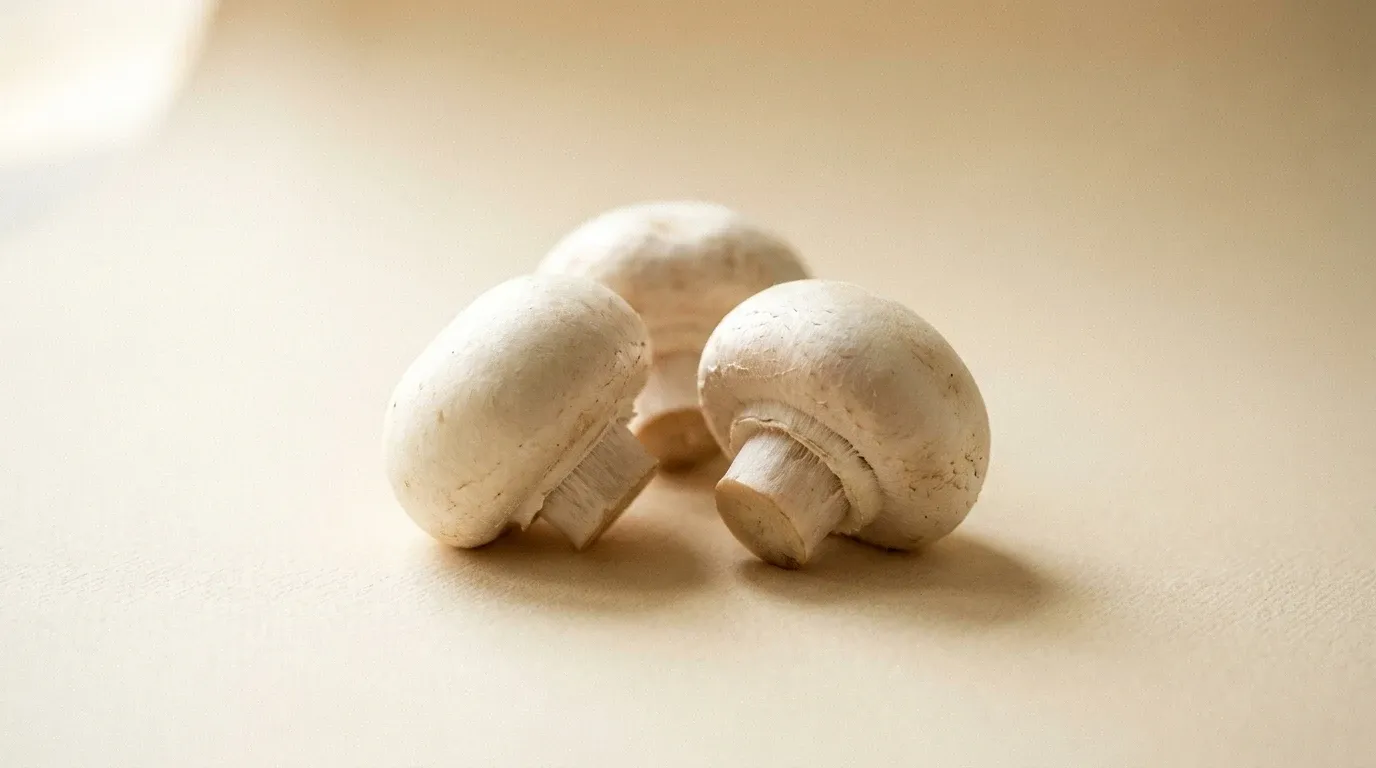
White button mushrooms are easy to overlook. They're cheap, mild-flavored, and sitting in a plastic tray at every grocery store. But a recent study on Agaricus bisporus, the species behind those common button mushrooms, is drawing fresh attention to what this humble fungus might do for metabolic health, specifically cholesterol markers.
Here's what the research actually shows, what it doesn't, and whether any of this should change what's on your plate.
What the New Study Found
Researchers tested Agaricus bisporus as a dietary adjunct in a hypercholesterolemic animal model. That means they fed mushroom-derived material to animals with induced high cholesterol and measured changes in metabolic markers over time.
The results were notable. Animals receiving the mushroom adjunct showed improvements across multiple markers associated with metabolic perturbation, including shifts in lipid profiles and indicators of systemic stress that typically accompany elevated cholesterol. The researchers concluded that Agaricus bisporus showed measurable potential as a dietary tool for managing cholesterol-related metabolic disruption.
That's a genuinely interesting finding. But the word "animal" in that sentence matters enormously, and we'll get to that.
Why Mushrooms Have a Plausible Case to Make
This isn't the first time mushrooms have shown up in metabolic health research. There are real, well-characterized compounds in Agaricus bisporus that give scientists a reason to look closely.
The two most relevant are ergosterol and beta-glucans.
Ergosterol is a sterol found in fungi that acts as a precursor to vitamin D when mushrooms are exposed to UV light. It's one of the very few non-animal dietary sources of a vitamin D precursor, which makes mushrooms unusual in the plant-adjacent food world. Beyond vitamin D synthesis, ergosterol has been studied for its own biological activity, including potential effects on lipid metabolism.
Beta-glucans are soluble dietary fibers found in mushrooms, oats, barley, and certain yeasts. Their cholesterol-lowering mechanism is relatively well understood: beta-glucans form a viscous gel in the gut that binds to bile acids, forcing the liver to draw on circulating cholesterol to produce more. The result, in well-controlled trials, is a modest but consistent reduction in LDL cholesterol. If you want the full picture on why dietary fiber does serious work in the gut, Without Fiber, Your Gut Bacteria Start Eating You breaks down what happens when fiber intake drops.
Mushrooms also contribute meaningful amounts of potassium, B vitamins, and selenium at very low calorie cost. A 100-gram serving of raw white button mushrooms contains roughly 22 calories. The nutrient density per calorie is genuinely high.
The Animal Study Problem. And Why It Matters
Animal models are a standard and legitimate tool in nutrition science. They let researchers test mechanisms, identify dose ranges, and generate hypotheses in a controlled way that would be impossible or unethical to replicate directly in humans. The hypercholesterolemic model used in this study is a well-established framework for preliminary lipid research.
But animal studies have a notoriously poor translation rate to human outcomes. Metabolic processes in rodents differ from humans in important ways: bile acid metabolism, gut microbiome composition, cholesterol synthesis pathways, and hormonal regulation all behave differently across species. A compound that reliably moves a lipid marker in a mouse model may show nothing in a human trial, or may work through a completely different mechanism.
This is not a flaw unique to mushroom research. It's a structural feature of early-stage nutritional science. The same caution applies to hundreds of promising compounds that performed well in animal models before human data deflated the initial enthusiasm. If you've seen supplement labels making sweeping claims based on preliminary findings, Benefit-Led Supplements: What the Shift Means for You is worth reading before you spend money on anything.
What the new Agaricus bisporus study gives you is a mechanistic signal. It's a reason to fund a clinical trial. It is not a reason to tell your doctor you've replaced your statin with mushrooms.
What Human Evidence Actually Shows on Beta-Glucans
The human evidence for beta-glucans and cholesterol reduction is real, but it's strongest for oats and barley, not mushrooms specifically.
The FDA allows a qualified health claim linking oat beta-glucan to reduced risk of coronary heart disease, based on evidence that consuming at least 3 grams of oat beta-glucan daily can lower LDL cholesterol by roughly 5 to 10 percent. The European Food Safety Authority has reached similar conclusions for oat and barley beta-glucans. This is one of the more robust diet-heart relationships in nutritional science.
Mushroom beta-glucans share structural similarities with oat and barley beta-glucans, but they're not identical. The molecular weight, branching structure, and solubility differ, and those differences affect how the compound behaves in the gut. Human trials specifically on mushroom beta-glucans and LDL are limited, small, and have produced mixed results. The mechanism is plausible. The human clinical evidence is not yet there to match oats or barley.
That gap between plausibility and proof is exactly where most nutrition claims live, which is why it's worth understanding how to read between the lines on study design and outcome data.
How to Think About This If You're Managing Cholesterol
If you're actively managing elevated LDL, the evidence-based dietary levers are well-established: reducing saturated fat, increasing soluble fiber (particularly oat and barley beta-glucans), eating more legumes, increasing plant sterol intake, and maintaining a healthy body weight. These approaches have robust human trial data behind them.
Mushrooms don't yet belong on that list as a primary cholesterol-lowering intervention. What they do offer is this: they're a low-calorie, nutrient-dense, versatile whole food that fits naturally into the kind of diet that tends to support healthy metabolic markers overall.
Replacing a portion of red meat with mushrooms in a meal, for example, simultaneously lowers your saturated fat intake and adds fiber, B vitamins, and potassium. That swap has an indirect effect on lipid management that's real, even if it's not coming from a direct mushroom-specific mechanism. That kind of dietary pattern thinking, where individual foods are part of a broader structure, matters more than any single ingredient. The same logic applies to how everyday movement counts as much as your workout when it comes to metabolic health outcomes over time.
It's also worth noting that cholesterol management doesn't sit in isolation. Sleep quality, stress load, and physical activity all influence lipid profiles meaningfully. A diet full of nutrient-dense whole foods like mushrooms supports that broader picture without requiring you to believe any single food is doing dramatic biochemical work on its own.
Practical Ways to Eat More White Button Mushrooms
- Blend them into ground meat dishes. Finely chopped mushrooms mixed into burger patties or meat sauces reduce calorie density and saturated fat without sacrificing texture or flavor.
- Use them as a base for sauteed vegetables. Mushrooms absorb oil efficiently, so you use less fat overall while increasing volume and nutrients on the plate.
- Expose them to sunlight before cooking. Setting mushrooms gill-side up in direct sunlight for 15 to 30 minutes significantly increases their vitamin D content through ergosterol conversion.
- Add them to soups, stews, and grain bowls. They work in almost any savory context and contribute umami without added sodium.
- Don't overlook them raw. Sliced thin, white button mushrooms hold up well in salads and add texture without cooking.
The Bottom Line
The new study on Agaricus bisporus is a legitimate contribution to early-stage metabolic research. The findings are mechanistically interesting, and they add to a body of evidence suggesting that mushrooms contain compounds worth studying further in human trials. That's how science is supposed to work: animal data generates hypotheses, human trials test them.
What the study doesn't do is establish that eating white button mushrooms will meaningfully lower your cholesterol. That claim requires human clinical evidence that doesn't yet exist for mushrooms specifically.
What you can say with confidence is that white button mushrooms are one of the most nutrient-dense, low-calorie foods available at any price point, and that including them regularly as part of a varied, fiber-rich diet is a reasonable dietary choice. If you're curious about how other compounds with promising early research actually perform under scientific scrutiny, the evidence on spermidine and liver function offers a useful parallel case study in reading emerging nutrition research carefully.
Eat the mushrooms. Just don't throw out the oatmeal.