
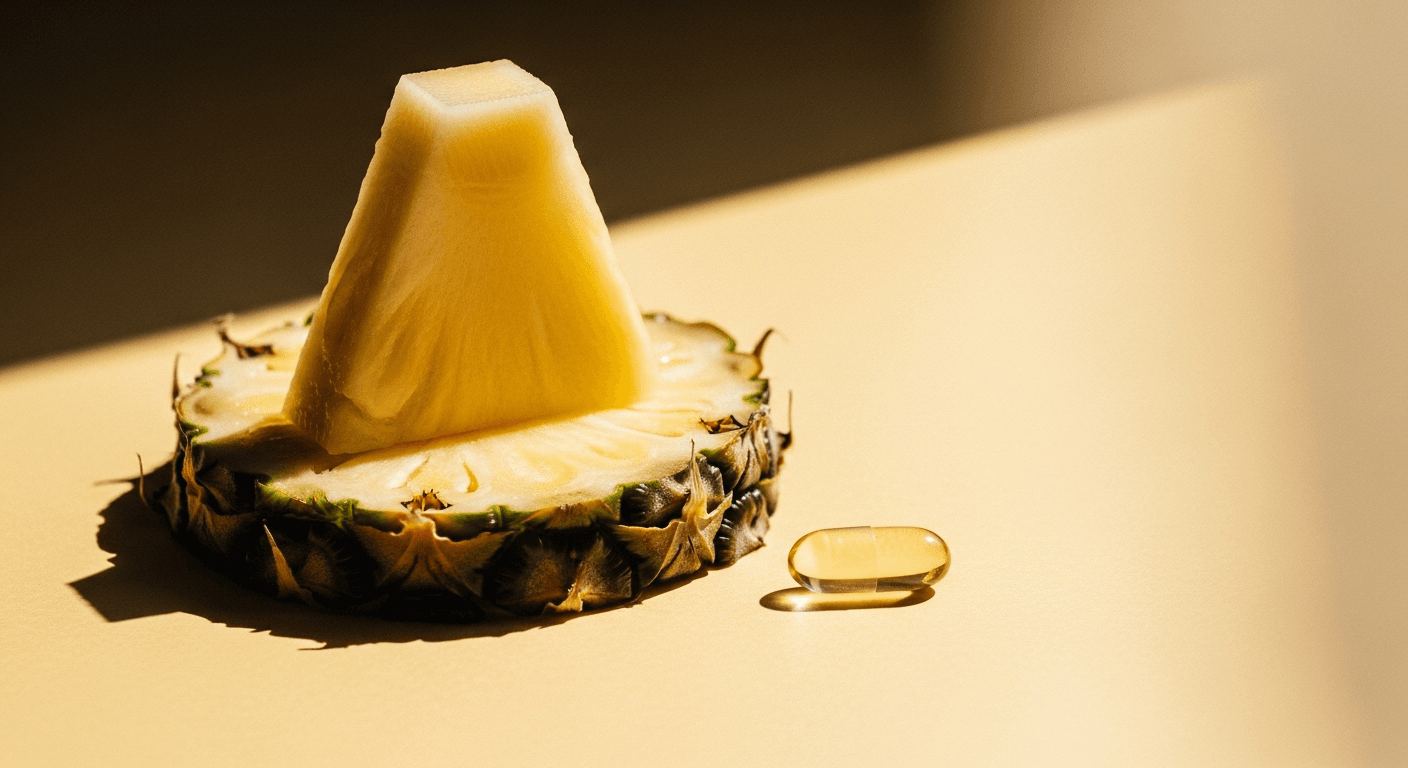
Bromelain has built a solid reputation in the wellness world. Extracted from pineapple stem, this proteolytic enzyme shows genuine promise for reducing inflammation, supporting post-exercise recovery, and easing joint discomfort. The research base is real. The interest from athletes and health-conscious consumers is entirely reasonable.
The problem isn't the ingredient. It's what's actually inside most of the bottles on the shelf.
A new industry report has flagged what insiders are calling a hidden quality crisis in commercial bromelain supplements. Across dozens of tested products, enzyme activity levels listed on labels frequently failed to match what was measurable in the capsule. Some products contained a fraction of the stated potency. Others were nearly inert. And because the average consumer doesn't know how bromelain potency is even measured, most people have no way of spotting the gap.
Why Bromelain Works. When It Works.
Bromelain is a mixture of proteolytic enzymes, meaning it breaks down proteins. That mechanism is directly relevant to inflammation. After intense training, damaged tissue triggers an inflammatory cascade. Bromelain appears to modulate that response by breaking down pro-inflammatory compounds and supporting circulation to the affected area. Studies have also linked it to reduced post-operative swelling and faster return to function after musculoskeletal injuries.
This makes it genuinely appealing for anyone pushing hard in the gym. If you're following a structured lower-body program, for example, the kind of tissue stress involved in movements covered in Hip Thrust: The Complete Guide to Stronger Glutes creates exactly the recovery environment where an effective anti-inflammatory enzyme could theoretically earn its place in your stack.
The operative word is effective. And that's where the quality crisis bites.
Milligrams Are Misleading You
Here's the core problem with most bromelain labels: they list dosage in milligrams. That number tells you how much material is in the capsule. It tells you almost nothing about how much enzymatic activity that material is capable of.
Enzyme potency is measured in activity units. For bromelain, the two standard measurements are GDU (gelatin-digesting units) and MCU (milk-clotting units). These figures reflect the actual functional capacity of the enzyme. A 500mg capsule with low enzyme activity is less useful than a 250mg capsule with high activity. Mass and potency are not the same thing, and brands that list only milligrams are either cutting corners or hoping you don't notice the difference.
Credible clinical studies on bromelain for inflammation and recovery have typically used products delivering between 1,200 and 2,400 GDU per gram of bromelain, with daily doses often ranging from 500 to 2,000mg of standardized extract. If a label doesn't list GDU or MCU, you genuinely cannot evaluate whether the product sits within that evidence-supported range.
This isn't a minor labeling quirk. It's the difference between a supplement that performs and one that's essentially an expensive capsule of filler.
The Scale of the Problem
Independent testing organizations have repeatedly found that enzyme supplements are among the most inconsistently formulated categories in the supplement industry. Bromelain is particularly vulnerable because enzyme activity degrades under heat, moisture, and improper storage. A product could leave the manufacturer with correct activity levels and arrive at a retailer's warehouse weeks later with substantially reduced potency due to supply chain conditions.
That variability compounds the labeling issue. Even products that start with accurate activity levels may not maintain them through distribution. Without testing at the point of sale, consumers have no way of verifying what they're actually getting.
This is a systemic issue, not a handful of bad actors. It affects budget brands and mid-tier products alike, and it's one reason that the supplement industry's self-regulatory track record on enzyme products looks particularly poor.
Third-Party Certification: Your Fastest Filter
You don't need a biochemistry degree to navigate this. The fastest practical filter is third-party certification. Look for seals from NSF International, USP (United States Pharmacopeia), or Informed Sport on the label. These organizations independently verify that what's on the label is in the capsule, at the stated activity level, without contamination from banned substances or unlisted ingredients.
NSF and USP both test enzyme activity specifically, not just ingredient mass. An NSF-certified bromelain product has passed scrutiny that goes well beyond what manufacturers self-report. Informed Sport certification is particularly relevant if you compete in any sport where doping controls apply, as it screens for prohibited substances.
The catch: relatively few bromelain products carry these seals. That scarcity is itself a signal. When a category is full of products that haven't sought independent verification, you should treat unverified products with proportional skepticism.
If you're already thinking carefully about which supplements are worth trusting, the framework in New App Scores Supplement Ingredient Credibility in Real Time offers a useful real-world tool for filtering evidence from marketing noise across a range of categories, not just enzymes.
What to Look for on a Bromelain Label
When you're evaluating a product, run through this checklist before buying:
- Activity units listed. The label must show GDU per gram or per serving, or MCU equivalents. Milligrams alone are not sufficient. If there's no activity unit listed, don't buy it.
- GDU range aligned with research. Look for products standardized to at least 1,200 GDU per gram. Products at 2,000 GDU per gram or higher are consistent with the dosing seen in better-designed clinical studies.
- Third-party certification seal. NSF, USP, or Informed Sport. One of these should appear on the label or be verifiable on the certifying organization's website.
- Storage and expiration transparency. Enzyme activity degrades. A reputable product will have a realistic shelf life stated and clear storage instructions. If the brand is vague on this, treat it as a red flag.
- No proprietary blend obscuring the bromelain dose. Some products bury bromelain inside a blend where individual amounts aren't disclosed. You can't evaluate what you can't see.
- Enteric coating or acid-stable formulation noted. Bromelain is partially degraded by stomach acid. Better products address this through formulation. It won't appear on every quality product, but its presence is a positive signal.
The Food-First Alternative
Before reaching for a capsule, it's worth knowing that fresh pineapple core is a legitimate source of bromelain. The core contains significantly higher enzyme concentrations than the flesh, and consuming it fresh (not canned, not juiced, not heated) delivers active enzyme that hasn't been through the degradation risks of commercial processing and distribution.
The limitation is standardization. You can't know exactly how much bromelain activity you're getting from a chunk of pineapple core the way you can from a well-certified supplement. But if your goal is general anti-inflammatory support rather than a targeted therapeutic dose, fresh pineapple core is a cost-effective, zero-risk starting point.
It also fits naturally into a recovery nutrition approach. For athletes focused on training consistency, recovery quality often has as much to do with overall dietary pattern as any single supplement. Strategies like those outlined in 5 Free Ways to Recover From Running That Actually Work are a useful reminder that the highest-impact interventions are often the least expensive ones.
Bromelain in the Broader Supplement Picture
Bromelain isn't alone in facing quality inconsistency. Enzyme-based supplements broadly, and plant-derived bioactives generally, are categories where the gap between marketing claims and verified performance is substantial. If you're building a supplement stack with any seriousness, bromelain is a good case study for applying the same critical lens to everything you're taking.
The question of what a supplement can realistically do for you is increasingly personalized. Research exploring Epigenetics and Supplements: How Personal Can Nutrition Get? suggests that individual variation in how people respond to bioactive compounds is significant enough that standardized dosing recommendations are, at best, a starting point. That makes product quality even more important: if you're already working with individual variability, adding quality variability on top of it makes outcomes nearly impossible to predict.
For those interested in other plant-derived compounds with emerging evidence in the recovery and muscle support space, Plant-Based Muscle Support: Which Ingredients Actually Have Evidence provides a useful comparative review of where the science actually stands across several categories.
The Bottom Line
Bromelain deserves its place in the conversation about recovery and inflammation management. The mechanism is real, the research is genuinely encouraging, and the ingredient isn't going away. But the supplement industry's handling of this enzyme has been poor enough that buying without scrutiny is essentially a lottery.
Don't abandon the category. Audit it. Look for GDU on the label. Look for a third-party certification seal. If you can't find both, put the product back and keep looking. Certified, properly dosed bromelain products do exist. They just require you to know what you're looking for before you buy.