

Walk through any supplement aisle or scroll through Instagram long enough and you'll spot a new category taking up space: all-in-one products combining all nine essential amino acids with a full electrolyte profile. The pitch is clean. One scoop handles hydration and muscle protein synthesis at the same time. But the question worth asking before you hand over $45 to $65 a tub is whether the science actually supports bundling these two things together, or whether the convenience is the only real selling point.
What the Combo Products Are Actually Promising
The core claim behind EAA-plus-electrolyte products is straightforward: your muscles need amino acids to repair and grow, and your cells need sodium, potassium, magnesium, and chloride to function and stay hydrated. Bundle them into a single drink, the marketing says, and you hit both targets in one shot.
Some products in this space are genuinely well-formulated. They include all nine EAAs at clinically relevant doses, typically 7 to 10 grams total, with leucine content at or above 2.5 grams to trigger the mechanistic target of rapamycin (mTOR) signaling pathway that drives muscle protein synthesis. The electrolyte side usually includes 200 to 500 milligrams of sodium, alongside smaller amounts of potassium and magnesium.
The caffeine-free angle is also worth noting. Without stimulants in the formula, these products can theoretically be used at any point in the day, including evening sessions or even sipped before bed to support overnight muscle protein synthesis. That's a meaningful practical advantage over pre-workout blends that would wreck your sleep.
The EAA Side of the Equation: Solid Ground
The research on essential amino acids for muscle protein synthesis is about as solid as supplementation science gets. Because your body can't synthesize EAAs on its own, you need to get them through food or supplements. When protein intake from whole food is low or absent, like during a fasted training session, between meals, or during a long endurance effort, EAA supplements can meaningfully stimulate muscle protein synthesis without requiring a full meal.
Leucine, the most studied of the branched-chain amino acids and an EAA itself, acts as a primary anabolic signal. Research consistently shows that a dose providing at least 2 to 3 grams of leucine is enough to maximally stimulate muscle protein synthesis in most healthy adults. Full-spectrum EAA products that meet this threshold have a real physiological argument behind them, particularly for athletes training in a fasted state, older adults with higher leucine thresholds, or anyone following a plant-forward diet where complete protein sources are less frequent. Why Diet and Exercise Together Beat Either One Alone covers how the timing and composition of your nutrition interacts with training to compound results over time.
Where EAAs become less critical is if you're already hitting 1.6 to 2.2 grams of protein per kilogram of body weight daily from whole food. At that intake level, your muscle protein synthesis is already well-supported, and the marginal benefit of an additional EAA supplement is modest. That doesn't make EAAs useless, but it does change the value calculation.

The Electrolyte Side: Where Things Get Complicated
Electrolytes are not optional. They regulate fluid balance, nerve function, and muscle contraction. Sodium loss through sweat is the dominant concern for most athletes, but here's where the fixed-dose problem starts. Sweat rate and sweat sodium concentration vary enormously between individuals. Research from sports science labs shows sweat sodium can range from roughly 200 milligrams per liter to over 1,500 milligrams per liter depending on genetics, heat acclimatization, and fitness level.
A product delivering 300 milligrams of sodium per serving might be meaningfully helpful for a recreational lifter doing a 45-minute gym session in a temperature-controlled space. That same dose is barely a rounding error for a cyclist grinding through two hours in summer heat with high sweat rates. Conversely, an athlete with low sweat sodium loss doing a moderate workout might be taking in sodium they don't particularly need.
The duration and climate dependency matters too. The American College of Sports Medicine's fluid replacement guidelines emphasize that electrolyte needs are highly individual and context-specific. This is precisely why sports dietitians generally favor adjustable, standalone electrolyte products for serious athletes. You can titrate the dose to your session. With a fixed combo product, you're stuck with whatever the formula dictates.
This doesn't mean the electrolyte component is worthless. For a large segment of the fitness population, moderate electrolyte supplementation during training is genuinely useful, and having it bundled into an amino acid drink removes one mental barrier to actually doing it. The problem is that the combo product optimizes for the average user, not for you specifically.
Caffeine-Free Timing Flexibility Is a Real Advantage
One underrated element of this product category is what's absent rather than what's included. Caffeine dominates the pre-workout market, and for good reason. But caffeinated products are time-restricted by default. Take one after 2 PM and you're likely compromising sleep quality, which is where the bulk of muscle repair and hormonal recovery actually happens.
EAA-plus-electrolyte products that skip the stimulants can be used before an early morning fasted workout, during a long training session, in the late afternoon, or even as a light evening drink for someone doing a second session or a late yoga class. This timing flexibility is a genuine functional advantage, not just a marketing line. What Restless Nights Actually Do to Your Brain Over Time is a sharp reminder of why protecting sleep quality deserves to be a non-negotiable part of your recovery strategy.
Some evidence also supports the idea that consuming EAAs before sleep, particularly leucine-rich blends, can support overnight muscle protein synthesis in a way that food-based protein also does but that many people skip. If you're training hard and your post-dinner window is light on protein, a small EAA serving could fill that gap without the digestive load of a full meal.
The Cost-Per-Gram Reality Check
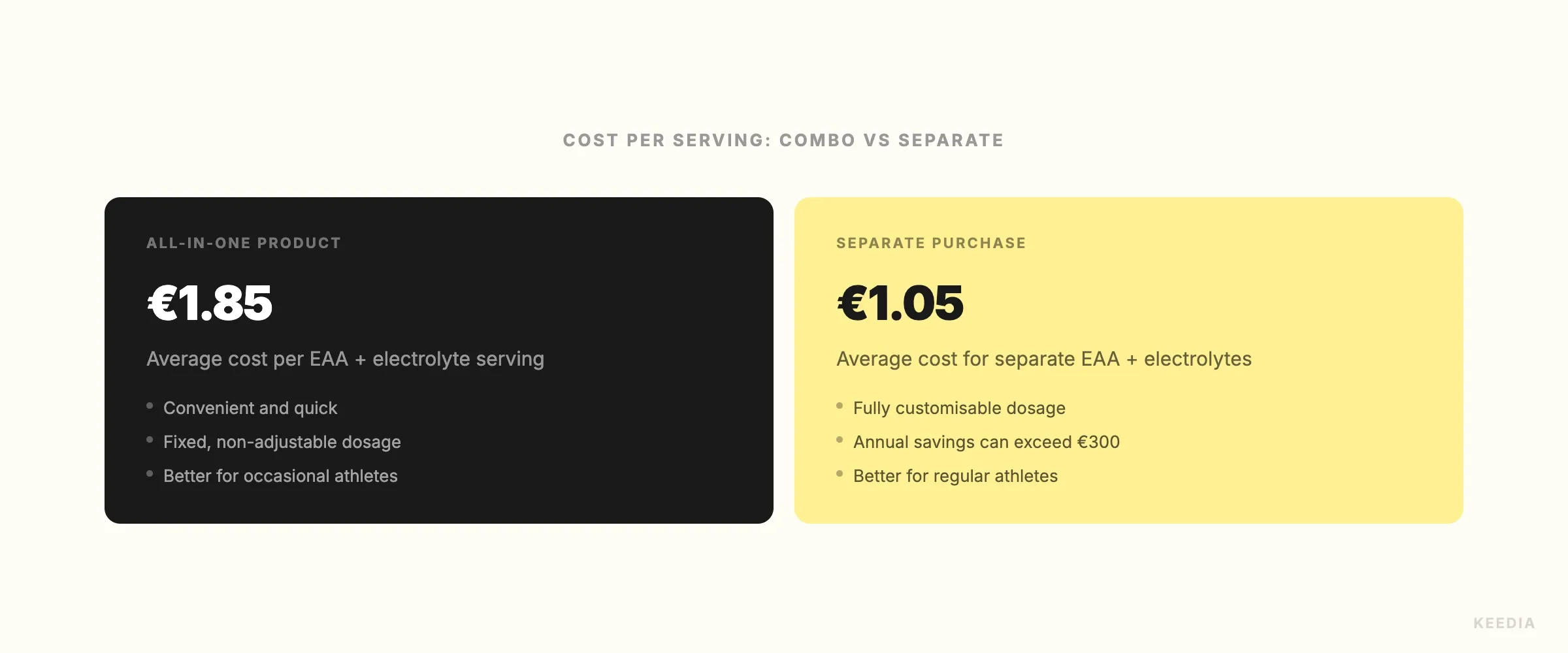
This is where the all-in-one framing starts to lose the argument for high-volume athletes. Breaking down the cost per gram of EAAs and cost per gram of key electrolytes separately versus in a combo product reveals a consistent pattern across the market.
- Standalone EAA powders from reputable brands typically cost $0.30 to $0.50 per 10-gram serving in the US market.
- Standalone electrolyte products, whether tablets or powders, often run $0.50 to $1.00 per serving for a well-dosed sodium-forward formula.
- Combined EAA-plus-electrolyte products regularly price between $1.50 and $2.50 per serving for comparable amounts of both.
If you're training once a day, that premium might feel acceptable for the convenience. If you're an endurance athlete or strength athlete training twice daily, the cost difference compounds fast. Over a month of double sessions, you could be spending $40 to $60 more for the combo format versus buying the two components separately and mixing them yourself.
The quality of electrolyte dosing in combo products also sometimes suffers because the formulator is balancing flavor, texture, cost, and amino acid content all at once. Standalone electrolyte products from specialist brands are more likely to dial in the sodium-to-potassium ratios that sports science actually recommends.
Who Actually Benefits From the Combo Format
Being honest about the tradeoffs here means being specific about who the right customer for these products actually is. The combo format makes the most sense if:
- You're a recreational or intermediate athlete doing one session per day at moderate intensity
- You train in a climate-controlled environment and your sweat losses are predictable and moderate
- You want to simplify your supplement protocol without tracking two separate products
- You train fasted or have gaps between meals where your protein intake falls short
- You want a caffeine-free option that fits across different times of day
The combo format makes less sense if you're a competitive endurance athlete, someone training in extreme heat, a heavy sweater who's regularly dealing with cramping or significant sodium losses, or a high-volume athlete watching supplement costs carefully over a full season.
If you're in the second group, your better move is to invest in a quality standalone EAA product and pair it with an electrolyte formula you can dose to match your actual sweat profile. That approach gives you precision the all-in-one format simply can't deliver. And if you want to understand how your training itself reshapes your body's metabolic machinery in ways that interact with everything from protein turnover to electrolyte regulation, How Exercise Rewires Your Metabolism Through One Hormone is worth your time.
The Bottom Line on EAA-Electrolyte Stacks
The combination isn't gimmicky in principle. EAAs and electrolytes are both legitimate performance nutrition tools with real evidence behind them. Putting them in the same product isn't physiologically absurd. The issue is that combining them into a fixed dose works best for a fairly specific type of user, and that user might not be you.
Before you commit to a tub, run a quick audit. Are you actually training in a state where EAAs will provide a meaningful stimulus above your dietary intake? Are your electrolyte needs close to what the product delivers, or are you a heavy sweater who'd be chronically underdosed? Is Strength Training the Key to Women's Longevity? is a useful frame for thinking about how hard you're actually training and what your recovery demands genuinely look like.
If the answer to both questions lines up with the product, the convenience is a real benefit and the price premium might be worth it. If not, you're paying for someone else's ideal formula. Separate products, more control, and a lower monthly spend might serve your goals better.